
Schurter Releases TCS43 Microminiature SMT Tactile Switch
A new compact components offering provides variable actuation forces and low-profile design configurations for space-constrained boards in medical and consumer hardware.
The demand for miniature electronics requires component manufacturers to reduce hardware footprints without degrading user experience or operational durability. Schurter addresses this balance by releasing the TCS43, a microminiature SMT tactile switch designed for high-performance systems. Featuring a footprint of 4.2 mm by 3.2 mm and a low-profile height of 2.5 mm, this switch allows hardware designers to optimize board space. The device incorporates a J-Type terminal configuration, which minimizes the total board area while maintaining reliable solder joint characteristics during reflow.
Haptic feedback remains a critical aspect of user interface design. To accommodate varied tactile preferences, the components are manufactured in three distinct actuation-force variants. Engineers can select from versions providing 180 gf, 250 gf, or 400 gf, which corresponds to an operational range of 1.76 N to 3.92 N. Actuation travel is specified at 0.2 mm, offering a responsive interface. Structurally, the switch incorporates stainless steel for the cover and contact elements, contributing to an end stop strength of 30 N sustained over 60 seconds. The switch is rated for a mechanical lifetime of up to 100,000 actuations.
Electrical Integration and Environmental Performance
From an electrical perspective, the switch is tailored for low-power circuits, supporting operating voltages ranging from 1 VDC to 12 VDC. The switching current ratings range from 10 µA to 50 mA. Maintaining signal integrity is aided by a low initial contact resistance of no more than 100 mΩ, which can increase to 500 mΩ over the operational lifetime. Signal bounce duration is limited to 5 ms or less, simplifying debouncing routines on microcontroller inputs.
Environmental and material certifications are vital for compliance. The switch is built using liquid crystal polymer (LCP UL 94V-0) for the socket and actuator housing. The assembly meets RoHS, China RoHS, and REACH guidelines. For environmental sealing, the device carries an IP40 protection rating and functions reliably across a temperature range spanning from -40 °C to +90 °C.
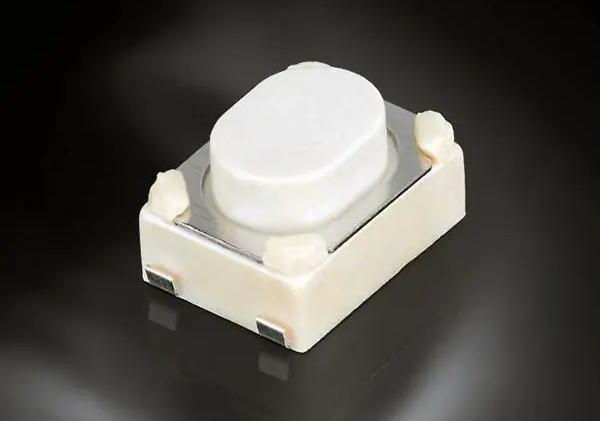
The TCS43 micro switch delivers precise tactile feedback from an ultra-small 4.2 × 3.2 mm SMT footprint. Image used courtesy of Schurter
Application Scope and Implementation
The combination of a small physical footprint, stable electrical parameters, and selectable haptic forces makes the switch highly adaptable for modern control panels. Typical implementations focus heavily on user interface tasks such as basic on-and-off switching, menu navigation, and precise parameter selection. These micro switches are well-suited for high-end consumer electronics, home automation systems, IoT devices, and specialized medical equipment such as blood pressure monitors and ventilators. Having multiple actuation forces allows engineering teams to implement consistent layouts across a product line while varying the physical click feel depending on whether a button triggers a critical system command or a simple menu scroll.


