
LooUQ Modem Inherits Skylo Satellite Certification via Nordic nRF9151
A Michigan-based embedded modem now automatically roams between cellular and satellite coverage, inheriting upstream-completed certification.
LooUQ’s MTC2-N9151 embedded modem has become the first product to inherit Skylo Non-Terrestrial Network (NTN) certification from Nordic Semiconductor’s nRF9151 module, sparing device makers a round of satellite testing that has traditionally slowed products meant to operate beyond cellular coverage. Because the certification is at the module level, any design built around the MTC2-N9151 automatically carries that qualification forward, without repeating the work Nordic and LooUQ have already completed.
Certification That Travels Down the Stack
At the center of the MTC2-N9151 is the nRF9151, which pairs an Arm Cortex-M33 application processor with 1 MB of flash and 256 kB of RAM, running at 64 MHz, with an LTE-M/NB-IoT or DECT NR+ modem and NB-NTN satellite support. That combination lets LooUQ’s module handle sensing, control, and connectivity without a separate MCU, trimming both bill-of-materials cost and board space. Security is provided by Arm TrustZone and Arm CryptoCell, both natively supported in the Nordic Connect SDK, alongside the Zephyr RTOS environment around which LooUQ’s board files and devicetree overlays are built.
Skylo operates its NTN service as a standard 3GPP network, accessed through mobile operator partnerships, so a certified device automatically switches between terrestrial and satellite links with no change to application code. The nRF9151 earned that certification earlier this year following a firmware update that added full NTN support to its existing LTE-M/NB-IoT capability. LooUQ’s MTC2-N9151 inherits that certification directly, and any company designing around that modem can now pursue its own Skylo certification with substantially less testing than starting from scratch.
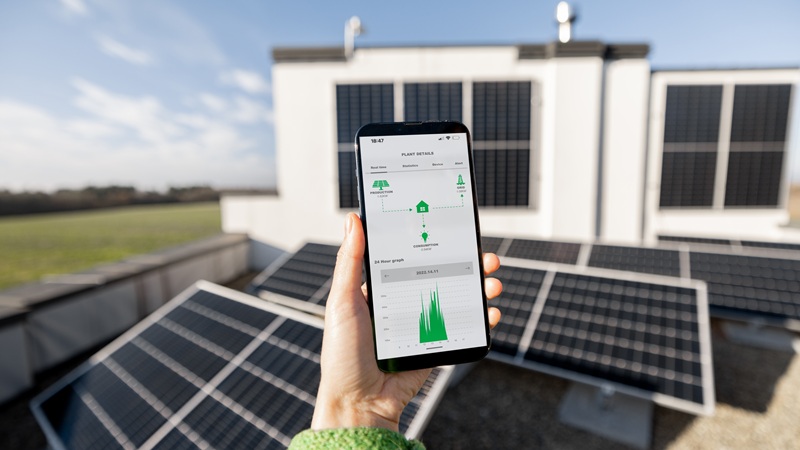
Skylo’s NTN service extends coverage into areas terrestrial cellular networks don’t reach. Image used courtesy of Adobe Stock
Two Parts, One Antenna
LooUQ designed the MTC2-N9151 to require only two external components for integration. Its combined NTN/TN antenna covers both terrestrial LTE and satellite 3GPP NB-NTN bands in a single element, eliminating the need for a separate antenna characterization step in the design cycle. Two development kits, a breakout board and a version with integrated regulators and an I²C-controlled RGB LED, enable engineers to begin over-the-air testing right away. LooUQ has been part of Nordic’s Partner Program since 2025 and is working toward carrier-end device certification to further shorten the regulatory path for IoT product teams.
Water Monitoring in Remote Terrain
Remsight, a Montana-based water technology company, is already operating the MTC2-N9151 in the field. Its HydroProxy platform uses the modem to keep solar-powered sensors online across irrigation infrastructure in the American West, where terrestrial cellular service has never been reliable, giving water managers a live view of systems that were previously checked by hand. Building on LooUQ’s certified foundation positions Remsight to pursue its own Skylo certification with relatively little additional testing.
The arrangement shows how certification can move down the supply chain rather than being repeated at every level: Nordic certified the nRF9151, LooUQ inherited that work for the MTC2-N9151, and downstream product teams can now do the same. That structure suits applications where a missed reading has real consequences, such as agricultural monitoring, energy infrastructure, asset tracking, and logistics, and where a device might reasonably need to fall back on a satellite link when cellular coverage runs out. For engineers evaluating connectivity options for remote or mobile hardware, the combination of an already-certified module and a drop-in embedded modem looks like a genuinely useful shortcut, one that trades a chunk of certification overhead for a design that already knows what to do when the terrestrial network disappears.


