
Kinetic’s KTS1642Q Load Switch Eases Automotive Transient Compliance
The automotive load switch bundles reverse-battery, overvoltage, and ESD protection into a single 4 mm square package.
Kinetic Technologies has rolled out the KTS1642Q, an AEC-Q100-qualified load switch designed to help automotive electronic systems withstand the electrical punishment that comes with life in a vehicle harness. The device targets compliance with two standards that automotive designers know well: ISO 16750-2, which governs electrical stress conditions, and ISO 7637-2, which addresses conducted transients. Rather than stitching together discrete protection components, engineers can integrate much of that functionality into this single part.
Vehicle electronics face a harsh environment of power events: reverse-battery connections during servicing, cold-crank sags when a starter motor drags down the rail, load-dump spikes when an alternator disconnects from a charged battery, and inductive switching transients from relays and solenoids. The KTS1642Q is engineered to operate across a 4V to 40V input range, with reverse-battery protection extending down to -28V. It also includes fixed overvoltage protection at a nominal 20.3V, with a typical response time of 360 ns.
Automotive Power Handling
Two N-channel MOSFETs form the core of the KTS1642Q, arranged in a back-to-back configuration with a typical on-resistance of 41 mΩ. One MOSFET guards against reverse-battery conditions, while the second controls turn-on and provides continuous protection for the downstream load, which can draw up to 6A. When paired with suitable external TVS diodes, the part meets the transient requirements defined in ISO 7637-2 and the broader stress conditions specified in ISO 16750-2, giving designers a shorter path to automotive qualification.
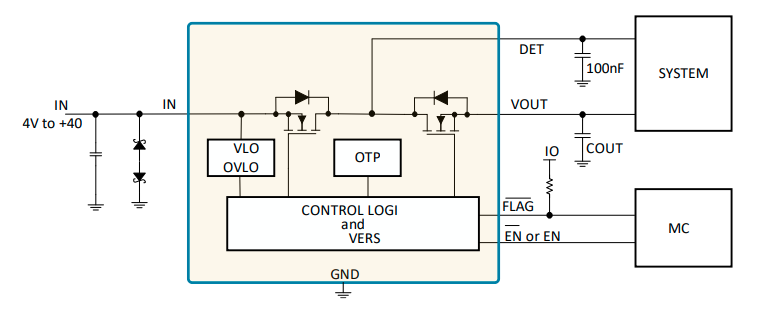
Typical application circuit for the KTS1642Q, showing the reverse-battery and control-logic blocks between the input and system load. Image used courtesy of Kinetic Technologies
Protection and Monitoring Features
Beyond voltage handling, the KTS1642Q includes over-temperature protection with auto-retry. The switch disables itself during a thermal fault and resumes operation automatically once the junction cools. A battery-detection pin, BDET, mirrors the input voltage minus the drop across the reverse-battery MOSFET and can source up to 500mA, allowing a host system to confirm that a battery or power supply is present. An open-drain fault flag reports abnormal conditions to a microcontroller, and the input pin provides ESD protection to IEC61000-4-2 Level 4, rated at ±15kV for air discharge and ±8kV for contact discharge. The part ships in a 4mm x 4mm TDFN package and is offered in two enable-logic variants: the KTS1642AQGDV-TR, which uses an active-high enable, and the KTS1642QGDV-TR, which uses an active-low enable.
Given the breadth of protection packed into a single small-footprint package, the KTS1642Q is a practical fit wherever a vehicle’s power rail needs protection against its own volatility. Automotive ECUs, ADAS camera modules, digital video recorders, instrument clusters, infotainment head units, wireless charging systems, and telematics units all face the same reverse-battery and transient risks, and consolidating that protection into a single qualified device could reduce both board space and the qualification workload for engineers tackling these designs.


