
Two New Capacitor Families Target Rugged Industrial Design
Passive components rarely make headlines, but two recent releases show how much engineering still goes into capacitors that spend their careers quietly holding a rail steady or blocking line noise. KYOCERA AVX and Vishay Intertechnology each introduced new capacitor series this month, one tackling the mechanical fragility of aluminum electrolytics in vibration-heavy equipment, the other shrinking the footprint of AC-line safety capacitors used for EMI suppression.
Passive components rarely make headlines, but two recent releases show how much engineering still goes into capacitors that spend their careers quietly holding a rail steady or blocking line noise. KYOCERA AVX and Vishay Intertechnology each introduced new capacitor series this month, one tackling the mechanical fragility of aluminum electrolytics in vibration-heavy equipment, the other shrinking the footprint of AC-line safety capacitors used for EMI suppression.
Bracing Aluminum Electrolytics Against Shock and Heat
KYOCERA AVX’s AEVA and AEVB Series aim at a longstanding weakness of aluminum electrolytic capacitors: their vulnerability to mechanical stress. Both series use surface-mount, can-type packages fitted with a plastic support structure and reshaped terminations that expand the soldering area, together increasing how firmly the parts anchor to a board. KYOCERA AVX rates both families to withstand up to 30g of acceleration and operate across -55°C to +125°C, conditions typical of robotics, motor-control units, DC/DC converters, UPS hardware, and photovoltaic inverters exposed to constant shaking.
The two series differ in voltage and capacitance range. AEVA spans 6.3 VDC to 100 VDC and 10 µF to 4,700 µF across five case sizes, with endurance up to 4,000 hours at rated voltage and 125°C. AEVB covers a narrower 16 VDC to 50 VDC and 47 µF to 2,200 µF window across four case sizes but edges out AEVA on longevity, reaching 5,000 hours under the same thermal load. Both use a liquid electrolyte dielectric, keep leakage current at or below 0.01CV or 3 µA (whichever is larger), and ship on 15-inch reels for automated, reflow-compatible placement. Halogen-free construction and RoHS compliance round out the package.
Shrinking the Footprint of Line-Rated Safety Capacitors
Where AVX’s parts chase mechanical durability, Vishay’s new SMDY1…S series chases real estate. The single-layer ceramic disc capacitors carry a Y1 rating of 300 VAC and 1500 VDC in a surface-mount casing, a configuration Vishay says trims board space by as much as 40 percent versus earlier-generation devices. Designed for EMI and RFI suppression, the parts comply with IEC 60384-14 and hold certifications from UL, CSA, VDE, ENEC, and CQC, allowing them to bridge double or reinforced insulation and serve DC networks rated to 1500 VDC under IEC Annex H.
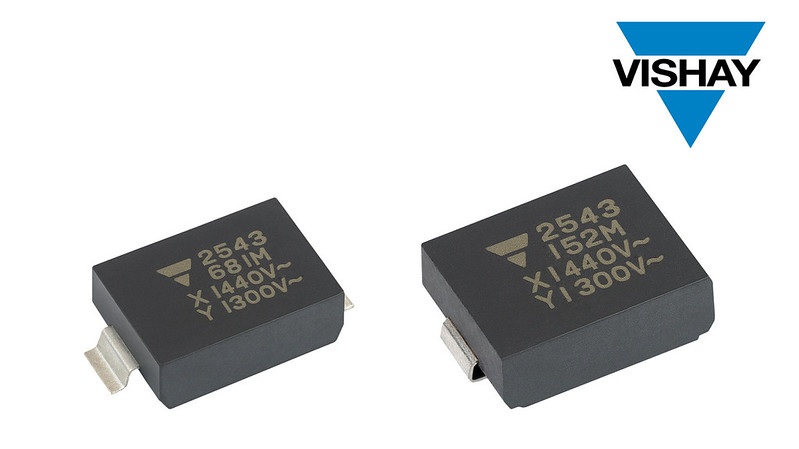
Vishay’s SMDY1…S series is available in two case sizes, both rated X1 440 VAC and Y1 300 VAC. Image used courtesy of Vishay
Electrically, the SMDY1…S line outpaces typical industry benchmarks: insulation resistance reaches at least 10,000 MΩ against a common 6,000 MΩ standard, and the operating range extends down to -55°C rather than the more typical -40°C floor, while still topping out at 125°C. Every unit passes through 100 percent production testing, including a five-point check covering AC voltage, capacitance, dissipation factor, insulation resistance, and visual inspection. Built from a copper- and silver-plated ceramic disc encapsulated in flame-resistant epoxy meeting UL 94 V-0, the capacitors come in two case sizes: an A size spanning 10 pF to 680 pF and a B size covering 1,000 pF to 1,500 pF. Vishay lists samples and production quantities as available now, with a 12-week lead time.
Between the two releases, engineers designing for harsh or space-constrained environments get a bit more room to maneuver. AVX’s vibration-hardened electrolytics suit power stages in robotics, motor drives, and renewable-energy inverters where shock and heat are unavoidable, while Vishay’s compact Y1 devices fit naturally into switch-mode supplies, motor drives, HVAC systems, and appliances that need line-side filtering without giving up precious board area. Neither component reinvents its category, but both chip away at the practical headaches — mounting strength, footprint, certification — that show up long after the schematic is finished.


