AMD’s 6th Gen EPYC CPUs Split Server Duties for Agentic AI
The new EPYC lineup assigns distinct silicon to running agents, feeding accelerators, and handling everyday enterprise compute.
AMD has expanded its EPYC server processor lineup with the 9006 Series, a portfolio designed to meet the compute demands of agentic AI. Announced at Advancing AI 2026, the announcement frames agentic workloads—systems that plan, call tools, execute code, and reason over enterprise data—as a distinct category of CPU-dependent work alongside traditional enterprise and HPC tasks.
Rather than offering a single chip for every scenario, AMD has split the 9006 Series into four variants, each tailored to a specific role in what the company describes as a three-tier data center architecture: a tier for running agents, a tier for feeding accelerators, and a tier for handling general enterprise services.
Four Chips, Three Roles
The EPYC 9006 SP7 targets high-density agent sandbox execution, scaling to 256 cores and 512 threads to run large numbers of agents per watt, per dollar, and per rack. Select high-frequency configurations of the same chip reach up to 5GHz and pair with PCIe Gen 6 connectivity, enabling it to double as an AI host node that keeps GPUs supplied with work. The EPYC 9006 SP8 trades peak density for efficiency, offering 8 to 128 cores in low-power configurations suited to edge deployments, power-constrained racks, and smaller clusters where enterprise services and lighter agent workloads share space.
For HPC and technical computing, the EPYC 9006X SP7 offers substantially more L3 cache per core than its SP7 sibling, up to three times as much, alongside frequencies up to 5.15GHz, targeting simulation, modeling, and other memory-bandwidth-sensitive applications. Rounding out the family, the EPYC 9006 LP, formerly codenamed “Verano,” is purpose-built as an AI host node processor. It uses LPDDR memory and clock speeds up to 5GHz to keep dense, accelerator-heavy racks fed as deployments scale from single nodes to full AI factories.
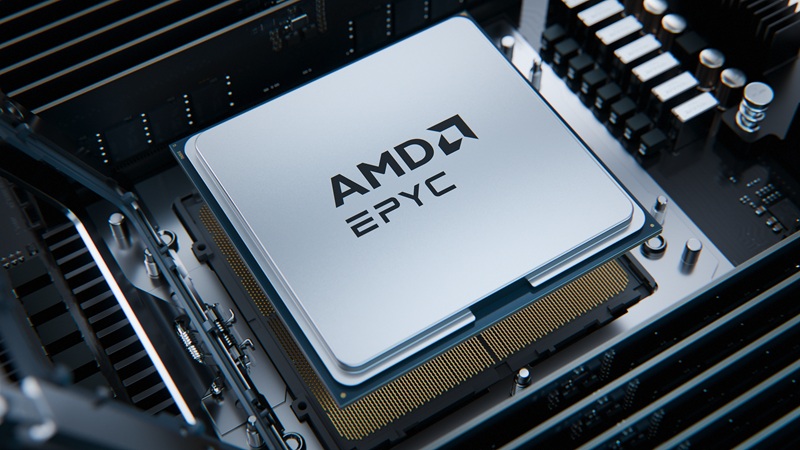
The AMD EPYC 9006 Series brings “Zen” 6 and “Zen” 6c cores to a single socket built for agentic AI workloads. Image used courtesy of AMD
A Shared Foundation Across the Lineup
Despite their differing specifications, all four processors share a common architecture built on “Zen” 6 and “Zen” 6c cores, a single software ecosystem, and the same underlying security foundation. That consistency lets data center operators mix processor types across a deployment without fragmenting their software stack or security posture, selecting core density for agent-heavy racks, frequency and bandwidth for GPU-feeding nodes, and efficiency for general-purpose servers, all while managing them on a unified platform.
AMD positions this modularity as a response to the evolution of enterprise infrastructure: agentic systems increasingly need CPU resources not only to run models but also to coordinate the work around them, from spawning tasks to managing I/O outside the GPU. For engineers evaluating server platforms, the EPYC 9006 Series offers a menu rather than a single part number, letting system designers pick the die that matches their rack’s specific workload. Whether that means packing sandboxes with lightweight agents, tightly pairing CPUs with GPU clusters, or running the databases and applications that keep a business online, the lineup gives data center architects a way to right-size compute instead of over-provisioning a single general-purpose chip across every function.