
Menlo Micro’s High-Speed Loopback Switch Delivers 80 Gbps Differential Signaling
The MM5627 is a fully-integrated 80 Gbps differential DP3T switch in a SiP package, offering 20 GHz bandwidth, 128 control states, and SPI control for AI GPU and IC test validation.
Menlo Microsystems has announced the MM5627, a high-speed differential loopback switch that combines 80 Gbps performance, integrated DP3T logic, and fully on-chip support components in a single System-in-Package (SiP) design. The device is aimed squarely at test and validation engineers working with AI GPUs, CPUs, and advanced semiconductor ICs — applications where throughput, signal integrity, and routing flexibility must coexist in the same test socket.
Menlo Micro publicly introduced the MM5627 at DesignCon 2026. The device sits within the company’s MM562x switch series, which traces a clear generational arc: 40 Gbps, then 64 Gbps, and now 80 Gbps with significantly expanded configurability.
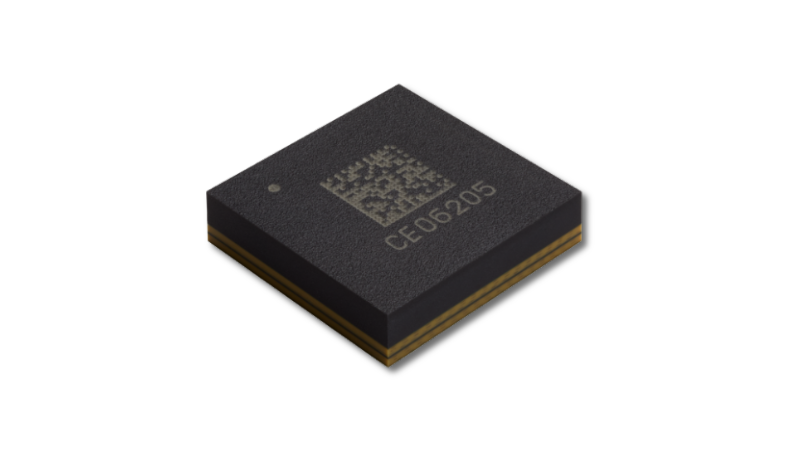
Menlo Micro’s MM5625 high-speed differential loopback switch delivers 80 Gbps performance with a bandwidth of 20 GHz. Image used courtesy of Menlo Microsystems
High-Speed Differential Loopback Switches
The MM5627 high-speed differential loopback switch is built on Menlo Micro’s Ideal Switch technology, a MEMS-based switching platform that the company positions as an alternative to both electromechanical relays and traditional solid-state switches. The SiP integrates a charge pump, high-voltage driver, and on-die loopback circuitry, eliminating the external components that those functions typically require and reducing board space in the process.
Headline performance figures include an 80 Gbps differential signaling, a 20 GHz bandwidth, and support for 128 distinct control states for differential pair management. That last number is particularly notable for test applications: 128 states means engineers can configure complex signal routing and loopback matrices without stacking multiple discrete switches or relying on external switching logic.
Control is handled exclusively via SPI, keeping integration straightforward in automated test equipment environments where digital control buses are already standard. The device’s cycle life is rated at more than three billion switching operations. This is a specification that reflects the realities of high-volume production testing, where a switch might cycle thousands of times per day across a product’s lifetime.
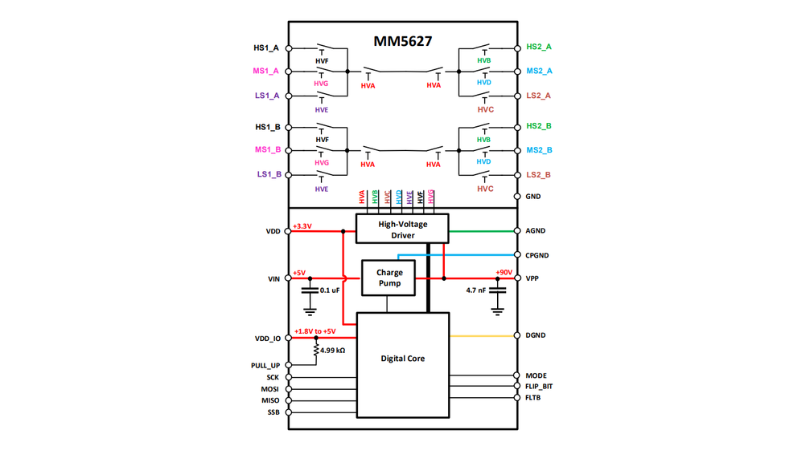
Functional block diagram of the MM5627. Image used courtesy of Menlo Microsystems
High-Speed Test and Validation
The MM5627’s design point is a large-scale automated test for AI infrastructure components. GPU and CPU validation for data center deployment requires routing high-speed differential signals — PCIe Gen6, SerDes links, and similar interfaces — through test fixtures that must be reconfigured rapidly and repeatedly. Mechanical relays struggle at these data rates, and many solid-state alternatives require significant external circuitry to achieve comparable routing flexibility.
By integrating the DP3T logic, loopback paths, and drive circuitry on-die, the MM5627 reduces the component count on test boards, thereby simplifying layout, shortening development cycles for test fixture designers, and reducing potential sources of signal degradation at high frequencies. The device’s 128 control states add configurability, allowing a single MM5627 to replace what might otherwise require multiple discrete switches, particularly in applications that need to validate differential pairs across multiple lanes or configurations within a single test pass.
The MM5627 is available now through Menlo Micro’s authorized distribution network, including Mouser, RFMW, Toward Relays, and Digi-Key.


