
NXP Combines AM/FM Radio and AI Audio Processing in One Chip
NXP's new SoC pairs analog tuning with machine-learning-based sound isolation, aiming to simplify infotainment architectures and shrink board space.
NXP Semiconductors has introduced the SAF9800, a system-on-chip that integrates an analog AM/FM radio tuner and an AI/ML-capable audio digital signal processor (DSP) into a single 9 x 9 mm package. The part targets automotive infotainment head units and software-defined vehicle (SDV) audio architectures, where OEMs are increasingly looking to reduce discrete components without sacrificing the flexibility to differentiate feature sets across trim levels.
Squeezing Radio and Audio Onto One Die
At the radio end, the SAF9800 features a wideband tuner architecture covering the full FM band and can be configured as a single- or dual-tuner setup. Both tuners and their supported standards are set via software rather than fixed at the hardware level. On the audio side, a HiFi 5 DSP runs at 600 MHz, equipped with neural-network accelerators and paired with 5 MB of shared SRAM for radio and audio workloads alike. Rounding out the I/O are up to 12 configurable analog-to-digital converters and 20 asynchronous sample-rate converters, feeding into I²S and TDM digital audio interfaces. NXP pegs the resulting footprint reduction at up to 85 percent relative to prior multi-chip architectures, with feature scalability handled through a keycode-based software licensing scheme that supports over-the-air upgrades and ASIL-A audio functionality.
Pulling Signal Out of Cabin Noise
The AI/ML component centers on acoustic source separation, a technique that isolates specific sounds, such as spoken commands, mechanical faults, or emergency sirens, from the layered noise of a moving vehicle cabin. Fixed-coefficient filtering tends to struggle in that dynamic acoustic environment, which is why NXP leans on a data-driven approach instead. Combined with hardware-based biquad accelerators, the DSP is said to deliver more than tenfold the audio processing throughput of the company’s earlier generations, providing enough headroom for real-time noise reduction and sound classification. Development is supported by DSP Concepts’ Audio Weaver toolset (with an AWE Lite license included), and an open-core HiFi 5 SDK built on XtensaXplorer, alongside Neural Network Extensions aimed squarely at AI/ML audio workloads.
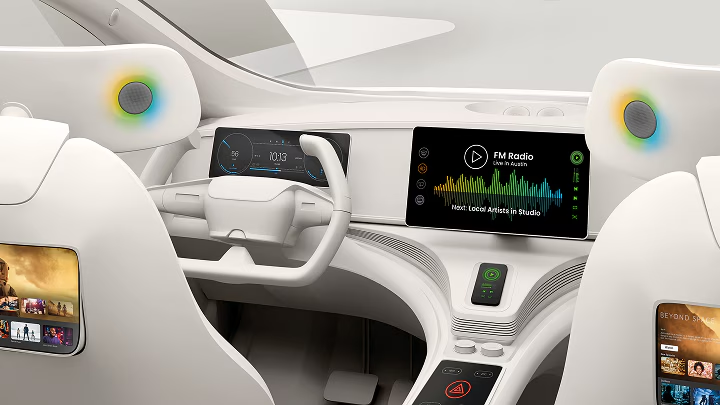
The SAF9800 is built for infotainment cockpits where radio, audio, and in-cabin sensing all draw from the same processing hardware. Image used courtesy of NXP
A Hedge Against AM Radio’s Shifting Fortunes
Timing is part of the pitch. Automakers are contending with a patchwork of radio-related pressures: proposed U.S. legislation would mandate continued AM access in vehicles, even as electrification introduces new interference into that same frequency band. NXP addresses the latter with EVAM-lite, its newest AM denoising technology, bundled with the SAF9800 to counter noise sources tied to EV powertrains. Because the tuner and DSP configuration is set in software, a single hardware platform can be adapted across regions with different regulatory expectations, rather than requiring a separate board spin for each market.
Between the radio consolidation and the AI-driven audio pipeline, the SAF9800 appears to be a practical solution to a cluttered infotainment stack, one where an automaker could use the same silicon across an entry trim and a flagship model. It’s a reasonable fit for connected radio modules, infotainment head units, and broader car audio systems built around SDV platforms. It’s already shipping as of May 2026, with development tools and software enablement support available now to get designs moving.


