
HPMicro HPM5100 MCU Series Brings 480 MHz RISC-V and 16-bit ADCs
Featuring 416 KB SRAM, 1 MB flash, integrated analog peripherals, USB 2.0 OTG, CAN FD, and 32 PWM channels for motor control.
HPMicro has announced the HPM5100 MCU Series, a family of 32-bit RISC-V mixed-signal microcontrollers, starting with the HPM5151 models. The HPM5100 MCU Series features a RISC-V processor running at over 400 MHz, 416 KB of SRAM, 1 MB of flash, four 16-bit ADCs, four operational amplifiers, and four analog comparators. The processor supports hardware floating-point operations and DSP extensions for improved computing performance. It also includes a 16 KB instruction/data cache and up to 384 KB of zero-wait-state instruction and data local memory (ILM/DLM) to reduce performance losses caused by external memory access latency.
The four high-accuracy 16-bit ADCs support sampling rates of up to 2 MSPS each and up to 48 analog inputs. When configured for 12-bit resolution, the conversion rate can reach 4 MSPS. The HPM5100 MCU Series also integrates a high-speed USB 2.0 OTG interface with an integrated PHY, CAN FD, multiple UART, SPI, and I2C interfaces, and 32 PWM channels for motor control. Its integrated analog peripherals can reduce the need for external ADCs and additional signal-conditioning circuits, helping simplify hardware design.
For power management, the microcontrollers feature multiple low-dropout regulators (LDOs) and support single-supply operation. They can also dynamically adjust the output voltage to balance processing performance and power consumption, providing greater flexibility in power supply design.
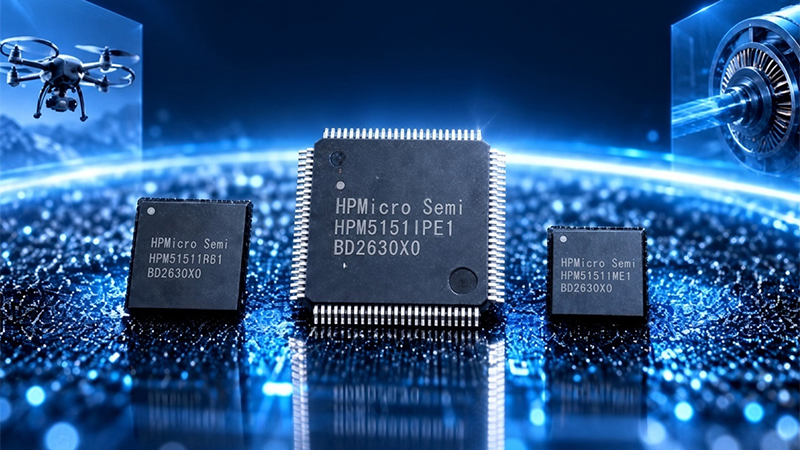
HPM5100 MCU Series
HPMicro HPM5100 Series Specifications:
- Processor:
- Single-core 32-bit RISC-V CPU operating at 400 MHz, with speeds up to 480 MHz in high-performance mode using an external power supply
- Hardware floating-point unit (FPU), SIMD, and DSP instruction support
- 16 KB L1 instruction cache and 16 KB L1 data cache
- Performance of up to 3.57 CoreMark/MHz
- On-chip memory:
- 416 KB SRAM
- 256 KB instruction local memory (ILM)
- 128 KB data local memory (DLM)
- 32 KB AHB SRAM
- Flash and external memory:
- 1 MB system-in-package (SiP) flash
- 128 KB boot ROM and 4 Kbit one-time programmable (OTP) memory
- XPI interface for external serial NOR/NAND flash, HyperFlash, HyperRAM, and PSRAM
- Analog subsystem:
- Four 16-bit successive approximation register (SAR) ADCs supporting sampling rates up to 2 MSPS, configurable for 12-bit resolution at up to 4 MSPS
- Differential ADC input support
- Four integrated operational amplifiers configurable as programmable gain amplifiers (PGAs)
- Four analog comparators with integrated 12-bit DAC-based reference generation
- USB connectivity: One USB 2.0 high-speed OTG interface with an integrated PHY
- CAN connectivity: One CAN controller with CAN FD support at data rates up to 8 Mbps
- Communication interfaces:
- Five UART interfaces
- Four SPI interfaces
- Three I²C interfaces
- Two I²S interfaces, unavailable on the QFN32 variant
- Digital I/O: Up to 79 general-purpose input/output (GPIO) pins
- Security features:
- Secure boot and JTAG protection
- 128-bit unique device identifier
- AES-128 CTR encryption for executing code from external NOR flash
- PWM and timing:
- Four 8-channel PWM modules, providing 32 channels in total
- Three general-purpose timer modules, each equipped with four 32-bit counters
- Three watchdog timers
- Dedicated trigger-routing and synchronization peripherals
- DMA: Two 32-channel direct memory access (DMA) controllers
- Power management:
- Main supply voltage: 3.0V to 3.6V
- Selectable 1.8V or 3.3V I/O banks
- Integrated LDO regulators
- Low-power wait, stop, and shutdown operating modes
- Package options:
- HPM5151IPEX: 14 × 14 mm LQFP100
- HPM5151IN8X: 8 × 8 mm QFN68
- HPM5151IN6X: 6 × 6 mm QFN48
- HPM5151IN5X: 5 × 5 mm QFN32
- Operating temperature:
- Ambient temperature range: −40°C to +105°C
- Maximum junction temperature: +125°C under rated operating conditions
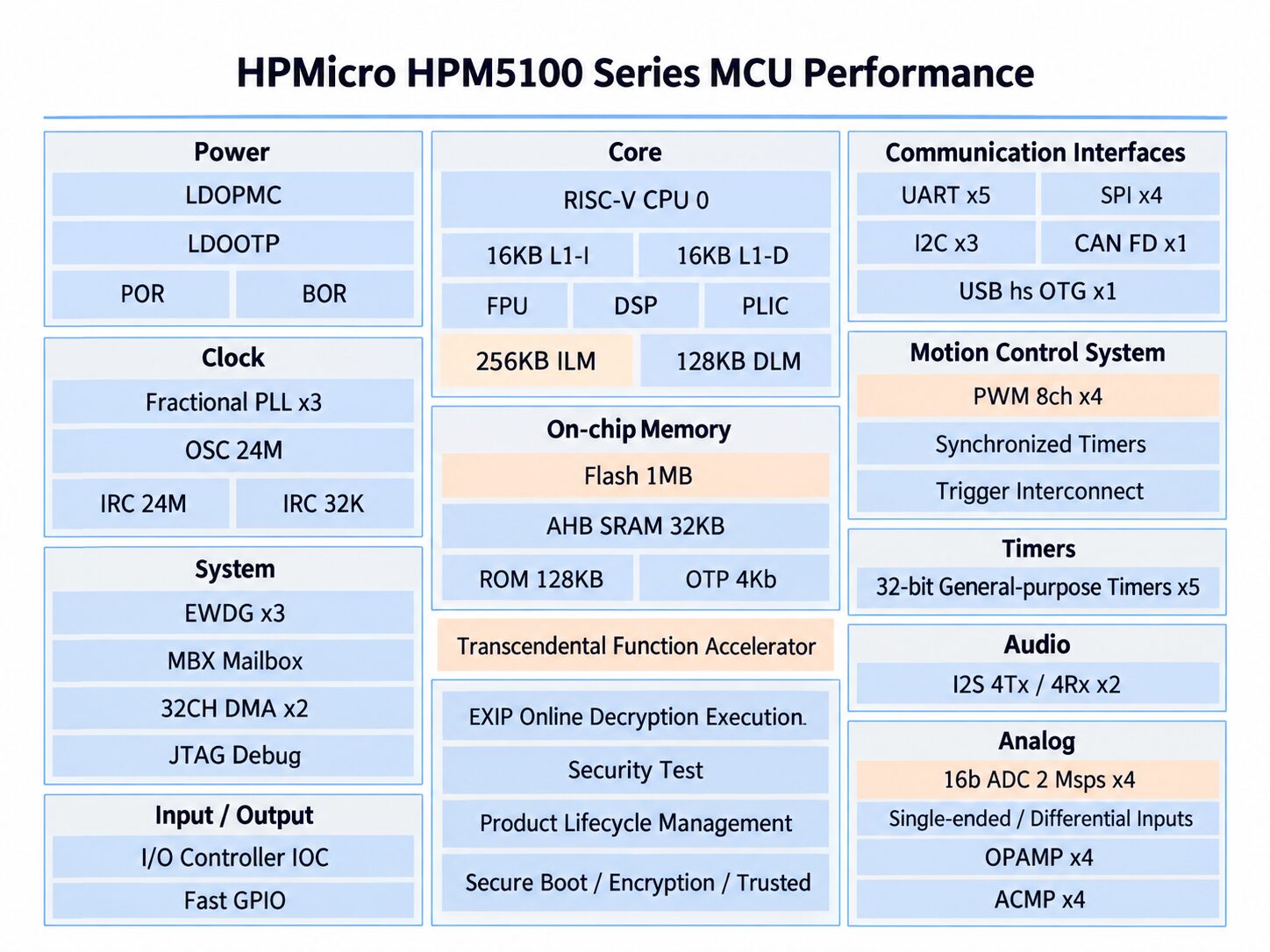
HPMicro HPM5100 Series MCU Block Diagram
The software side includes HPMicro’s open-source HPM SDK with low-level drivers and middleware and software components like FreeRTOS and TinyUSB. Support for HPM5100 and HPM5100EVK was made available in SDK version 1.13.0, released in September 2026. Developers are able to use Segger Embedded Studio for RISC-V. HPMicro offers standardized development instructions and benchmark applications via its SDK repository and online documentation.
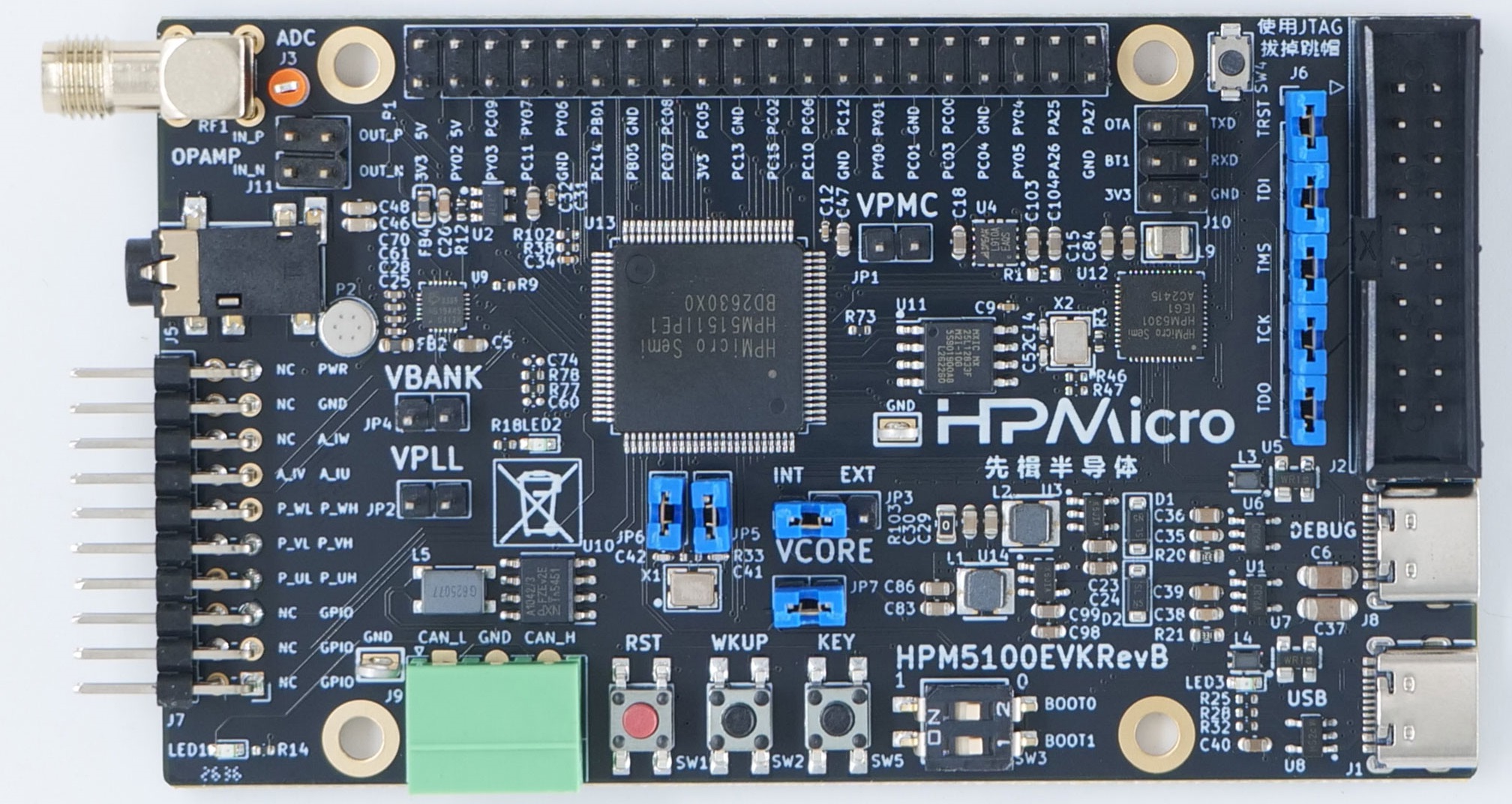
HPM5100EVK Evaluation Board
The company also announced the HPM5100EVK evaluation board with an HPM5151 MCU, external QSPI NOR flash, an ES8389 audio codec, a CAN transceiver and an onboard HPM5301 debugger that supports JTAG and serial communication. There’s also a pair of USB Type-C ports for debugging and USB OTG, a motor control connector, dedicated ADC and OPAMP connectors, and a Raspberry Pi-compatible 40-pin expansion header on the board. The onboard jumper enables you to select an internal LDO or external DC-DC supply for power. Users can find more information regarding the development board in the documentation section.
The HPM5100 series is at present in mass production. HPM5151IN61 (QFN48) from Huaqiu Mall at ¥15.60 ($2.33), HPM5151IN81 (QFN68) at ¥16.90 ($2.52), and HPM5151IPE1 (LQFP100) at ¥19.50 ($2.91). The HPM5100EVKREVB evaluation board is also available for ¥258 (around $38.50). Prices in China include taxes but do not include shipping. See the product page regarding additional information.
Images used courtesy of HPMicro.


