
Microchip Capacitance Digitizer Targets Robotic Tactile Sensing
Built around a 20-channel analog front end, the ATFCD52 turns up to 640 sensor nodes into filtered frames for grip control, slip detection, and wearables.
Cameras can tell a robot where an object sits, yet they reveal little about how firmly a gripper holds it or whether it has begun to slide. Microchip Technology has introduced the ATFCD52, a high-speed capacitance digitizer that tackles the second half of that problem by converting signals from fine-grid, two-dimensional capacitive sensor arrays into digital data. An external processor can then use that data to calculate normal and shear forces, giving robotic grippers and dexterous humanoid hands the contact information needed to adjust their grasp on soft, fragile, or irregular objects.
Scanning Dense Arrays at Speed
The device supports up to 52 channels, which works out to 32 transmit lines crossed with 20 receive lines, or 640 sensor nodes in all. Twenty parallel analog front ends sit on the chip and acquire every receive line simultaneously, so a full frame never has to wait on a serial sweep of the array. Frame rates reach up to 800 Hz, depending on array size, and a 10 × 10 matrix sees an initial latency of just 1.25 ms between the start of a measurement and the start of data output. This speed lets a control loop catch the onset of a slip and tighten its grip before an object drops or gets crushed.
Sensitivity matters just as much. The ATFCD52 is designed to resolve capacitance changes below 1 femtofarad (fF), and its adjustable gain helps with the faint signals produced when a light touch deforms a soft sensor surface. It supports both single-ended and differential mutual capacitance sensing methods.
Holding Its Own Around Motors
Robots are electrically rowdy places. Servo motors, power electronics, and switching regulators all generate interference that can bury signals this small, so the digitizer carries several countermeasures. It can switch among multiple transmit burst frequencies, settling automatically on the quietest one, and acquisition frequency is configurable up to 300 kHz per transmit line. Oversampling, adjustable up to 255 times with built-in averaging, joins common-mode noise removal and an FIR low-pass filter to clean up each frame. Real-time automatic diagnostics for monitoring the connected sensor round out the package, a nod to safety-critical designs.
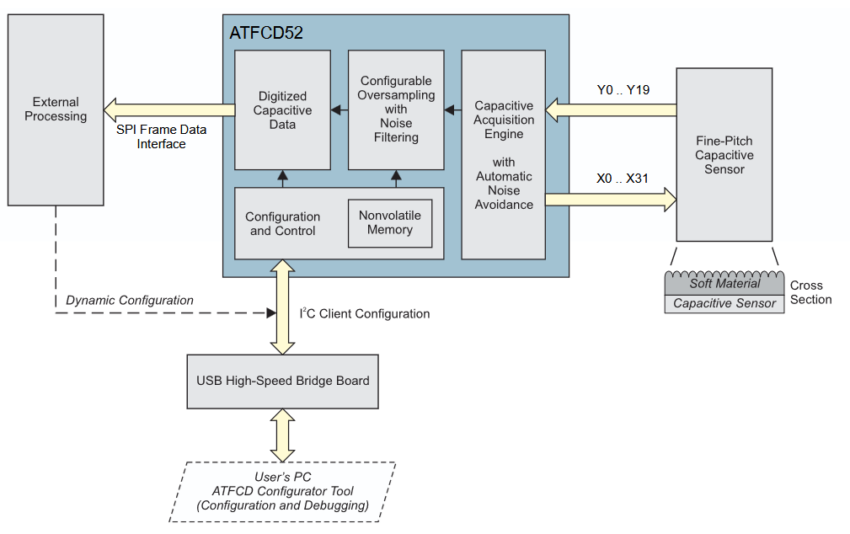
Configuration runs on a separate route: a PC-based Configurator tool talks to the device through a USB bridge board, while the external processor can adjust settings on the fly. Image used courtesy of Microchip
Interfaces, Tools, and Availability
Digitized frames leave the chip over an SPI interface clocked up to 12.5 MHz, while an I2C interface running up to 3.4 MHz handles configuration. Developers can pair the ATFCD52 with Microchip MCUs, MPUs, or FPGAs, choosing the processing architecture that suits either localized control or higher-throughput computation. The part runs from 3.3 V supplies, with an internal voltage pump generating up to 9.9 V to drive the X lines. It arrives in an 88-ball, 6 × 6 mm package, is specified from −40 °C to +85 °C, and is an industrial-grade device not characterized for automotive use.
For evaluation, the EV-ATFCD52 development board connects to a customer’s sensor through an 80-way connector, and the ATFCD52 Configurator software handles parameter settings and real-time, timestamped data logging. You can buy the digitizer directly from Microchip or through authorized distributors.
All told, the ATFCD52 packs a lot of tactile-sensing machinery into a few square millimeters of silicon. Robotic grippers and humanoid hands are the headline use, but the same fast, filtered contact data should also serve medical devices, factory automation, augmented reality and gaming accessories, data-collecting gloves and foot mats, and electronic skin for wearables. Anyone wrestling with how to read a soft sensor stack quickly will probably find the evaluation board a pleasant place to begin.


