
Infineon Adds Post-Quantum Security to Quad-Motor Control MCUs
The new PSC3M/P6 controllers run up to four brushless DC motors from a single Arm Cortex-M33 core and verify firmware with quantum-resistant signatures.
Infineon has expanded its PSOC Control C3 family with the Main Line PSC3M/P6 microcontrollers (MCUs), announced on 19 October 2026. The line splits into two dedicated parts: the PSC3M6 for motor control and the PSC3P6 for power conversion. Both use an Arm Cortex-M33 core running up to 180 MHz, and a single device can drive up to four brushless DC motors in either sensored or sensorless configurations. Infineon positions the family for industrial drives, drones, robotics, home appliances, renewable energy systems, telecommunication servers, data centers, and digital healthcare equipment.
Control Hardware for Several Motors at Once
Driving four motors from one chip takes more than CPU speed. The core pairs a digital signal processor and a floating-point unit with 512 KB of read-while-write flash and 128 KB of SRAM, both with built-in error correction. On the analog side, a 12-bit SAR ADC converts at up to 9 Msps. Its 16 parallel sample-and-hold stages can capture several inputs simultaneously, which suits multi-motor and multiphase current sensing. Up to nine comparators with 10-bit DACs and slope generation, up to four op amps, two 12-bit DACs, and three hardware 3P3Z compensation filters round out the front end.
Timing and position feedback get similar attention. The timer/counter pulse-width modulator (TCPWM) block offers 16 16-bit channels and 8 32-bit channels, with a high-resolution mode that places PWM edges to better than 100 ps. Two motion interface blocks handle Hall sensor and quadrature encoder inputs, while a CORDIC engine offloads the trigonometric math behind field-oriented control. For connectivity, the parts provide six serial communication blocks (one with PMBus support), an I3C interface, USB full-speed host and device operation, and up to two CAN FD channels. Packages range from 64 to 100 pins and are rated for ambient temperatures from −40 °C to 115 °C.
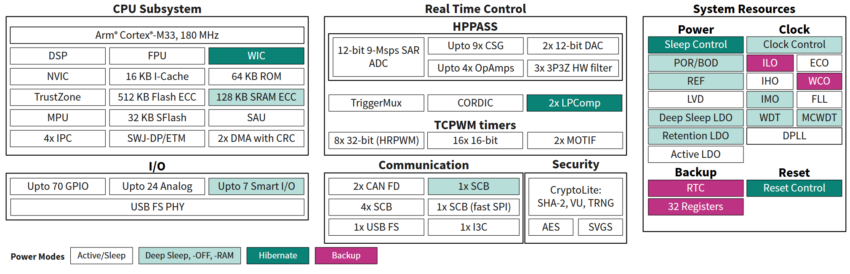
Hardware support for multi-motor control in the PSC3M/P6 includes 8 32-bit and 16 16-bit TCPWM channels, two MOTIF blocks, and a SAR ADC with a 9 Msps conversion rate. Image used courtesy of Infineon
Security Built for the Post-Quantum Era
Security sets this release apart from the rest of the lineup. The MCUs meet the post-quantum cryptography (PQC) firmware-protection requirements laid out in the Commercial National Security Algorithm (CNSA) Suite 2.0, using SHA-512 hashing and LMS verification for secure boot and firmware-update checks. The datasheet adds support for the ML-DSA and ML-KEM algorithms through the wolfSSL crypto library. Beyond that, the devices are ready for Platform Security Architecture (PSA) Level 3 enablement, which applies only to the 512 KB flash variants, and they support the device identifier composition engine (DICE) mechanism. An Arm TrustZone root of trust and a supply voltage glitch sensor, which monitors attempts to manipulate the input voltage, cover both the software and physical sides of the problem. Infineon says that supporting both standards eases the move to stronger security in the PQC era while keeping designs in line with the Cyber Resilience Act (CRA).
Tools and Availability
Software support comes through ModusToolbox, specifically the Power Suite and Motor Suite, which bundle a graphical interface, control libraries, and development tools. A ModusToolbox AI Assistant is meant to ease migration from other solutions to PSOC Control. Steve Tateosian, Infineon’s senior vice president and general manager for IoT, consumer, and industrial MCUs, points to industrial applications that increasingly call for faster control loops, tighter control, and better efficiency, and he presents the PSC3M/P6 as another option that does not enlarge the footprint. The devices are available now.
Taken together, the PSC3M/P6 folds multi-motor control, digital power conversion, and a forward-looking security stack into one family, which may let designers consolidate chips. Drives, drones, robots, and appliances get the multi-motor headroom, while server power supplies and renewable energy systems can lean on the power-conversion variant. And for anyone who has wondered how long today’s firmware signing will hold up, seeing PQC support at launch is a reassuring touch.


