
Keysight Debuts 1U XR3 Oscilloscope for High-Channel-Count Test Racks
Four analog and 16 digital channels, a 14-bit converter, and hardware auto-sync let multiple units combine into time-correlated test systems of 100-plus channels.
Keysight Technologies has introduced the XR3, a low-profile oscilloscope that fits four analog channels, 16 digital channels, and a 14-bit analog-to-digital converter (ADC) into a single rack unit. The motivation is easy to follow. Automated test systems in aerospace and defense, manufacturing, and physics keep growing denser, and setups that once relied on one bench oscilloscope now often need several instruments working in step. Every extra box eats rack space, adds cabling, and invites signal skew. The XR3 targets that squeeze by pairing benchtop-class measurement with a rack-ready chassis.
Acquisition and Triggering
Two pieces of silicon anchor the design: Keysight’s MegaZoom 5 custom application-specific integrated circuit (ASIC) and the 14-bit ADC. Together they deliver a noise floor below 50 microvolt root mean square (µVrms) at full bandwidth, along with an update rate of 1.3 million waveforms per second. Each channel samples at up to 3.2 GSa/s into 100 Mpts of memory. Bandwidth options span 200 MHz to 1 GHz, and license-only upgrades let a unit climb that ladder after purchase.
Triggering is fully digital, firing on acquired data rather than through separate analog circuitry. According to the data sheet, that approach keeps triggers free of jitter and sensitive enough to respond to a single step of the converter’s resolution. A real-time zone trigger sits in hardware on the acquisition path, qualifying signals at 6.4 billion tests per second, so anything passing through a user-drawn zone gets captured, including intermittent events. Segmented memory, which stores up to 256,000 triggered segments, pairs with an expert-system feature called Fault Hunter, which checks signals against user-defined criteria for up to two days.
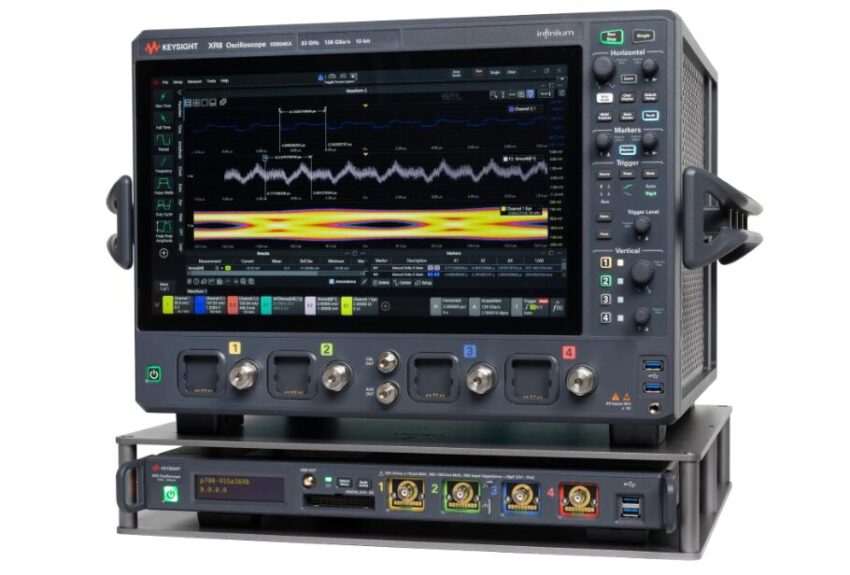
An XR3 sits beneath an XR8 oscilloscope, adding high-impedance inputs without taking up a high-speed channel. Image used courtesy of Keysight
Synchronization and Software
Channel count grows through an autosensing 10 MHz reference input and output, which lets multiple units share one clock and trigger. Three hardware automations handle the setup. Auto-discover finds each connected scope by its reported network address, auto-sync aligns the reference clocks, and auto-deskew uses delay lines in the ASIC to correct system-wide skew. Keysight states that the result can integrate more than 100 time-correlated channels.
Each XR3 runs the native InfiniiVision interface, and embedded servers enable remote viewing and control from a browser. Protocol decoding, power-supply testing, and jitter analysis arrive as licensed software packages. For multi-unit systems, the free Infiniium 2026 software can run on an external Windows PC and display signals from several XR3 units in a single window. The same software can also pair an XR3 with Keysight’s XR8 oscilloscope, adding low-noise, high-impedance (Hi-Z) inputs that support AutoProbe 1, passive, and current probes, without surrendering a high-speed XR8 channel to an adapter.
Where It Fits
Beyond the oscilloscope itself, each unit folds in counters, voltmeters, and a frequency response analyzer, with an optional 100 MHz waveform generator, so a single rack slot can double as a compact bench. All told, the XR3 reads like a practical answer for teams that keep running out of rack space before they run out of signals to measure. Aerospace and defense labs, production lines, and physics experiments stand to gain the most from that density, while engineers already invested in the XR8 may appreciate an economical way to add Hi-Z probing. Anyone assembling an automated test rack will probably want a closer look.


