
Infineon Debuts 7 nA TMR Magnetic Switch for Wearables and Patches
Idling at roughly seven nanoamps yet able to source up to 50 mA, a new XENSIV part wakes sealed health and consumer devices with nothing more than a passing magnet.
A battery-powered gadget that sits in a box for months still drains its cell, even though nobody has pressed a button. Infineon is targeting that quiet loss with the TLV55624-1O, a new addition to its XENSIV magnetic sensor portfolio. The part is a TMR-based magnetic switch that pairs ultra-low current consumption with direct load switching. Infineon says the combination reduces standby drain in always-ready systems and can cut external component counts.
Nanoamps at Rest, Milliamps on Demand
The headline figure is a typical average supply current of about 7 nA, specified at 25 °C with a 1.55 V supply. Duty cycling makes it possible: the sensor idles for most of each cycle, then wakes briefly to check the field at a typical rate of 1.2 Hz. Heat erodes the advantage somewhat, with typical averages climbing to 15 nA from 25 °C to 50 °C and 50 nA from 50 °C to 85 °C.
Speed is the price of that thrift. A glitch filter, typically 250 ms, makes the device wait for a steady field before the output changes state, so this is a wake-up switch rather than a fast sensing element. On the output side, the push-pull stage handles up to 50 mA of continuous current, enough to switch downstream electronics directly.
Infineon’s lead example is the continuous glucose monitoring (CGM) patch. Here, the switch can power up the patch when it is lifted off its applicator, so it wakes up without NFC, a smartphone, or an additional controller. In an example built around a 6 mAh silver-oxide cell, Infineon reports a ten-fold gain in shelf life. Thomas Cemernek, Senior Product Manager at Infineon, notes that combining low current, contactless activation, and load switching in one device helps shrink board area and component count in sealed patches.
Sensing and Control Features
The TLV55624-1O includes a TMR sensing element, comparator circuitry, power management, and a push-pull output stage, all running from 1.1 V to 3.6 V, a range that suits single-cell batteries. Sensing is omnipolar, so either a north or a south pole will trigger it, which simplifies magnet selection. Typical operating points sit at ±1.0 mT and release points at ±4.5 mT.
Two dedicated pins extend the behavior. Driving LOCK high freezes the output in its current state regardless of nearby field. Paired with FSLP, LOCK also enables a forced sleep mode, in which Q is held at ground until a further FSLP pulse (with LOCK low) or a power cycle restores normal operation. A microcontroller can therefore take charge once the initial wake-up is complete.
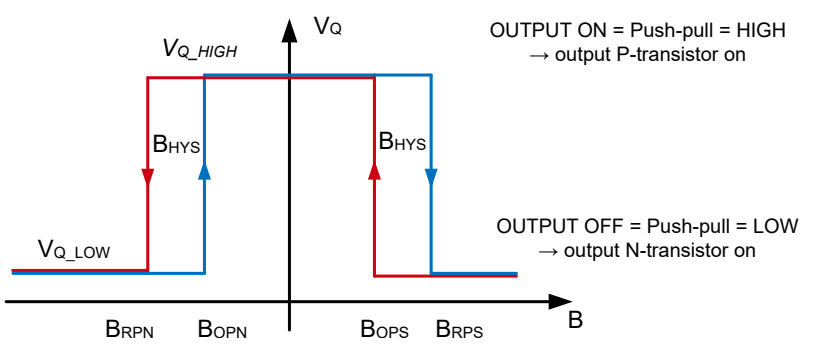
Omnipolar response: the switch treats both magnetic poles alike, with a hysteresis band on each side that separates the turn-on and turn-off thresholds. Image used courtesy of Infineon
Package and Applications
The device ships in a PG-XQFN-7-1 package measuring 1.50 × 1.50 × 0.38 mm³ and is rated for −40 °C to +85 °C. The compact outline supports small PCB layouts and close magnetic coupling between sensor and magnet. A data sheet, product page, and evaluation board are available.
In short, the TLV55624-1O answers a narrow but stubborn question: how little can a device spend while it waits? With nanoamp idle current, direct load switching, and a footprint barely 1.5 mm on a side, it fits sealed, single-cell designs where every bit of charge counts. CGM patches and other medical disposables lead the target list, joined by wearables, smart glasses, AR/VR devices, and hearing aids, while the data sheet also names IoT edge nodes and smart metering with tamper detection. For products that must wait patiently and then spring to life on cue, a magnet and a 1.5 mm chip make an appealing pairing.


