
Same Sky Adds 18 Compact MEMS Microphones to CMM Family
Analog and digital outputs, top or bottom ports, and reflow-ready packages as small as 2.75 x 1.85 mm give designers new options for space-starved audio boards.
Same Sky’s Audio Group has expanded its MEMS microphone portfolio with 18 new models, all belonging to the CMM family. Packaged in sizes as small as 2.75 x 1.85 x 0.90 mm, the parts offer a choice of top or bottom acoustic ports. Compatible with reflow soldering, they slot neatly into surface-mount assembly lines.
Specifications Across the Family
Output style is the first fork in the road: designers can pick an analog version or a digital one that uses pulse density modulation. Every model is omnidirectional. Sensitivity spans -42 to -26 dB, and tolerances can be held to ±1 dB, which is useful when several microphones share a board and need to behave alike.
Signal-to-noise ratio ranges from 57 to 67 dBA, while the operating frequency range runs from 20 Hz up to 20,000 Hz. Current draw dips as low as 80 μA, and select models add a low-power mode for designs where every microamp counts.
Inside the CMM-2718AT-421Z-TR
The data sheet for the CMM-2718AT-421Z-TR puts concrete numbers behind the family’s headline claims. This analog, top-port part measures 2.75 x 1.85 x 0.95 mm and weighs about 0.0107 g. Its typical sensitivity is -42 dB at 94 dB SPL and 1 kHz, and its acoustic overload point sits at 130 dB SPL. Total harmonic distortion is typically 0.10% at 94 dB SPL, and the signal-to-noise ratio is typically 56 dBA over a 20 Hz to 20 kHz bandwidth. This model’s frequency response is specified from 100 Hz to 10,000 Hz.
Power requirements are modest. The supply ranges from 1.6 to 3.6 V, with a typical draw of 130 μA at 2.0 V, and the device operates from -40 to 100 °C. At 2.0 V, the output rests at about 0.95 V DC and presents a typical impedance of 100 Ω. The reference interface circuit uses 0.1 μF bypass capacitors and an external amplifier stage, with gain set by the ratio of two resistors, so the designer can choose the amplification.
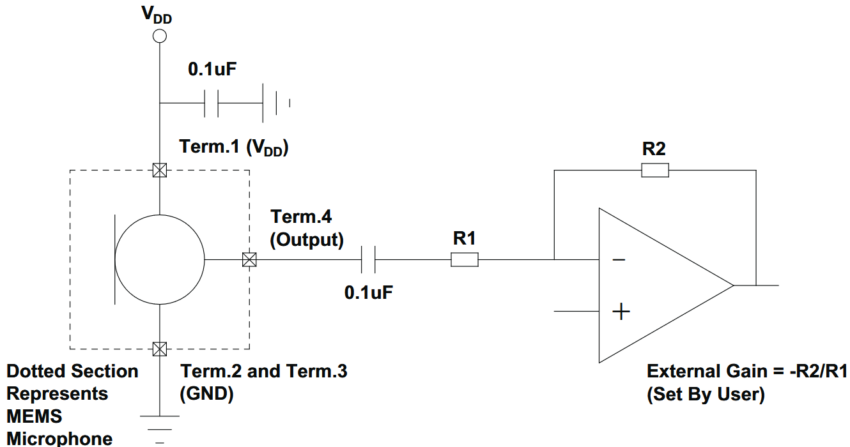
An inverting op-amp configuration lets designers choose how much amplification the microphone’s analog output receives. Image used courtesy of Same Sky
Assembly, Availability, and Applications
The data sheet lists a peak reflow temperature of 260 °C and advises against more than three reflow cycles. It also steers builders away from several practices that could harm the acoustic port, including washing the board after reflow, blowing air heavily across the opening, or pulling a vacuum over it. Parts ship on 178 mm reels of 1,000 pieces.
CMM models are now available through distribution, with prices starting at $0.45 per unit for 100 pieces. Lead times run from stock to 8 weeks, and OEM pricing is available by contacting Same Sky.
Small, solder-friendly, and offered in both analog and PDM flavors, the CMM microphones cover plenty of ground for a part that costs under half a dollar in 100-piece quantities. Smartphones, wearables, smart home devices, and other portable electronics are the natural homes, with the low-power variants earning a closer look wherever battery life is tight. For anyone sketching a new voice-capture design, the family’s spread of sensitivities, package options, and output types makes for an easy shortlist.


