
pSemi Launches Monolithic 2.4 GHz Front-End Modules for IoT Radios
The PE566212 and PE566213 fold a power amplifier, low-noise amplifier, and switch into a 1.8 mm square package for Bluetooth, Zigbee, and Thread designs.
pSemi, a Murata company, has announced two 2.4 GHz front-end modules (FEMs) built for low-power wireless products: the PE566212 and the PE566213. Both parts serve Bluetooth, Zigbee, and Thread designs, and both carry forward the company’s long record of packing RF front ends into handsets. This time, that integration know-how targets smart-home equipment, wearables, wireless audio, and sensing hardware.
Integration and RF Performance
Each module contains a power amplifier, a low-noise amplifier, and an RF switch, all housed in a 14-lead LGA package measuring just 1.8 × 1.8 × 0.63 mm. Fabrication relies on pSemi’s UltraCMOS+ process, a patented silicon-on-insulator (SOI) variant, which the company offers as a silicon-based alternative to the GaAs and SiGe front ends that traditionally fill this role. Configuration happens through a GPIO control interface, and the external parts list is meant to stay short.
As for the numbers, the transmit output reaches +20 dBm, the receive noise figure is 1.8 dB at 13 dB of gain, and the bypass path adds a typical 0.8 dB of loss. The operating band spans 2400 MHz to 2483.5 MHz. pSemi quotes up to 5 to 10 times the range of a standalone SoC; that comparison is the company’s own, so results in a given design will hinge on the host radio and the antenna.
Two Variants, Two Priorities
The pair diverges in Bluetooth support and transmit-gain control. The PE566212 supports Bluetooth BDR and BLE up to +20 dBm, and its digital transmit-gain control covers 22.5 dB in 1.5 dB steps. Its product brief emphasizes link robustness, fewer dropped packets, and power savings.
The PE566213 keeps the +20 dBm BDR and BLE capability but adds Bluetooth EDR up to +12 dBm. Its gain control is narrower yet finer, spanning 15 dB in 1 dB increments. With that added EDR support, pSemi steers this version toward throughput-focused work such as wireless audio and wearables.
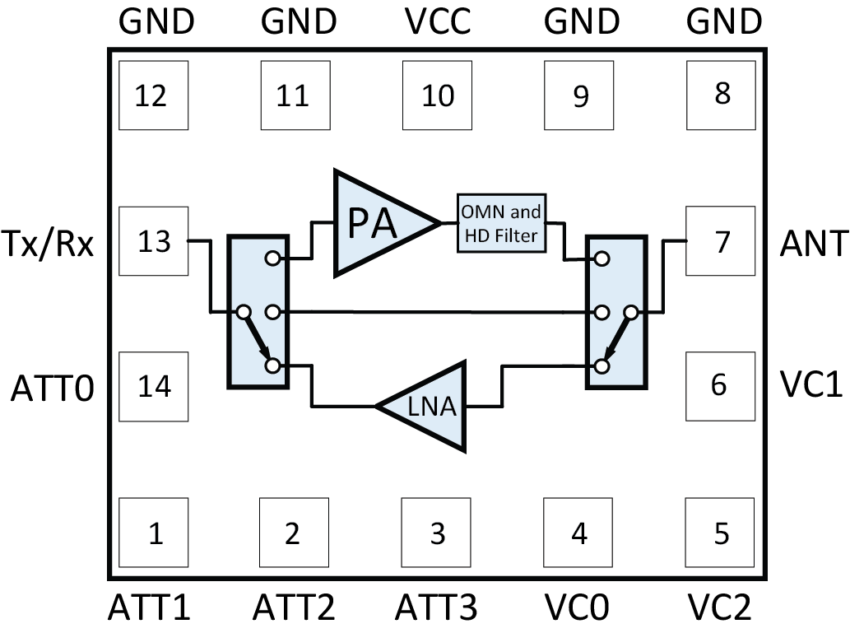
Two switches steer signals between the Tx/Rx pin and the antenna pin, sending them through the PA, the LNA, or a direct connection. Image used courtesy of pSemi
Availability and Use Cases
Both devices are available now and listed as in production, with evaluation boards (EK566212-01 and EK566213-01) on offer for each. Product briefs are public; full datasheets come by request through pSemi.
All told, the PE566212 and PE566213 look like a tidy way to stretch the reach of a 2.4 GHz radio without a heavy footprint penalty: three RF functions, a package under 2 mm per side, and a choice between a link-robustness part and a throughput-minded one. The product briefs name wearables, wireless audio, smart speakers, smart lighting, smart thermostats, in-home appliances, sensors, range extenders, and general IoT devices as targets, which covers a good share of the connected gadgets scattered around a modern home. Designers weighing GaAs or SiGe front ends for these products may want to take a closer look at this silicon route.


