
Silanna Folds a DSP Into Its Compact Plural Nano Converter Family
New on-chip signal processing lets designers trim or drop a downstream FPGA while keeping 12- to 16-bit sampling at up to 250 Msps in packages measuring under 4 mm per side.
Silanna has added a DSP function block to its Plural Nano data converters, a family the company describes as the world’s smallest. The new on-chip processing is meant to let designers handle signal conditioning and channel correction in the converter itself, so a downstream FPGA can shrink in scope or disappear from the design altogether. That, according to the company, frees board area and trims both cost and complexity.
Processing Moves Onto the Converter
Despite their diminutive packages, the Plural Nano DSP devices offer the same functions as their larger Plural DSP siblings: decimation, digital down-conversion (DDC), interleaving, and IQ-mismatch correction. Randy Wayland, Silanna’s vice president of data converter products, notes that conditioning and channel correction can now happen directly on the converter, which in many applications should substantially reduce FPGA requirements or eliminate them entirely.
The preliminary SD7226-250 datasheet fills in some detail for one member of the family. Its processing chain accepts the outputs of two converter channels, which can run independently or as an IQ pair, and passes them through an input multiplexer, gain and offset correction, phase correction, a down-converter, and a decimator. The decimator supports factors of two and four, and the phase correction block spans roughly ±14 degrees. You can bypass any stage when it isn’t needed.
Packages and Family Lineup
The Plural Nano DSP parts arrive in 12-, 14-, and 16-bit resolutions, with sample rates from 5 to 250 Msps. Two package sizes are offered: 3.4 × 3.4 mm for the 12-bit single and dual devices and the 14- and 16-bit single-channel devices, and 3.7 × 3.7 mm for the 14- and 16-bit dual-channel parts. Silanna says these footprints are 83% and 86% smaller than competing converters sampling above 125 Msps, which are almost universally 9 × 9 mm or larger. Against competing 125 Msps devices measuring 5 × 5 mm or larger, the reductions are 45% and 54%. Those savings are calculated before considering any downstream processing.
At launch, 24 Nano ADCs with the DSP function are available across the three resolutions, pushing the total number of Plural Nano devices past 170. Additional resolutions are slated for announcement in the coming months. Like the original Plural lineup, the Nano family pairs a pipeline ADC core with on-chip reference and clock management circuitry, supports LVDS and CMOS outputs, and operates from −40 to +85 °C.
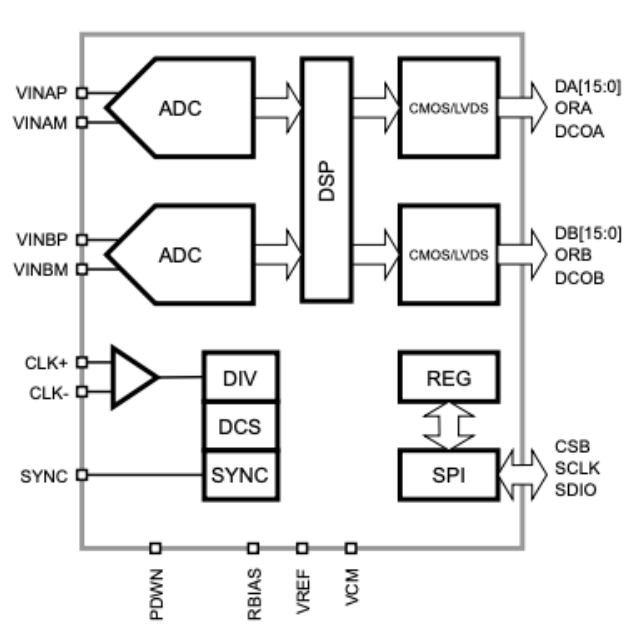
The SD7226 places its DSP block between the two ADC channels and the CMOS/LVDS outputs, so it processes data before it leaves the chip. Image used courtesy of Silanna
A Closer Look at the SD7226-250
The SD7226-250, a dual-channel, 16-bit converter sampling at up to 250 Msps, offers a representative example. Its datasheet lists an SNR of 71.4 dBFS and an SFDR of 75.3 dBc at 70.2 MHz and 250 Msps, with typical power consumption of 631 mW at that rate. The device comes in a 3.7 × 3.7 mm BGA package with a 0.4 mm ball pitch. Because the datasheet is marked preliminary, these specifications may change.
All told, the Plural Nano DSP line looks like a handy option for designs where every square millimeter counts and the FPGA is mostly there to tidy up converter data. The datasheet points to communications, software radios, IQ demodulation, diversity radio and smart antenna systems, multimode receivers, ultrasound, radar and LiDAR, and test and measurement as target applications, while Silanna also names edge AI among the sectors it addresses. Evaluation kits and samples are available through the company’s authorized distributors, making it fairly painless to kick the tires.


