
What Is DECT NR+? Examining the New 5G Non-Cellular Mesh Standard
DECT NR+ shares a name with cordless phones but not their design. Here is how this license-exempt mesh standard compares with LoRaWAN and cellular IoT.
DECT NR+ sounds like old cordless phone technology, but the radio underneath is entirely new. The similar names cause a lot of confusion. ETSI published the standard in 2020. The ITU later added it to IMT-2020, its family of 5G technologies. This makes DECT NR+ the first non-cellular technology on that list. This article explains how it works and how it compares with LoRaWAN and cellular IoT.
What DECT NR+ Is and Is Not
DECT stands for Digital Enhanced Cordless Telecommunications, and classic DECT was built to carry voice calls for cordless phones. DECT NR+ is a full redesign for data, formally named DECT-2020 NR and defined by ETSI in the TS 103 636 series.
The two still share a few design choices, and they do so on purpose. Both use a 1.728 MHz base channel width, and their frame and slot lengths align, which allows the new radio to coexist with classic DECT in the same band.
DECT NR+ also borrows several techniques from cellular systems, yet it needs no mobile operator. The term “non-cellular” means that no carrier network or subscription sits between the devices, because the devices form the network themselves.
The ITU recognized DECT NR+ for two 5G use cases:
- Massive machine-type communication for smart grid electrical networks and water utility metering.
- Ultra-reliable low-latency communication for applications that include industrial motion control, robotics, and professional wireless audio.
How a DECT NR+ Network Forms
A DECT NR+ network can be point-to-point, star, or mesh. The mesh variant is organized as a clustered tree. One device, called the sink, connects to the internet, picks a channel, and sends beacons that other devices hear before they join.
Relay nodes pass data between clusters, and leaf nodes sit at the edge. Each device chooses its own next hop. If a path fails, the network can find another route.
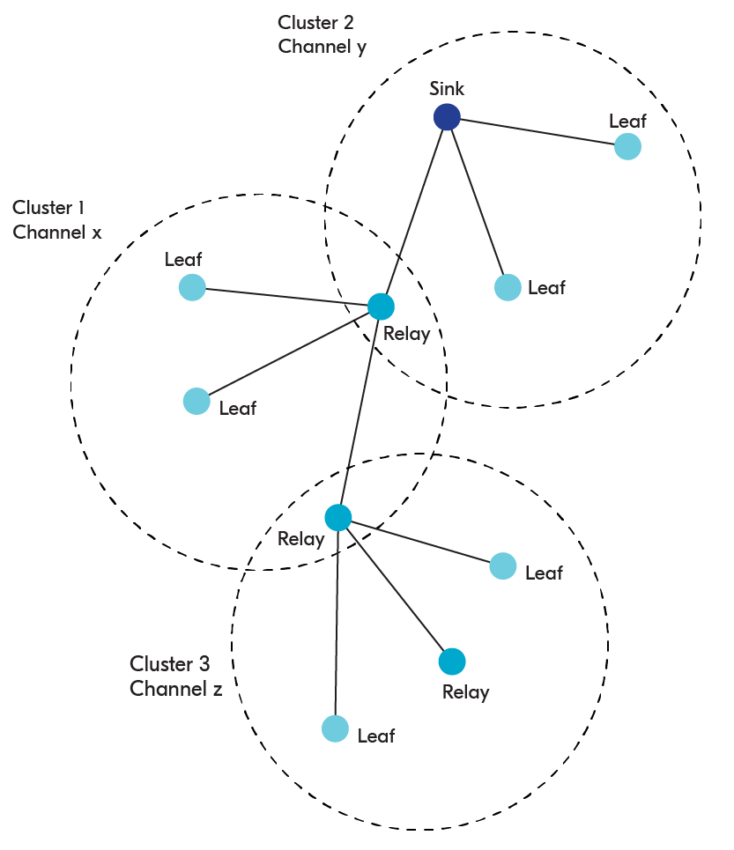
Figure 1. DECT NR+ mesh network with one sink, relay nodes, and leaf nodes grouped into clusters on different channels. Image used courtesy of Nordic Semiconductors
The standard defines bands from 450 MHz to 5.875 GHz, but the main one is the license-exempt DECT band, which spans 1880 to 1900 MHz in Europe and 1920 to 1930 MHz in the United States and Canada. Some products also run on the 915 MHz ISM band.
Latency is low: a single radio link takes under 1 ms, and simulated mesh paths stay under 100 ms end to end.
Range depends on transmit power and antenna height. In a perfect line-of-sight scenario, DECT NR+ can reach 6 km. In urban areas, non-line-of-sight connections are limited to less than 200 m.
How It Compares With LoRaWAN and Cellular IoT
LoRaWAN uses a star-of-stars layout in which devices talk only to gateways, and the gateways forward the data to a network server. Its data rate ranges from 0.3 to 50 kbps, and in Europe a 1% duty cycle limits airtime.
Cellular IoT includes LTE-M and NB-IoT, both of which run in operator-managed licensed spectrum, so you pay for a SIM and a data plan. LTE-M reaches about 1 Mbps and supports mobility, whereas NB-IoT is slower and can show latency from 1.6 to 10 seconds.
Table 1. Comparison of DECT NR+, LoRaWAN, LTE-M, and NB-IoT.
| Feature | DECT NR+ | LoRaWAN | LTE-M | NB-IoT |
|---|---|---|---|---|
| Spectrum | License-exempt 1.9 GHz DECT band; also ISM and other bands | License-exempt sub-GHz ISM | Licensed LTE bands | Licensed LTE bands |
| Topology | Mesh, star, point-to-point | Star-of-stars | Operator towers (star) | Operator towers (star) |
| Data rate | 1 Mbps to 1.3 Gbps defined (MAC layer) | 0.3 to 50 kbps | About 1 Mbps | About 127 kbps down, 159 kbps up (NB2) |
| Range | About 600 m per hop outdoors (measured) | About 5 km urban; up to 30 km line of sight | Operator coverage | Operator coverage |
| Mobility | Handover supported | Limited | Full | Limited |
| Cost model | No subscription | Own gateways, or a paid network provider | Operator SIM and data plan | Operator SIM and data plan |
Each technology has a clear strength. LoRaWAN reaches farthest per hop, and cellular gives wide coverage that someone else builds and maintains. DECT NR+ offers very low latency and the highest defined data rates, although you build and run the mesh yourself.
Real deployments use far less than the top rate, and one reference mesh case shows only 0.45 kbps per device.
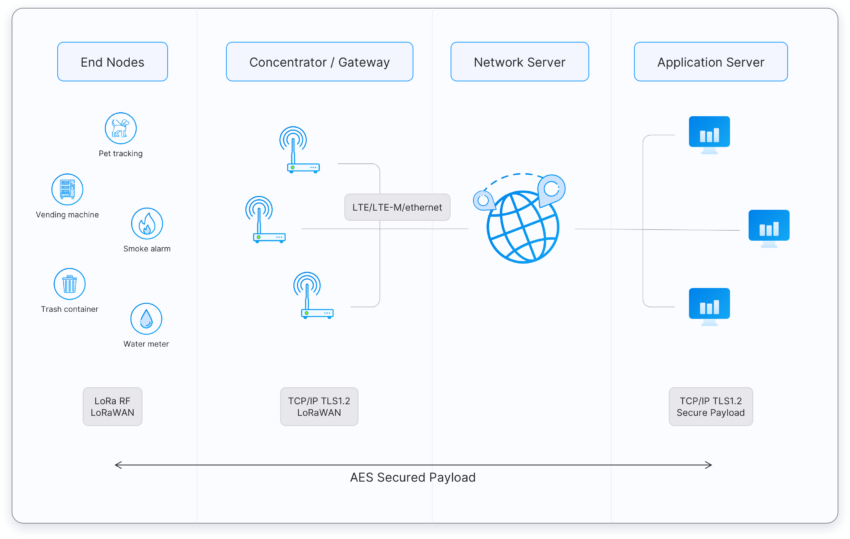
Figure 2. In a LoRaWAN network, end nodes reach the system only through gateways, creating a star-of-stars layout. Image used courtesy of The Things Network
Getting Started With DECT NR+
Hardware is available now. Nordic’s nRF9151 module supports DECT NR+ alongside LTE-M and NB-IoT. Wirepas sells a mesh stack built on the standard, and product makers license it. In one smart-metering deployment, Sustainable Energy Technologies has launched meters on the nRF9151 with Wirepas firmware.
For hands-on work, Norik offers a USB dongle based on the nRF9151 that works either as a child node or as a USB-powered gateway. It ships with Nordic’s DECT NR+ console shell, so you can discover networks, join them, and run link tests from a serial terminal. Open-source examples in the nRF Connect SDK help you write your own firmware, and a built-in CMSIS-DAP debugger removes the need for an external probe.
Software is the main gap because, as of mid-2026, the standard still lacks a well-documented open-source reference implementation. A project called OpenDECT-X began in May 2026 to close that gap.


