
Nordic Semiconductor Expands Ultra-Low-Power Wireless SoC Series
The nRF54LV10A low-voltage Bluetooth LE SoC is suitable for miniaturized medical devices powered by a silver oxide coin cell, including continuous glucose monitors and wearable biosensors.
Nordic Semiconductor has released the nRF54LV10A, the latest addition to the company’s nRF54L series of Bluetooth LE SoCs. Positioned for power-critical connected health and sensor applications, the defining characteristic of this new device is its ultra-low operating voltage, which allows for stable function down to 1.2-1.7 V. This operational floor significantly impacts the power supply design for miniaturized electronics, particularly by eliminating the need for common external voltage boosting components when utilizing next-generation low-voltage power sources.
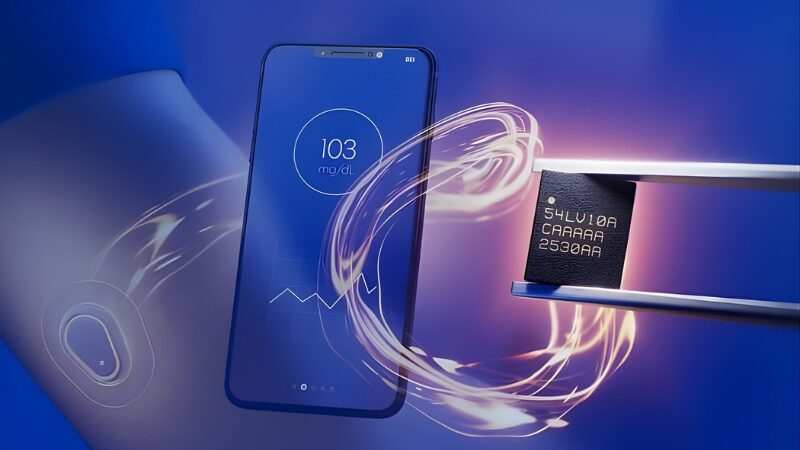
Nordic Semiconductor has built the nRF54LV10A SoCs for use in small wearable medical devices, including continuous glucose monitors. Image used courtesy of Nordic Semiconductor
Multi-Core Architecture and Memory Resources
The nRF54LV10A SoC is built on a multi-core architecture engineered for concurrent efficiency and performance. Application processing is managed by a high-performance ARM Cortex-M33 core, optimized for both performance and efficiency. To maintain a clear distinction between application and protocol tasks, a separate custom RISC-V core is dedicated to handling the Bluetooth LE 5.5 stack and radio control. This division ensures that the main M33 core is consistently available for computationally intensive sensor processing and user interface management, avoiding the latency spikes often associated with interleaved wireless stack operation.
The nRF54LV10A’s technical breakthrough lies in its 1.2 V – 1.7 V minimum supply voltage. By operating natively at such a low voltage, the nRF54LV10A simplifies the overall power management architecture, reducing the bill of materials and saving valuable PCB area.
The nRF54LV10A features a 128 MHz Arm Cortex-M33 processor, a 128 MHz RISC-V coprocessor, and a 2.4 GHz radio. Video used courtesy of Nordic Semiconductor
Integrated dedicated coprocessors provide further architectural specialization. These units offload highly specialized tasks, such as sensor data aggregation and security acceleration, which provides a cumulative reduction in system-wide power consumption. For embedded system engineers, the memory specifications include 1 MB of NVM and 192 KB of RAM, providing ample resources for complex firmware, over-the-air updates, and local data logging required in medical-grade applications.
Integrated Security and Peripherals
For integrating external sensors and peripherals, the nRF54LV10A features a robust set of interfaces, including a high-resolution ADC, Comparator, I2C, SPI, and UART. The incorporation of an integrated temperature sensor, PWM, and RTC further enhances the device’s utility as a highly integrated SoC.
Additionally, Nordic has prioritized the nRF54LV10A’s security to meet stringent medical device standards. The SoC features full support for ARM TrustZone, which enables the partitioning of sensitive code and data into secure processing environments, isolating them from non-secure applications. Hardware acceleration is provided for state-of-the-art cryptography, and the device incorporates a NIST-certified hardware random number generator, ensuring robust protection for sensitive patient data and device authentication.
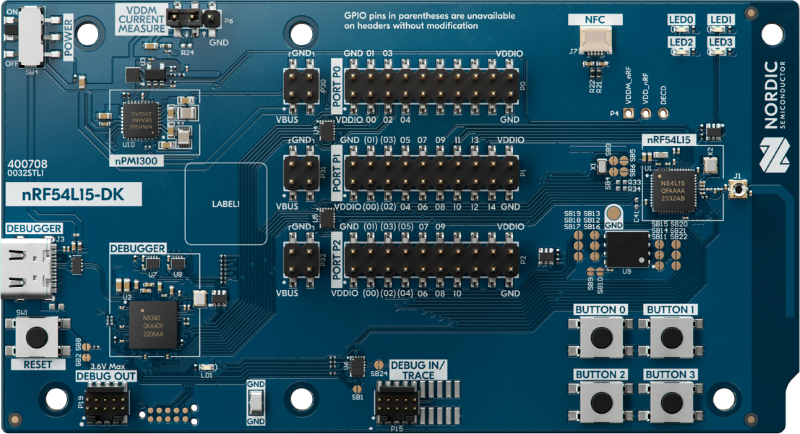
To get started with the nRF54LV10A, Nordic recommends using the nRF54L15 DK development kit. Image used courtesy of Nordic Semiconductor
Advancing Healthcare Wearables
The nRF54LV10A’s ultra-low-voltage operation, optimized multi-core architecture, and comprehensive security framework represent Nordic’s aim to advance battery-powered, small-form-factor devices. Its ability to function down to an ultra-low voltage while offering considerable power reduction makes it an ideal component for advanced wearable biosensors, continuous glucose monitors, smart rings, intelligent patches, and hearing aids, enabling the design of smaller and longer-lasting connected health products.


Wow.