
Pixblasters MINI Converts Addressable RGB LEDs Into Real-Time Video Displays
The FPGA-based controller presents LED arrays as standard monitors, driving up to 8,192 addressable RGB LEDs at 60 FPS without custom programming or CPU overhead.
Pixblasters has announced the Pixblasters MINI, an FPGA-based video controller that enables addressable RGB LED arrays to function as standard computer monitors. The device supports up to 8,192 LEDs across popular chipsets, including WS2812B, SK6812, APA102, and SK9822, operating at 60 FPS regardless of LED count.
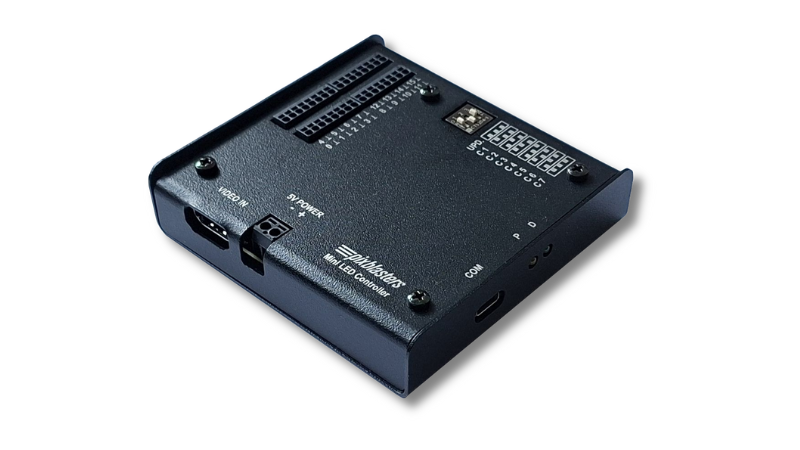
Pixblasters’ MINI video LED controller displays computer monitor images on up to 8,192 RGB LEDs at 60 FPS. Image used courtesy of Pixblasters
MINI Video RGB LED Controller
The Pixblasters MINI Video LED controller accepts standard DVI-compatible video input through an HDMI-type cable and maps a user-selected screen region to connected LED arrays. Built around an AMD Spartan-6 XC6LX9-3 FPGA, the device handles real-time video processing independently of the host system. A Microchip PIC18F26J50 microcontroller manages configuration storage and firmware updates.
The system presents itself to the host computer as a conventional display device with on-board EDID flash, supporting resolutions up to 720 p at 1280×720@60 and RGB888 color depth. This approach eliminates the need for specialized LED control software or custom drivers, allowing users to employ standard digital signage applications, media players, or custom software that outputs to a display.
The Pixblasters MINI enables LED video displays in a wide range of applications, including art and architecture. Video used courtesy of Pixblasters Master
Hardware Configuration and Output Topology
The MINI LED controller provides 16 digital outputs, each capable of driving up to 512 LEDs. Snap-action connectors enable tool-free assembly without soldering. The controller supports both three-wire protocols, such as WS2811 and WS2812B, and four-wire protocols, including APA102 and HD107S. Configuration is handled through on-board DIP switches for operation mode changes, with additional parameters accessible via USB-C connection to a configuration utility.
Output resolution options include native 512 x 16 pixel configurations, as well as 256 x 32 and 128 x 64 arrangements. The device integrates hardware video input cropping, multiple lines per output mode, brightness control, and LED gamma correction. With 30 LED/m strips, the controller can address displays covering approximately 10 square meters in various geometric configurations.
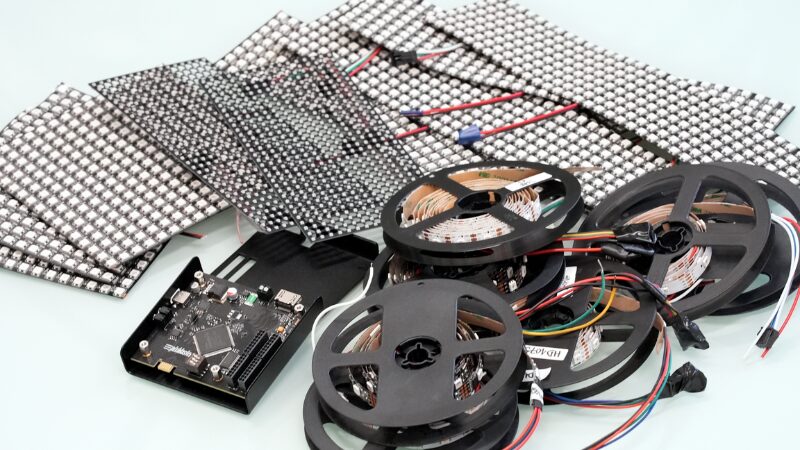
The Pixblasters MINI supports three-wire and four-wire LED strips. Image used courtesy of Pixblasters
Applications and System Integration
The controller operates independently of host CPU and GPU workload, maintaining a consistent 60 FPS output regardless of LED count or display size. Power requirements are 5 V DC at 0.6 A for the controller, with separate power supplies for the LED arrays. The compact 89.6 x 92 x 21 mm form factor facilitates integration into custom installations.
Target applications include architectural lighting, interactive installations, dynamic signage systems, and stage production environments. For displays with more than 8,192 LEDs, Pixblasters offers the MS1 controller, which supports chaining for installations with hundreds of thousands of LEDs. The MINI is listed as coming soon on Crowd Supply, while the MS1 is currently available for deployment.


