
Rambus Debuts DDR5 9600 RDIMM Chipset for AI Servers
A new registering clock driver pushes server memory to 9600 MT/s, targeting bandwidth-hungry agentic AI and HPC workloads.
Rambus has rolled out its DDR5 9600 Server RDIMM chipset, a lineup of memory interface components engineered to keep pace with the ballooning bandwidth and capacity demands of modern data center servers. Built around a newly developed 6th Generation Registering Clock Driver, or RCD06, the chipset pushes registered DIMMs to a peak data rate of 9600 MT/s, a 20% jump over the company’s prior-generation solution. The announcement arrives as CPU-based server platforms increasingly bear the weight of agentic AI, inference, and other data-hungry workloads.
Memory Bandwidth Meets Agentic AI
According to Rambus, the shift from AI model training toward real-time inference and autonomous, multi-step agentic workflows is reshaping what server memory subsystems must deliver. These workloads are iterative by nature, repeatedly drawing from large datasets and maintaining persistent context across many operations. Techniques such as key-value (KV) caching compound the effect: by storing and reusing contextual data during large language model inference, KV caching reduces redundant computation and speeds token generation, but it also drives up both memory bandwidth and capacity requirements.
To compound matters, CPU platforms continue to add cores and expand memory channel density, which only amplifies the appetite for faster DIMMs and greater aggregate bandwidth. Rambus positions the DDR5 9600 RDIMM chipset as a direct response to this convergence of pressures, aiming to give server architects the headroom needed to scale AI infrastructure without memory becoming the limiting factor.
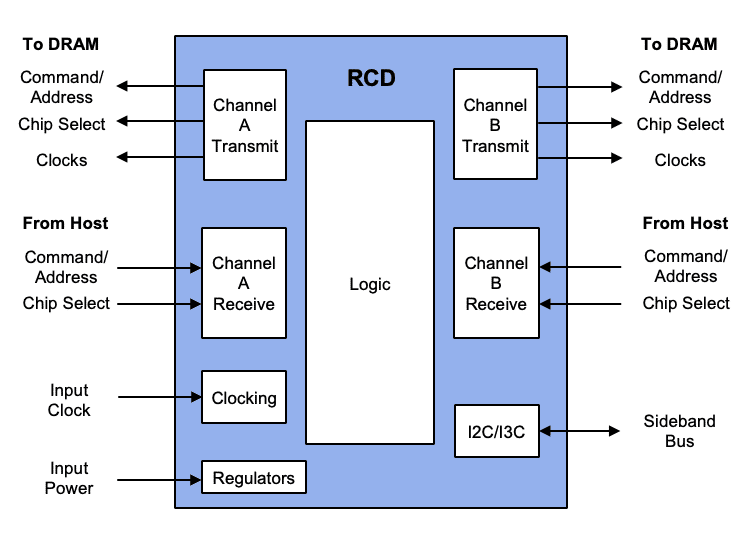
DDR5 RCD High-Level Functional Block Diagram. Image used courtesy of Rambus
A Complete Chipset, From Clocking to Thermal Monitoring
Rather than offering the RCD06 in isolation, Rambus is packaging it alongside several companion chips that together form a full RDIMM solution. The lineup includes the PMIC5030 power management IC, which supplies high-current power at low voltage to support advanced DDR5 module configurations; a Serial Presence Detect (SPD) Hub with an integrated temperature sensor; and standalone Temperature Sensor ICs for additional thermal telemetry.
Bundling clocking, power delivery, and monitoring functions into a single chipset is meant to ease the burden on module manufacturers, who would otherwise need to qualify and integrate these pieces separately. As DDR5 speeds climb, preserving signal and power integrity grows more difficult, and Rambus frames the chipset’s tight integration as a way to maintain reliability at 9600 MT/s while shortening the path from design to production. That integration also carries implications beyond the module itself, since a validated, ready-made chipset can compress the qualification cycle that server OEMs typically face when bringing new memory platforms to market.
Taken together, these pieces point toward a memory subsystem built for the realities of high-core-count CPUs and increasingly autonomous AI software. Server OEMs and hyperscalers building platforms for agentic AI, HPC simulation, and other memory-bound cloud workloads stand to benefit most directly, since faster, higher-capacity RDIMMs translate into fewer bottlenecks between compute and data. It’s a reminder that as AI systems grow more capable, the humble memory module keeps having to work harder to keep up.


