
Everspin Releases High-Reliability MRAM Devices Targeting Extreme Environments
The new devices deliver AEC-Q100 Grade 1 qualification and 10-year data retention at 125°C for mission-critical systems in industrial, aerospace, and automotive industries.
The design and integration of non-volatile memory in systems subject to extreme conditions, such as high ambient temperatures, sustained vibration, or radiation exposure, demand robust electrical and physical specifications. Everspin Technologies has addressed this niche by expanding its PERSYST family of magnetoresistive random access memory (MRAM) with two new high-reliability components: the EM064LX HR (64 Mb) and the EM128LX HR (128 Mb). These devices are engineered to maintain data persistence and operational integrity under demanding conditions found in specialized industrial, defense, and automotive systems.
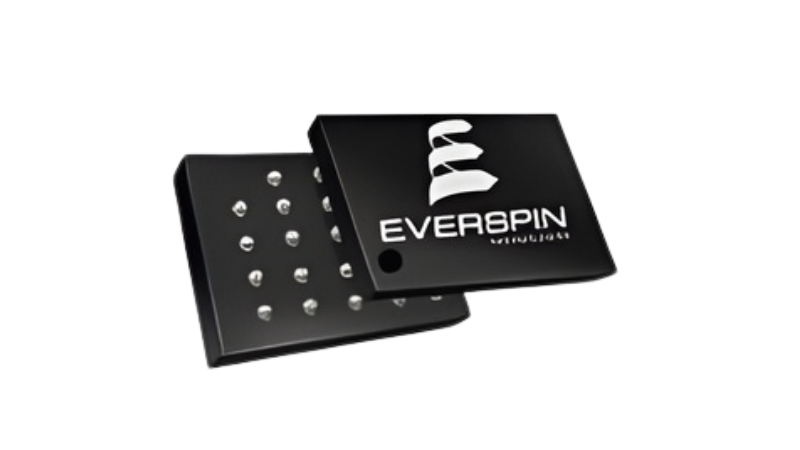
Everspin has added the EM064LX HR (64 Mb) and the EM128LX HR (128 Mb) to its PERSYST MRAM family. Image used courtesy of Everspin Technologies
Unlimited Endurance and Burn-In Verification
Everspin has developed its new MRAM devices to achieve mission-critical reliability metrics. Both the 64 Mb and 128 Mb versions hold the AEC-Q100 Grade 1 qualification and feature an extended operating temperature range of −40°C to 125°C. For persistent memory operating at the thermal limit, data retention is a key parameter. These devices are specified to maintain data for 10 years at 125°C. This long-term retention performance, combined with MRAM’s inherent unlimited read/write endurance over the same 10-year period, provides a predictable memory subsystem for long-life products. To ensure initial component integrity, each device undergoes a 48-hour burn-in process before deployment.
From a performance standpoint, the devices are architected to deliver high-speed data transfer while retaining deterministic performance characteristics. The devices are specified for a read and write bandwidth of 90 Mbytes/sec, which is sustained across the component’s operational lifespan.
Transfer Rates and Single-Event Latch-up Immunity
The device’s primary interface is the Quad Serial Peripheral Interface (QSPI). This standard interface supports two primary operational transfer rates: a 133 MHz single transfer rate and a 90 MHz dual transfer rate operation. The QSPI protocol facilitates integration into existing architectures that require high bandwidth for data-intensive logging or configuration storage, where latency and data loss risk must be minimized. The ability to utilize the industry-standard QSPI interface and corresponding package types enhances design flexibility for users integrating the non-volatile memory.

The EM064LX HR and EM128LX HR devices offer high reliability in demanding applications in industrial, aerospace, and automotive industries. Image used courtesy of Adobe Stock
For applications where exposure to ionizing radiation is a concern, such as in aerospace or high-altitude systems, the EM064LX device underwent independent testing. Validation was conducted at the Berkeley Accelerator Space Effects facility at Lawrence Berkeley National Laboratory under a program sponsored by the NASA Jet Propulsion Laboratory. The testing was focused on the device’s resilience to single-event effects. Specifically, the results demonstrated no observed single-event latch-up events up to a linear energy transfer of 61 MeV-cm2/mg at ambient temperature. Since the EM064LX HR and EM128LX HR share an identical design architecture and reliability specifications, this validation attempts to support the high-reliability profile of the entire expanded family.
High Reliability in Extreme Conditions
The introduction of the EM064LX HR and EM128LX HR devices establishes a benchmark for persistent memory operating in thermally and environmentally challenging regimes. Key technical features include the AEC-Q100 Grade 1 qualification, 10-year data retention at 125°C, unlimited endurance, a sustained 90 Mbytes/sec bandwidth, and proven tolerance to single-event latch-up. These specifications target use in mission-critical applications across the aerospace and defense sectors, including data logging and boot code storage, as well as in high-end industrial systems and automotive architectures that require secure, high-speed non-volatile storage under extreme operating parameters.


Everspin has released a new range of high-reliability MRAM (Magnetoresistive Random Access Memory) devices specifically designed for use in extreme environments. These MRAM devices combine the speed of SRAM, the density of DRAM, and the non-volatility of flash memory, making them ideal for mission-critical applications. Unlike traditional memory technologies, MRAM can retain data without power and withstand high temperatures, radiation, vibration, and shock.
Everspin’s high-reliability MRAM products are well suited for aerospace, defense, industrial automation, automotive, and energy sectors, where system failure is not an option. The devices support fast read/write cycles, unlimited endurance, and long data retention, even under harsh operating conditions. Additionally, they reduce system complexity by eliminating the need for backup batteries or frequent memory refresh cycles.
By targeting extreme environments, Everspin’s MRAM solutions help improve system reliability, reduce maintenance costs, and enable dependable performance in the most demanding applications.