
Silicon Labs’ BG2B SoC Targets Ultra-Low-Power Bluetooth Designs
A new Bluetooth 6 SoC combines channel sounding, hardware security, and integrated peripherals to reduce battery consumption in battery-powered IoT designs.
Silicon Labs has introduced the EFR32BG2B, a Bluetooth 6 system-on-chip the company describes as its lowest-power Bluetooth Low Energy device to date. Built around an 80 MHz Arm Cortex-M33 core, the BG2B pairs a dual-output DC-DC buck architecture with a multi-core layout to reduce current draw across active, receive, and sleep states. Alongside these efficiency gains, the part includes Bluetooth Channel Sounding, Secure Vault High hardware security, and a broad set of onboard peripherals, aiming to give designers of battery-powered IoT devices a single chip that covers ranging, protection, and system integration.
Lower Current Draw Across Every Operating Mode
Battery life is the recurring constraint for devices that spend most of their lives sleeping and only occasionally wake to transmit. The BG2B is built around minimizing current at every stage of that cycle. Compared with Silicon Labs’ previous lowest-power Bluetooth LE part, the company reports a 14 to 15 percent reduction in MCU active current, lower Bluetooth receive current, and a deep-sleep figure of 1.1 microamps with RAM retention. The datasheet also lists 23 microamps per MHz in active mode, 3.1 mA of receive current at 1 Mbps GFSK, and an EM4 shutoff current of just 0.17 microamps. Those numbers matter most for products like wireless sensors, asset tags, smart locks, remotes, wearables, and electronic shelf labels, where months or years of runtime on a coin cell is the design target rather than a bonus.
Ranging and Peripheral Integration in One Package
For applications that need to know not only that a device is nearby but also roughly how far away, the BG2B supports an expanded Channel Sounding feature set, including Mode 3, Normalized Attack Detector Metric (NADM), and Inline Phase Correction Term (Inline PCT). The chip is designed to meet Apple and Google Bluetooth Channel Sounding specifications, which should improve interoperability for products that need to work across both major mobile ecosystems. It’s backed by a royalty-free ranging library, along with supporting software and tools.
Beyond ranging, the SoC integrates several functions that would otherwise require separate components on the board. Integrated CAN-FD enables a single chip to handle both Bluetooth connectivity and wired vehicle network diagnostics, which is useful for fleet management and industrial equipment monitoring without a separate bridge device. An integrated LED boost converter with four-channel LED sink support eliminates the need for external driver circuitry. At the same time, dual 12-bit ADCs enable simultaneous analog sampling, and a Variable Resistive Load (VRL) function helps estimate battery health more accurately over a product’s service life.
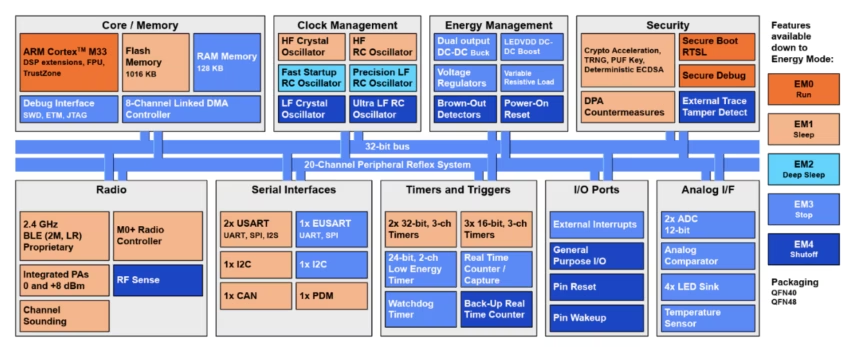
A look at the BG2B’s peripheral integration, including CAN, ADCs, LED sinks, and Channel Sounding radio support. Image used courtesy of Silicon Labs
Security Designed for Tightening Requirements
Connected products face growing pressure to demonstrate robust cybersecurity, and the BG2B relies on Silicon Labs’ Secure Vault High implementation to protect device identity, firmware, cryptographic keys, and other sensitive data. The chip is designed to support PSA Level 3 compliance and is positioned to help manufacturers prepare for regulations such as the European Union’s Cyber Resilience Act. Paired with Silicon Labs’ Custom Part Manufacturing Service, manufacturers can provision devices with unique identities, certificates, and cryptographic credentials during production, rather than adding a separate provisioning step downstream.
The BG2B is currently available through an early customer engagement program, with production hardware and modules expected in 2027. With its power figures, expanded Channel Sounding support, and the peripheral set it integrates onto a single die, the chip looks like a solid fit for electronic shelf labels, asset-tracking tags, smart locks, wearables, and vehicle diagnostic systems that need to squeeze more capability out of shrinking power and board-space budgets. It’s the kind of part that could quietly simplify many BOMs once it reaches full production.


