
Advantech 3.5-Inch SBC Features Qualcomm QCS6490 or QCS5430 SoC For Edge AI
The Advantech MIO-5355 is an industrial 3.5-inch SBC using Qualcomm QCS6490 or QCS5430 SoCs, offering LPDDR5 memory, rich I/O, edge AI acceleration, and long-term OS support.
Advantech has recently released the Advantech MIO-5355, a 3.5-inch industrial SBC built around the Qualcomm DragonWing QCS6490 or QCS5430 processors.
The SBC is designed for embedded applications such as machine vision, industrial automation, robotics, smart kiosks, and intelligent gateways. These applications require long-term availability, low power consumption, and extended temperature support. The board supports a 12V DC supply and can work within extended temperatures from -20°C to 70°C with airflow. In addition, it supports Windows, Linux, and other operating systems.
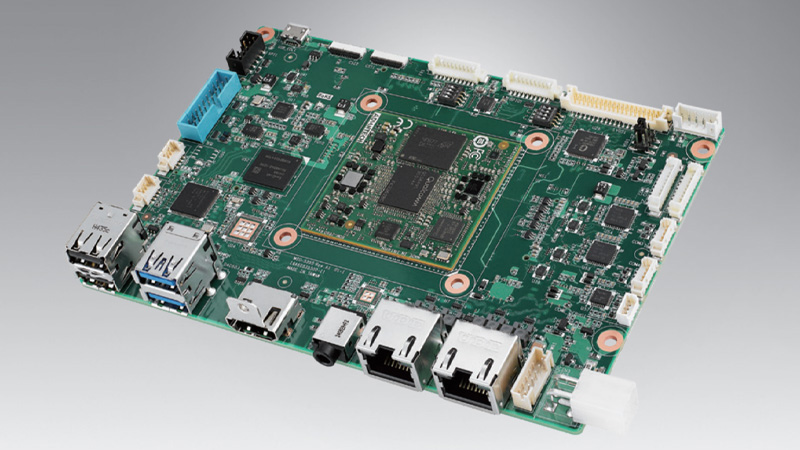
Advantech MIO-5355, a 3.5-inch SBC built on Qualcomm DragonWing QCS6490 or QCS5430 SoC
Processor Options and AI Performance
The MIO-5355 SBC supports either the QCS6490 or the QCS5430 SoC, and each option targets different performance needs. The QCS6490 integrates an octa-core Kryo 670 CPU with one Cortex-A78 Gold Plus core running at up to 2.7 GHz, three Cortex-A78 Gold cores at up to 2.4 GHz, and four Cortex-A55 Silver cores up to 1.9 GHz. It also features an Adreno 643 GPU and Qualcomm’s 6th-generation AI Engine with Hexagon DSP, with up to 12.3 TOPS of AI performance. Moreover, the SoC supports 4K60 video decode, 4K30 encode, and HDR10/HDR10+ playback.
Whereas the QCS5430 targets lower-power designs. It features a hexa-core Kryo 670 CPU with two Cortex-A78 cores and four Cortex-A55 cores, an Adreno 642L GPU, and an AI engine rated at up to 3.5 TOPS. Despite the lower AI performance, it retains similar multimedia capabilities, including 4K60 decode and 4K30 encode.
Interface and Connectivity Features
The MIO-5355 supports up to 8GB of soldered LPDDR5 memory. For storage, it supports up to 128GB of UFS or eMMC flash. The board also provides expansion through an M.2 B-Key 2280 slot for NVMe SSDs and a microSD card slot.
Display options include one HDMI 2.0 port supporting up to 4K at 60 Hz and either dual-channel LVDS (18/24-bit, up to 1920×1080) or eDP 1.4, selectable via hardware switch. Dual independent display operation is supported. The company also talks about a Chrontel CH7218A chip, which is used for DP-to-HDMI conversion, while a CH7513A handles eDP-to-LVDS conversion.
For vision applications, the SBC integrates two 4-lane MIPI-CSI interfaces, enabling support for dual high-resolution image sensors. Meanwhile, audio output relies on a Realtek ALC5682I codec paired with a 3.5 mm combo audio jack.
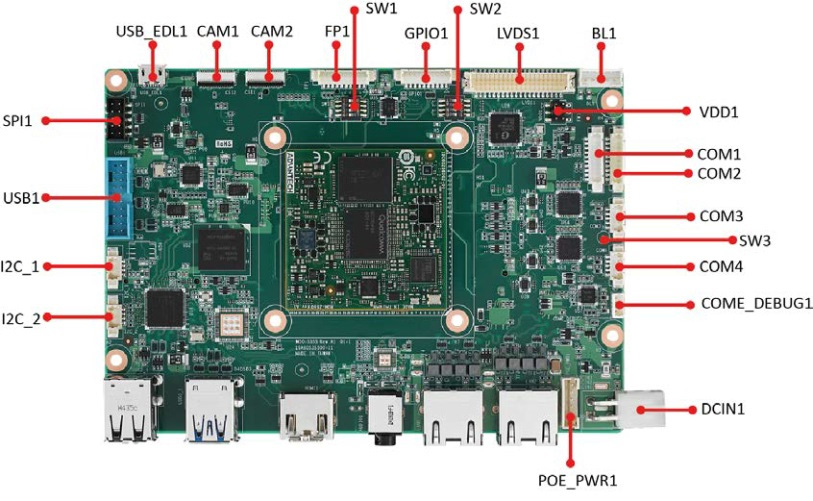
Advantech MIO-5355 Interfaces (Top)
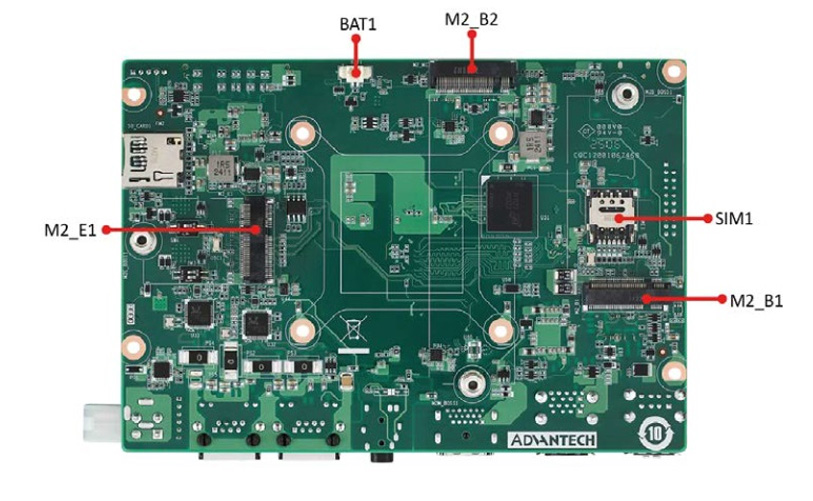
Advantech MIO-5355 Interfaces (Bottom)
Networking and expansion
The board includes two Gigabit Ethernet ports based on Realtek RTL8211FS controllers. Additionally, there is option to add wireless connectivity through an M.2 E-Key 2230 slot for Wi-Fi and Bluetooth modules. For cellular connectivity, there is an M.2 B-Key 3052 slot along with a Nano-SIM socket to support 4G or 5G modules.
There are two USB 3.0 Type-A ports and two USB 2.0 Type-A ports on the rear I/O. Internal headers add support for two more USB 3.0 and two USB 2.0 ports. additionally , the board exposes two RS-232/422/485 ports and two RS-232 ports through internal headers, alongside GPIO, I²C, and SPI interfaces.
Thermal Design and Environmental Specifications
The MIO-5355 operates from a 12V DC supply (±10%) using an ATX 2×2-pin connector, whearas a DC-in jack is available on request. Advantech specifies a maximum power consumption of up to 18.08 W for the QCS6490 variant. Meanwhile, the QCS5430 version reports an idle power consumption of around 8.26 W, although both figures remain TBD.
The SBC supports standard operating temperatures from 0°C to 60°C. With airflow, it extends operation down to -20°C and up to 70°C. In addition, the board meets industrial vibration requirements, supports high-humidity environments, and carries CE and FCC Class B certifications.
Software support and availability
Advantech provides support for Windows 11 IoT Enterprise LTSC, Ubuntu 24.04 LTS, and Yocto Linux 4.0 (Kirkstone), along with its SUSI API for system management and hardware control.
At launch, Advantech lists QCS6490-based SKUs only, with no QCS5430 variants announced so far. The MIO-5355 is already available through Advantech and selected distributors, such as Fortec US and APC Technology (UK), although pricing is not publicly disclosed and is provided on request.
Images used courtesy of Advantech


