
Nanopower’s nPZ2100 Cuts Sensor System Power Use by 90%
A new companion IC keeps host processors asleep until sensor data warrants attention, extending battery life in IoT devices.
Battery life increasingly determines which edge designs succeed and which stall out in the field. As wireless sensor nodes, trackers, and other always-on products lean on capable microcontrollers and radios to make sense of the world, those same processors often become the biggest drain on a battery expected to last months or years between changes.
Nanopower Semiconductor is addressing that tension with the nPZ2100, the newest member of its nPZero power-saving IC (PSIC) platform. Rather than asking a host MCU to handle every sensor poll and system check itself, the nPZ2100 sits between the battery and the rest of the system, taking on housekeeping duties so the host can stay powered down until there’s genuine work to do.
Managing Peripherals Without Waking the Host
The nPZ2100 can autonomously manage up to six sensors or peripherals over I²C or SPI, polling them on a defined schedule and rousing the host MCU only when a configurable threshold or event demands attention. Four integrated 1 mA peripheral power switches and a dedicated 10 mA host switch let the device cut power to sensors and processor independently, eliminating idle draw from components that aren’t in use at a given moment. Nanopower rates the nPZ2100’s own consumption at 200 nA idle and 1 µA while polling, both at 3.0 V, with the device operating across a 1.7 to 3.6 V supply range and an industrial temperature range of −40°C to +85°C.
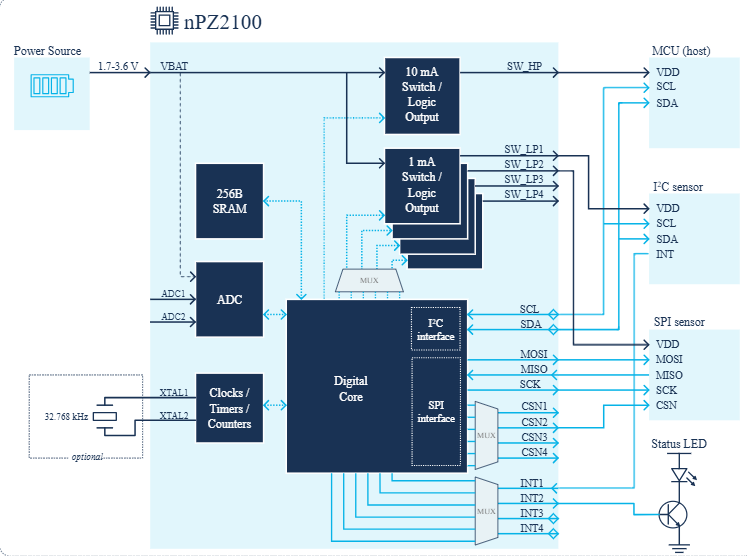
The nPZ2100’s digital core coordinates I²C and SPI interfaces, four low-power switches and a host switch, and onboard SRAM, ADC, and timing resources. Image used courtesy of Nanopower
Onboard Memory, Timing and Sensing
Supporting this autonomous operation is a compact set of onboard resources. A 256-byte SRAM block can store sensor initialization commands, log readings, or hold general-purpose data without waking the host. A three-channel, 8-bit ADC with two external channels and an internal reference enables threshold-based wake events, while a global time counter with alarm and watchdog functionality tracks elapsed time, schedules wake-ups, and can power-cycle the host MCU when needed. A separate general-purpose event counter tallies input-pin or sensor power-on events for added system visibility, and power-aware operation for energy-harvesting systems throttles polling and wake-ups when available power runs low.
Packaging options include a 5.00 x 5.00 mm QFN32 and a 2.50 x 2.50 mm WLCSP34, giving designers some flexibility in board footprint. Datasheets, a one-page product information document, and application notes are available through Nanopower’s development portal, and the company plans to make development kits, engineering samples, and nPZero 2100 “Stamp” boards available from September 2026, ahead of volume production targeted for the second quarter of 2027.
The timing aligns with a broader push to curb battery waste in fielded electronics, including the EU Battery Regulation’s upcoming requirements around removable and replaceable batteries. For engineers designing wireless IoT sensors, asset trackers, electronic shelf labels, wearables, and other battery-powered or energy-harvesting products, offloading routine sensing and monitoring tasks to a dedicated low-power companion IC like the nPZ2100 could translate into meaningfully longer service intervals between battery changes, along with the ability to run smaller batteries or harvest ambient energy in places where swapping cells simply isn’t practical.


