
BrainChip AKD1500 M.2, PCIe and SPI Edge AI Boards Start at $99
Three development platforms bring low-power neuromorphic AI to Raspberry Pi, Linux PCs, and microcontroller-based applications, with prices starting at $99.
BrainChip has expanded its AKD1500 neuromorphic AI hardware line with three development platforms, including an M.2 accelerator card, a PCIe development card, and the compact BrainBoard 1500 SPI module. All three use the AKD1500 edge AI co-processor, which delivers up to 800 effective GOPS while consuming less than 300 mW, according to BrainChip.
The platforms are designed for low-power AI inference in industrial sensors, smart cameras, wearables, and IoT devices. They allow you to run neural networks locally without relying on cloud processing. The main difference between the three boards is their host interface, with M.2 and PCIe options for Linux-based systems and an SPI module for microcontroller applications.
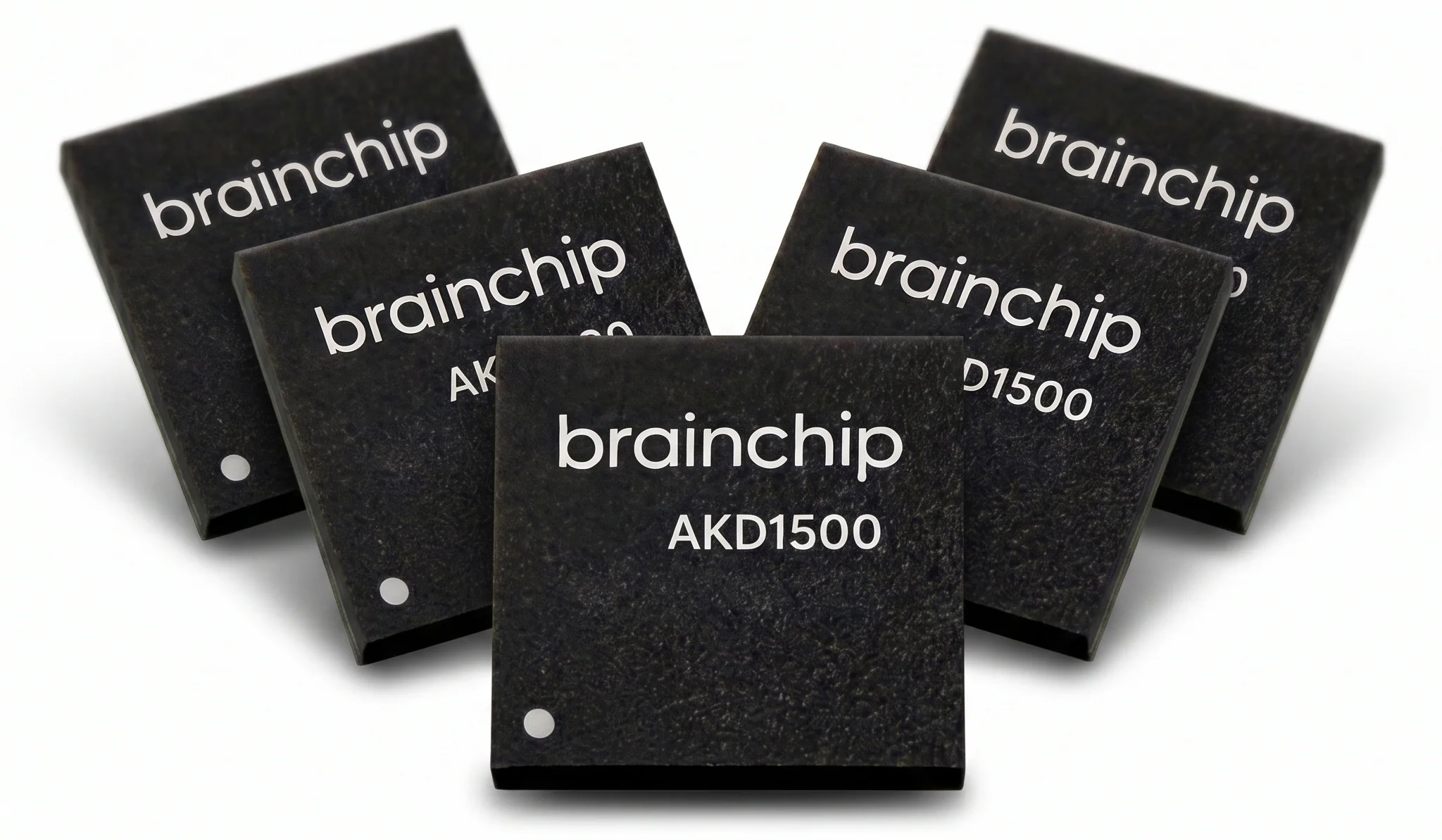
BrainChip AKD1500 neuromorphic Edge AI co-processors
AKD1500 Neuromorphic AI Processor
The brain of all three boards is the BrainChip’s AKD1500 ultra-efficient Edge AI co-processor based on BrainChip’s Akida event-based neural processing architecture. Manufactured using a 22 nm FD-SOI process, the chip integrates 32 neural processing units (NPUs), 1 MB of on-chip SRAM, and supports operating frequencies up to 400 MHz, depending on the configuration.
Unlike generic processors that perform continuous computations, Akida uses event-based processing to reduce unnecessary operations when neural network activity is sparse. It also supports on-chip learning, allowing compatible models to adapt to new information without requiring cloud-based retraining. These features make it suitable for always-on sensing, keyword detection, image classification, and industrial anomaly detection.
AKD1500 M.2 Development Card
The AKD1500 M.2 development card uses an M.2 2230 form factor measuring 22 × 30 mm with a B+M Key connector. It supports PCIe or SPI host communication and can be used with the Raspberry Pi 5 through a compatible M.2 HAT, as well as other supported host systems.
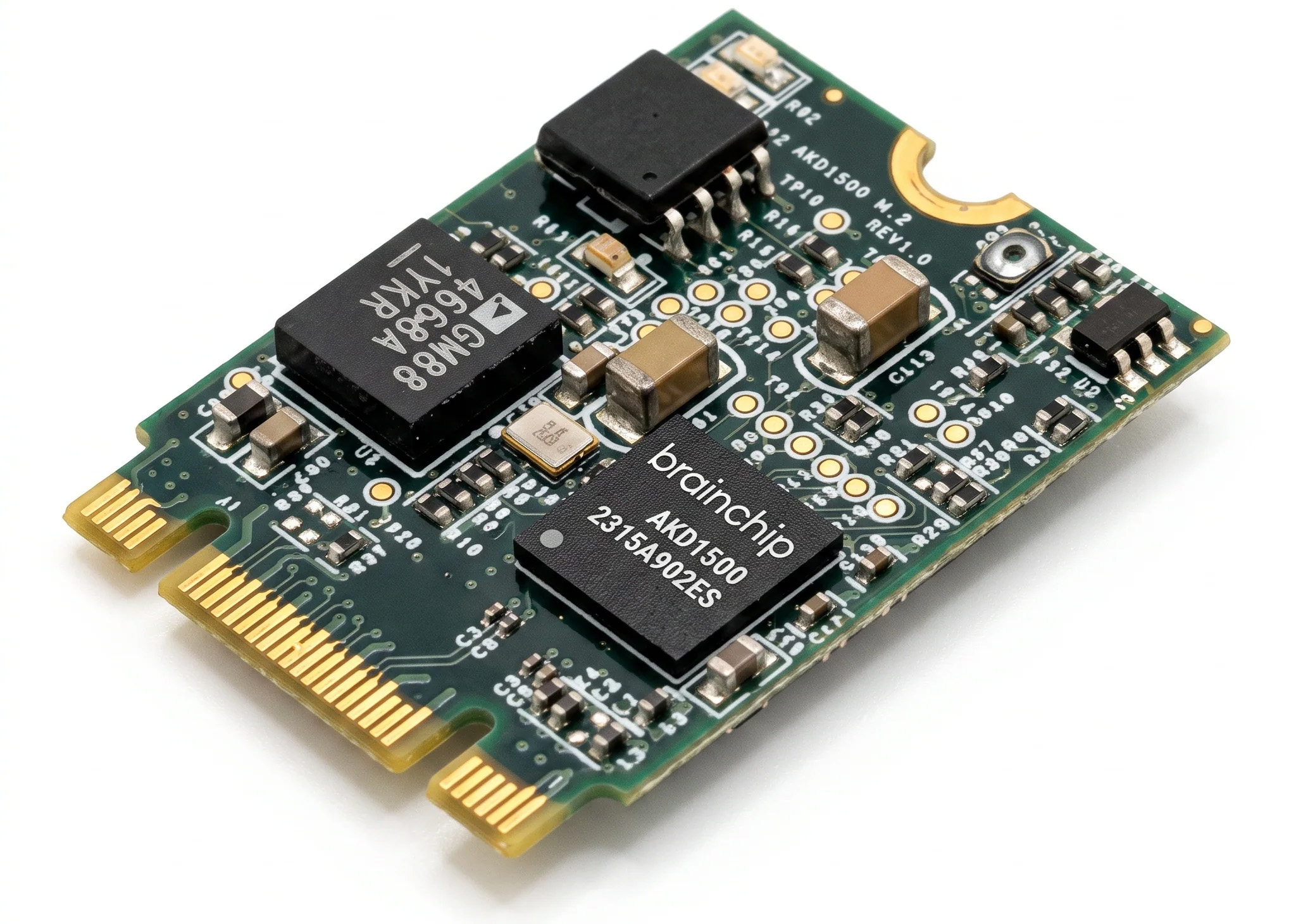
BrainChip AKD1500 M.2 2230 development card with B+M Key connector
The card uses a fanless design and supports operation from 0°C to 70°C. Its compact size lets you add dedicated AI inference to existing embedded computers without a larger accelerator board or extra active cooling. It is designed for remote sensing, smart home devices, and low-power industrial monitoring.
AKD1500 PCIe Development Card
For desktop and industrial systems, BrainChip has introduced the AKD1500 PCIe development card, which uses a PCIe 2.0 x1 interface. The card fits into a standard PCIe expansion slot and supports Linux-based systems, including compatible x86 and single-board computers.
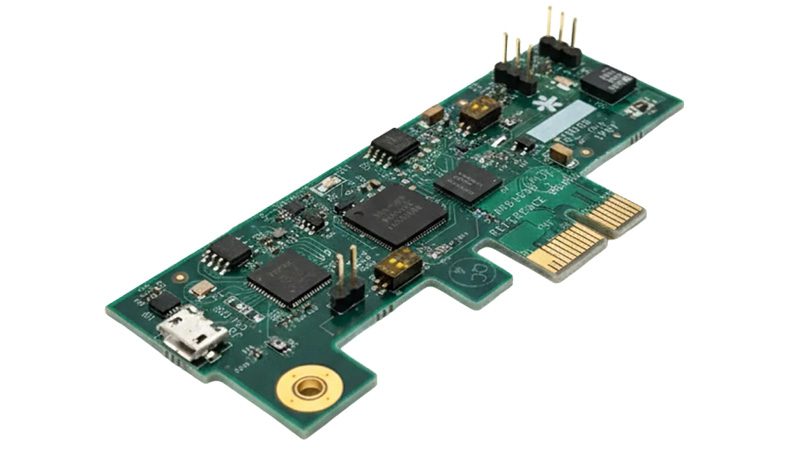
BrainChip AKD1500 PCIe development card with PCIe 2.0 x1 interface
It uses the same AKD1500 neuromorphic processor and supports on-device inference and adaptive learning. This makes it suitable for evaluating neural network models on existing PCs before moving them to smaller embedded hardware. Applications include predictive maintenance, smart surveillance, healthcare sensing, and other edge AI workloads.
BrainBoard 1500 SPI Module
The BrainBoard 1500, developed with Neuromorphyx, is a smaller alternative for microcontroller-based applications. It measures 22.86 × 22.86 mm and uses an Arduino Nicla-compatible footprint, so it connects to supported development boards such as the Arduino Nicla Vision and Nicla Sense ME.
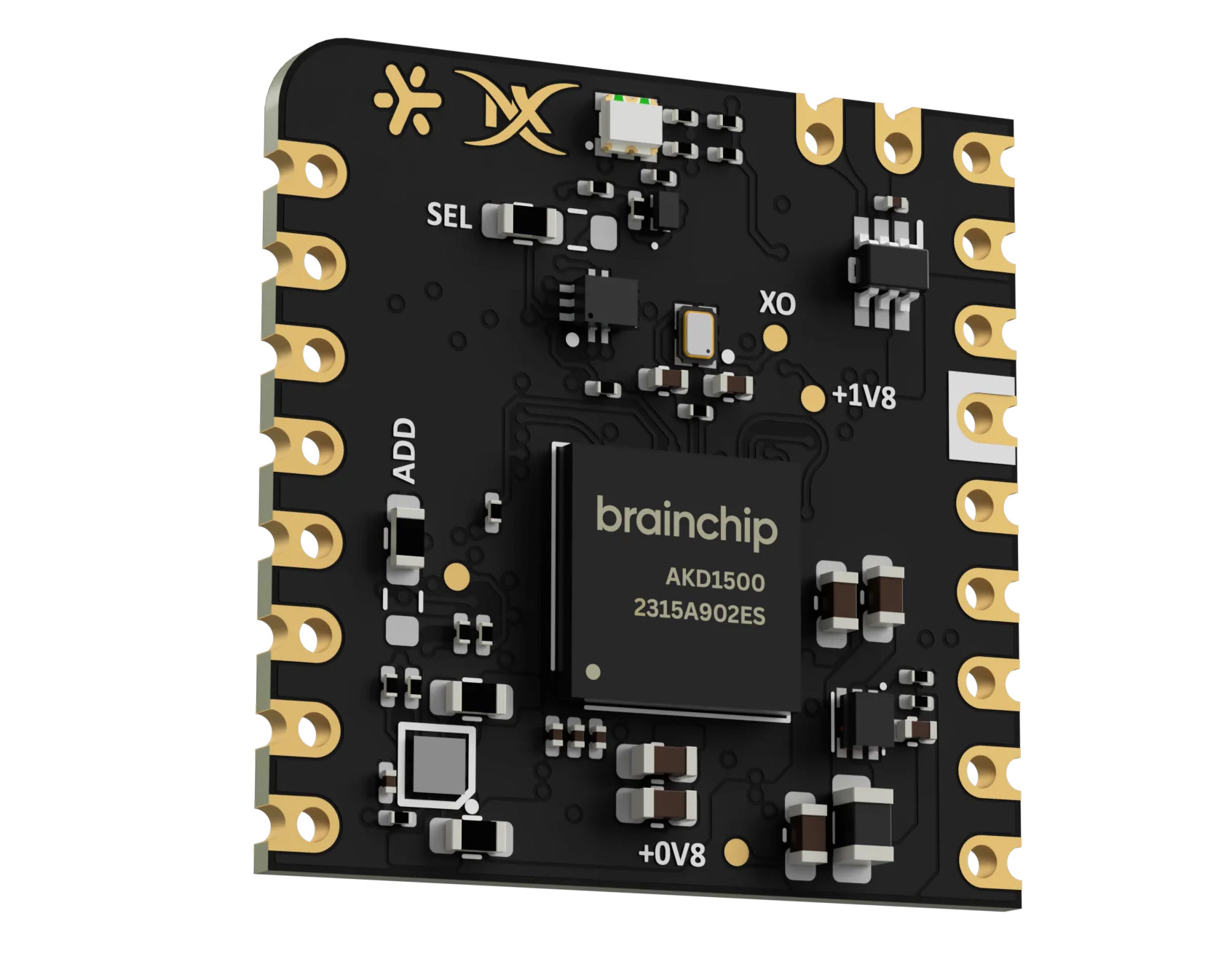
BrainBoard 1500 SPI module with AKD1500 neuromorphic AI co-processor
The module supports SPI/QSPI host communication, with an I2C interface for configuration and control. It includes 4 MB of flash memory for storing Akida-compatible models, with an 8 MB option available on request. A two-channel power monitor allows developers to measure power consumption during inference, while its 3.0 V to 5 V supply range makes it suitable for embedded and battery-powered designs.
The BrainBoard 1500 is designed for applications like audio recognition, sensor monitoring, image classification, and other low-power edge AI tasks where a full Linux system is unnecessary.
Software Support and Development Tools
The AKD1500 M.2 and PCIe cards support Linux-based development using BrainChip’s MetaTF software environment. MetaTF provides tools to develop, quantize, convert, and test neural network models created with TensorFlow, Keras, and PyTorch. It also includes pre-trained models and a software runtime for testing models before deploying them on Akida hardware.
The BrainBoard 1500 follows a different development workflow using an open-source Arduino library maintained by Neuromorphyx. The repository includes example sketches for the Arduino Nicla Vision, covering applications such as person detection, keyword spotting, model flashing, and on-chip learning. BrainChip’s GitHub repository includes Linux drivers and installation instructions.
Pricing and Availability
The AKD1500 M.2 development card is available for $129, while the PCIe development card costs $149. Both are listed as in stock on the official BrainChip store. The BrainBoard 1500 starts at $99 and is sold through Neuromorphyx.
More information, including product specifications, user guides, and software resources, is available on the BrainChip online store, the BrainChip Developer Hub, and the Neuromorphyx website.


