
CES 2026: Intel Debuts Wildcat Lake Core Series 3 Processors with 40 TOPS AI
Intel showed off "Wildcat Lake" Core Series 3 chips with 6 cores, Xe3 graphics and NPU 5 at CES 2026. This budget 18A (1.8 nm) processors offer 40 TOPS AI performance.

Images used courtesy of @PatrickMoorhead on X
Intel Wildcat Lake is a new low-power Core Series 3 processor family that can be considered as a successor to Alder Lake-N and Twin Lake, and is designed for budget laptops, Chromebooks, mini PCs, and entry-level embedded or SBC-like systems. First shown at CES 2026, the platform sits between ultra-low-cost “Intel Processor” parts and higher-end Core Ultra chips, with improved single-thread performance, better efficiency, and basic on-chip AI acceleration rather than gaming-class graphics.
The SoCs integrate a 6-core hybrid CPU with two “Cougar Cove” P-cores and four “Darkmont” low-power E-cores, along with Intel Xe3 graphics with two Xe-cores and no ray-tracing support. AI workload is handled via Intel’s NPU 5, where Intel mentions 40 TOPS AI power when combining CPU, GPU, and NPU performance. The platform supports single-channel DDR5 memory up to 6400 MT/s or LPDDR5X up to 7467 MT/s, and also includes six PCIe Gen4 lanes, and various I/O options such as Thunderbolt 4 ports, USB 3.2 and USB 2.0, along with Wi-Fi 7 and Bluetooth 6.0. Built on Intel’s 18A(1.8nm) process, it consumes almost 9 to 25 W of power and is designed for fanless or low-noise systems like compact desktops, education, and edge or embedded applications.
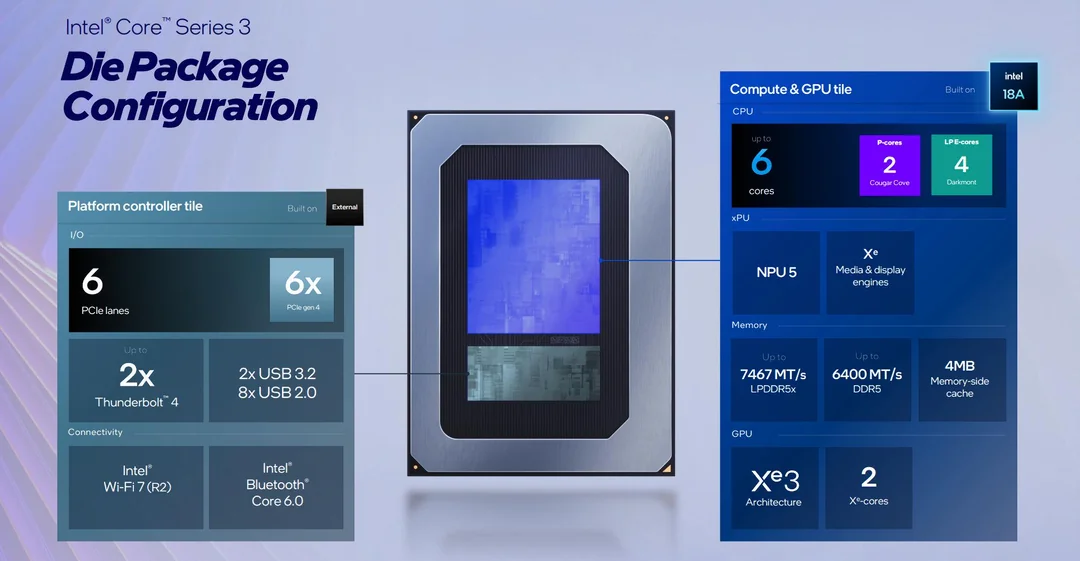
Images used courtesy of r/intel on Reddit
Core Series 3 “Wildcat Lake” Specifications:
- CPU: 6-core hybrid design
- 2× Cougar Cove P-cores (performance cores)
- 4× Darkmont low-power E-cores
- GPU: Intel Xe3 graphics with 2 Xe-cores
- No ray tracing, not intended for gaming
- AI Accelerator: Intel NPU 5
- Up to 40 TOPS combined CPU + GPU + NPU performance
- Memory:
- Single-channel DDR5 up to 6400 MT/s
- Single-channel LPDDR5X up to 7467 MT/s
- PCIe: Up to 6× PCIe Gen4 lanes
- USB:
- Up to 2× Thunderbolt 4
- 2× USB 3.2
- Up to 8× USB 2.0
- Wireless Connectivity:
- Intel Wi-Fi 7
- Intel Bluetooth 6.0
- Power: Approximately 9 W to 25 W (TDP/PBP, TBC)
- Process Technology: Intel 18A
Although Intel announced the Wildcat Lake family at CES 2026, it did so quietly, and posts on X suggest the processors are expected to launch sometime in 2026 rather than immediately. Some have questioned whether pricing will be truly low-cost, but Patrick Moore has commented on X that the platform appears to be cost-effective.
Users’ reactions to Intel Wildcat Lake are mixed but generally engaged. Some commentators, including Patrick Moorhead [Founder and Chief Analyst at Moor Insights & Strategy, and a former AMD executive known for his deep semiconductor industry analysis], believe the chip looks cost-effective based on its packaging and positioning. He sees it as a cost-optimized design that could compete with Apple’s rumored lower-cost Macs using smartphone-class processors.
Others highlight the very small die size and question details such as whether the design uses single-channel memory or how the chip’s tiles are organized. Several posts focus less on Wildcat Lake itself and more on Intel’s broader strategy, including GPU availability, future Celestial GPUs, and Intel’s advantage as the only company that both designs and manufactures its own chips. Overall, users see Wildcat Lake as an interesting, efficiency-focused platform, but many are still waiting for clearer pricing, memory configuration details, and product availability before getting too excited.
Thanks to Liliputing and CNX Software


