
E-Peas Introduces Energy-Harvesting PMIC for Indoor and Outdoor Environments
The new AEM15820 is a single-chip PMIC that extracts power from indoor and outdoor light sources, supporting hybrid photovoltaic cells in self-powered consumer and industrial designs.
The continuing demand for self-powered devices and extended battery life has driven innovation in ambient energy harvesting solutions. Addressing the challenge of widely varying light conditions, from dim indoor lighting to direct sunlight, E-peas has released the AEM15820, a power management IC (PMIC) optimized for hybrid photovoltaic cells. This single-chip solution is designed to efficiently manage the dynamic power range produced by such cells, spanning from microwatts under interior illumination to several watts outdoors.
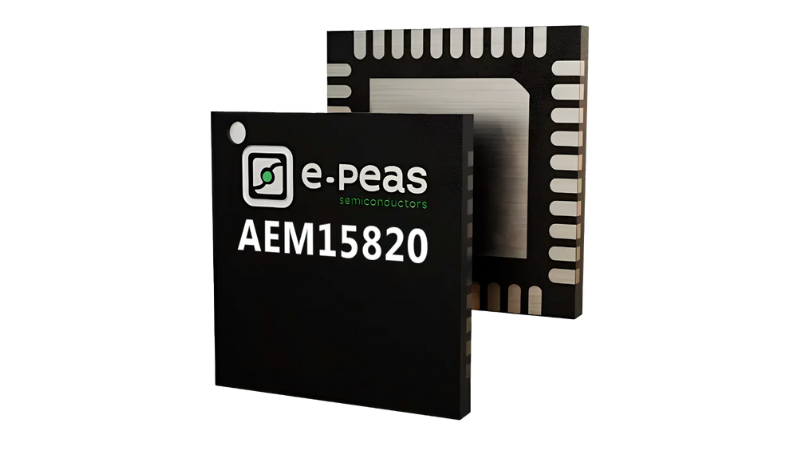
E-Peas’ AEM15820 PMIC comes in a 5 mm × 5 mm QFN40 package and extracts power from indoor and outdoor light sources. Image used courtesy of E-peas
Hybrid Architecture and Power Extraction
E-peas has built the AEM15820 PMIC around a high-efficiency hybrid boost converter architecture. This design automatically transitions between a low-power mode and a high-power mode to maintain maximum efficiency across the entire input power spectrum. Key specifications related to power extraction include an input voltage range of 300 mV to 4.34 V, supporting an input current up to 1 A. The device’s open circuit voltage capability extends up to 4.6 V. According to E-peas, the harvester source’s efficiency is up to 97%.
A critical feature for devices operating in power-starved environments is the ability to initiate operation from minimal stored energy. The AEM15820 achieves an ultra-low-power cold start threshold of 5 μW at 275 mV. Once operational, the PMIC supports either constant voltage regulation or maximum power point tracking source regulation to optimize power transfer from various PV harvesters.
For energy storage, the PMIC is compatible with various rechargeable chemistries, including lithium-ion, lithium-polymer, lithium-ceramic pouch, and lithium-ion capacitors, managing voltages between 2.4 V and 4.59 V. Additionally, the PMIC integrates a comprehensive protection suite, offering configurable thresholds for overcharge, overdischarge, and charge ready status, along with configurable thermal protection to monitor the storage element during charging and discharging cycles.

Functional block diagram of the AEM15820 PMIC. Image used courtesy of E-peas
Load Output and System Control
The PMIC’s regulated output for the application circuit is handled by a high-efficiency buck converter, reporting efficiency above 90%. This output is configurable between 0.6 V and 3.3 V and can supply up to 100 mA.
For system flexibility, configuration and monitoring are supported either through the GPIO pins or dynamically via an I²C interface. Additionally, the device includes an average power monitoring feature to measure energy transfer both to and from the storage element. The AEM15820 also includes a 5 V charger input with a configurable current limit up to 135 mA, providing an auxiliary charging option from a mains source. The device is delivered in a 5 mm x 5 mm QFN40 package.
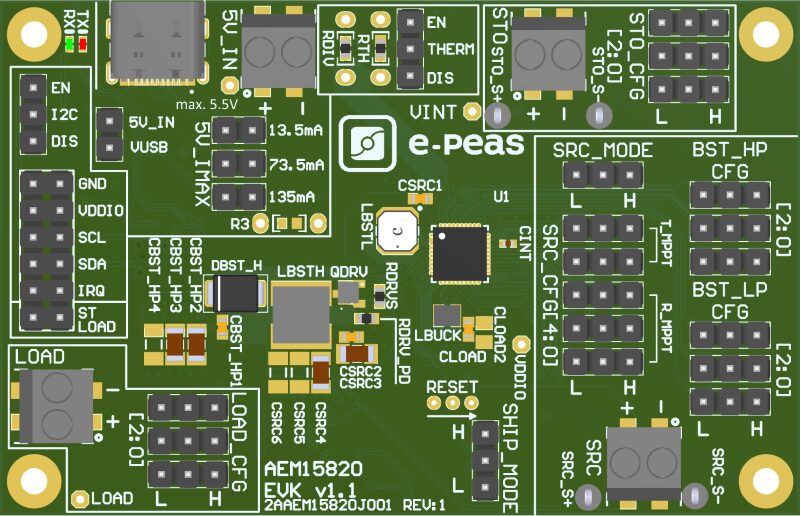
Users can start prototyping and developing for the AEM15820 with the PMIC’s compatible evaluation board. Image used courtesy of E-peas
High-Efficiency Power Management
E-peas’ AEM15820 PMIC offers a high-integration solution for energy harvesting systems that must operate reliably across highly variable light sources, enabling a continuous power supply and simplifying the design of power-independent electronics. By combining a wide-range hybrid boost converter with flexible storage management and an I²C interface, the PMIC enables system designers to maximize harvested energy for portable and remote applications.
Potential use cases span self-charging consumer devices like headphones and e-readers, as well as industrial and commercial systems such as remote security cameras, smart glasses, and specialized electronics for asset tracking.


