
ESP32-E22 Gets Wi-Fi 6E Certification and Linux Drivers
Espressif's new M.2 Radio Co-Processor has officially received certification from the Wi-Fi Alliance, accompanied by an initial release of open-source software support.
The ESP32-E22 was first introduced at CES 2026 back in January with a dual-core RISC-V processor clocked at up to 500 MHz, 1MB RAM, tri-band Wi-Fi 6E, and dual-mode Bluetooth 5.4 connectivity co-processor designed for host-based wireless systems. The company has now received a Wi-Fi CERTIFIED certificate for it, covering the 2.4 GHz, 5 GHz, and 6 GHz bands. Espressif has also released Linux drivers supporting Wi-Fi over PCIe and Bluetooth over USB.
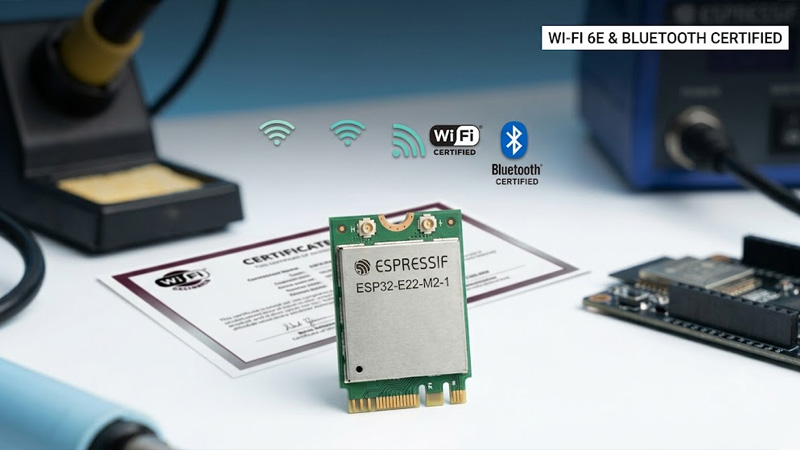
ESP32-E22-M2-1 module showcased with Wi-Fi 6E and Bluetooth certification highlights (Image generated with Gemini)
Tri-Band Wi-Fi 6E Connectivity
The ESP32-E22 features a dual-core 32-bit RISC-V processor clocked at up to 500 MHz, 1 MB of RAM, and 41 GPIOs. It is designed as a radio co-processor (RCP), handling Wi-Fi and Bluetooth processing for a separate host processor.
The Wi-Fi subsystem supports 802.11ax across the 2.4 GHz, 5 GHz, and 6 GHz bands, with up to 160 MHz channel bandwidth, 2×2 MU-MIMO, beamforming, and 1024-QAM. It supports data rates of up to 2.4 Gbps.
The Wi-Fi certification covers Station mode with 2×2 MIMO, supporting up to 40 MHz channels at 2.4 GHz and 160 MHz at 5 GHz and 6 GHz. It also covers WPA/WPA3 security, WMM, and Wi-Fi Agile Multiband. Access Point mode is planned.
Bluetooth and Host Interfaces
Alongside Wi-Fi 6E, the ESP32-E22 supports Bluetooth Classic and Bluetooth Low Energy 5.4. The RCP architecture allows the wireless functions to be handled independently from the host processor, which can simplify integration into Linux-based computers, gateways, networking equipment, and other connected systems.
For host connectivity, the device supports PCIe 2.0 and SDIO interfaces for Wi-Fi, while Bluetooth can communicate over USB or UART. Espressif’s ESP32-E22-M2-1 module puts the SoC in an M.2 form factor, making it suitable for systems that require a compact wireless expansion module.
Open-Source Linux Driver
The company has also released Linux drivers for the ESP32-E22. The current drivers support Wi-Fi Station mode over PCIe and Bluetooth BR/EDR and BLE over USB.
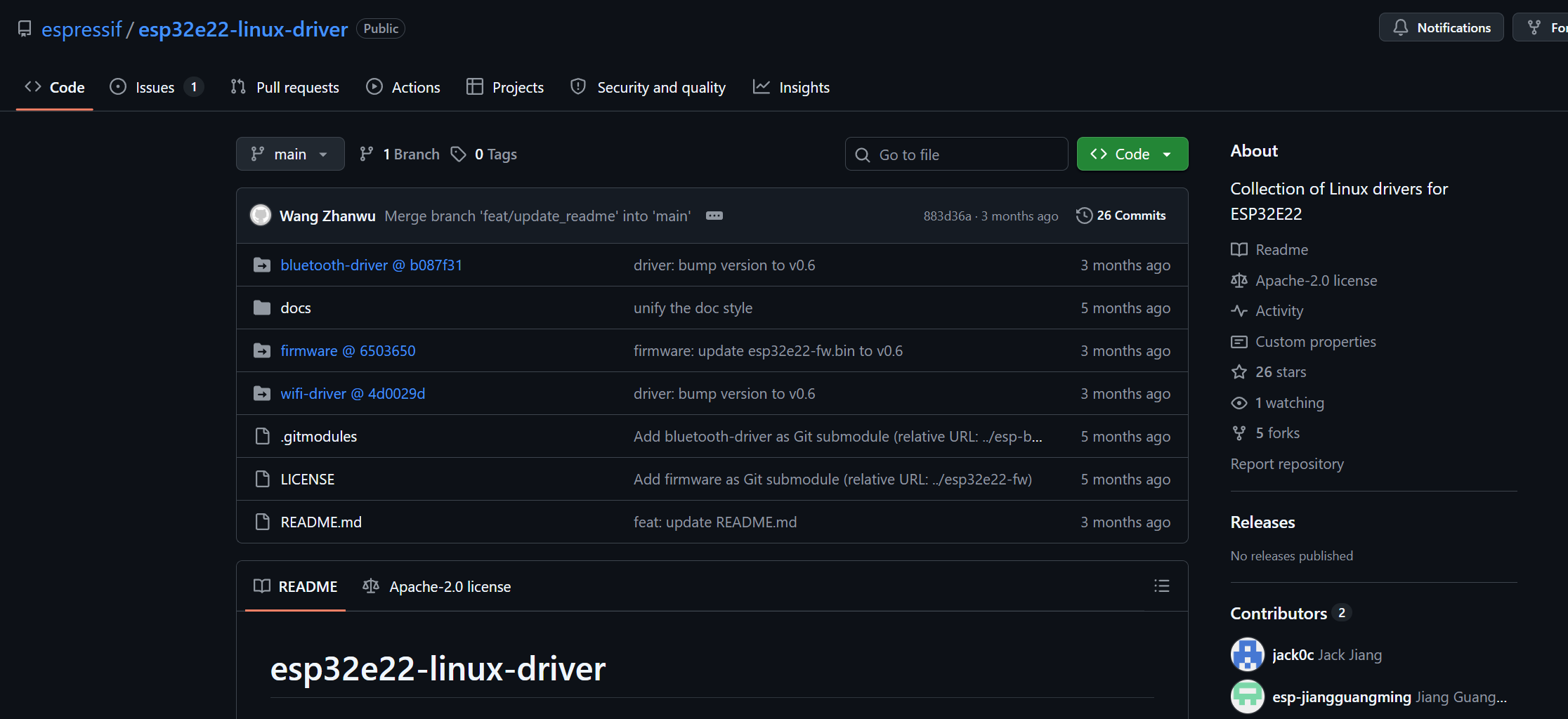
ESP32-E22 Linux driver on GitHub, featuring Wi-Fi, Bluetooth, and firmware components (Images used courtesy of Espressif GitHub)
The current driver status includes:
- Wi-Fi Station mode over PCIe – supported
- Wi-Fi Station mode over SDIO – not yet supported
- Wi-Fi Access Point mode over PCIe/SDIO – not yet supported
- Bluetooth BR/EDR and BLE over USB – supported
- Bluetooth over UART – not yet supported
- Firmware download over PCIe or USB – supported
- Secure firmware download – not yet supported
- Wi-Fi/Bluetooth coexistence – not yet supported
- Suspend/resume – not yet supported
At the time of writing, the driver supports Linux kernel 5.14 and later. Espressif also provides unified firmware for Linux and Windows, distributed as a binary. Additional interfaces and features are planned.
ESP32-E22 Applications
The ESP32-E22 is designed for smart-home hubs, wireless video systems, industrial edge devices, networking equipment, laptops, tablets, and AR/VR devices. Its PCIe interface and M.2 module support make it suitable for Linux-based systems that need Wi-Fi 6E and Bluetooth connectivity handled by a separate co-processor.
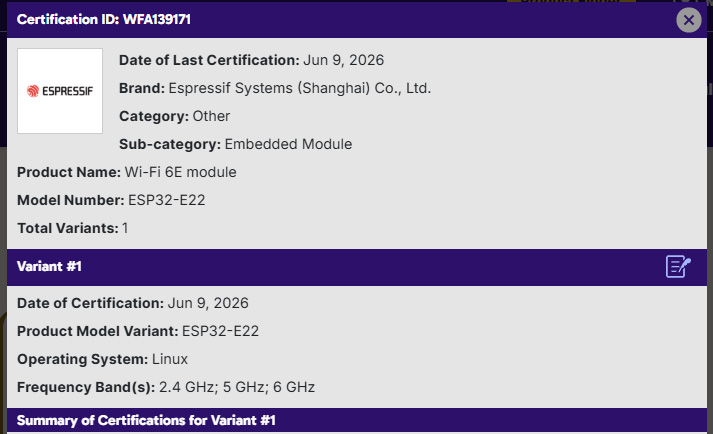
Wi-Fi Alliance certification for the ESP32-E22, covering Linux and 2.4, 5, and 6 GHz operation (Images used courtesy of wi-fi.org)
The ESP32-E22-M2-1 module measures 22 × 30 × 2.3 mm and includes an antenna connector. Espressif has not yet announced pricing or general retail availability for the ESP32-E22 SoC or ESP32-E22-M2-1 module. More information about the ESP32-E22 and its Linux driver is available on Espressif’s product page and GitHub.


