
Harwin’s Kontrol Connectors Improve PCB Retention Force
Harwin adds through-hole retention to its Kontrol connector series, delivering up to twice the PCB retention force and enhanced resistance to vibration for demanding industrial applications.
In industrial and embedded applications, the integrity of board-level connections is paramount. With devices facing increased vibration, shock, and thermal cycling, the mechanical reliability of connectors is just as critical as their electrical performance. Harwin has addressed these challenges by adding through-hole retention (THR) options to its Kontrol series of industrial connectors, a development aimed at providing engineers with a more robust solution for demanding environments.
Saving Space While Strengthening Board Connections
The new THR connectors are designed to improve the mechanical link between the connector and the printed circuit board. While surface mount technology is dominant for its assembly efficiency, through-hole components often offer superior mechanical strength, particularly in applications subject to high-stress conditions. The Kontrol THR series combines the benefits of through-hole retention with a compact 1.27mm pitch, a combination that is valuable for modern, space-constrained designs.
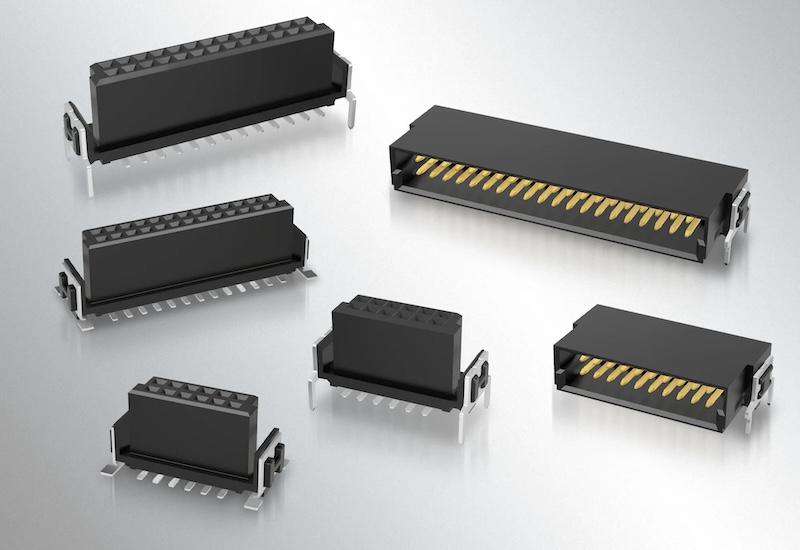
The Kontrol line offers 1.27mm pitch durable, fully shrouded connectors that can be used for a wide variety of industrial applications. Image used courtesy of Harwin.
According to testing conducted by Harwin, the through-hole retention feature can deliver up to twice the PCB retention force compared to typical surface-mount options. This significant increase in mechanical strength is crucial for preventing a connector from detaching from the board due to forces applied during mating/unmating, cable strain, or persistent mechanical stress from vibration. The connectors are rated for a vibration tolerance of 20G for up to 12 hours, a specification that demonstrates their suitability for harsh environments, such as those found in factory automation and off-highway vehicles.
Contact Configurations for Every Connection
Beyond the enhanced retention, the Kontrol THR connectors share the features of the existing Kontrol series. They are fully shrouded with recessed contacts to protect against physical damage, and they are polarized to ensure correct, error-free assembly, which is particularly useful for blind-mating applications. The series is available in a variety of pin layouts, ranging from 6+6 to 40+40, with both vertical and horizontal mounting options to accommodate different board configurations.
A full range of configurations allows for nearly any board design or configuration using the Kontrol line to be viable and reliable. Image used courtesy of Adobe Stock.
For engineers, the introduction of the Kontrol THR series provides a direct answer to a common design trade-off. The ability to use a small-pitch connector without sacrificing mechanical robustness means that designers can achieve high-density layouts while still meeting reliability requirements for challenging applications. The connectors’ compatibility with automated assembly processes ensures they can be integrated into high-volume manufacturing lines without a corresponding increase in production complexity.
Summary
The expanded Kontrol series, with its new through-hole retention options, reflects a trend in the industrial electronics sector: the integration of features previously reserved for high-reliability, niche products into more mainstream, cost-effective industrial lines. This approach allows engineers to build more resilient systems that can withstand harsh operating conditions without necessarily adopting the higher cost and complexity of aerospace-grade components. The result is more reliable equipment, improved uptime, and reduced maintenance costs in the field, all of which are critical considerations in industrial design.


