
Hirose Introduces FX31 Series Floating Board-to-Board Power Connectors
The new series of high-current board-to-board connectors offers high-vibration resistance and high-heat resistance for use in harsh applications, including automotive powertrains.
Hirose Electric Group has released the FX31 series, a new line of board-to-board power connectors engineered specifically for demanding automotive applications. The series is designed to address the dual engineering challenges of delivering high current while maintaining mechanical integrity under severe vibration. By integrating a floating contact structure with high-power handling capabilities, the FX31 aims to replace traditional busbar connections in automotive powertrain systems.
Addressing Vibration in High-Current Applications
In automotive power electronics, particularly within the powertrain, components are subjected to constant mechanical stress and thermal cycling. Traditionally, engineers have relied on busbars secured with screw fasteners to manage high currents in these environments. While robust, screw-fastened busbars impose limitations regarding assembly automation, weight, and board real estate.
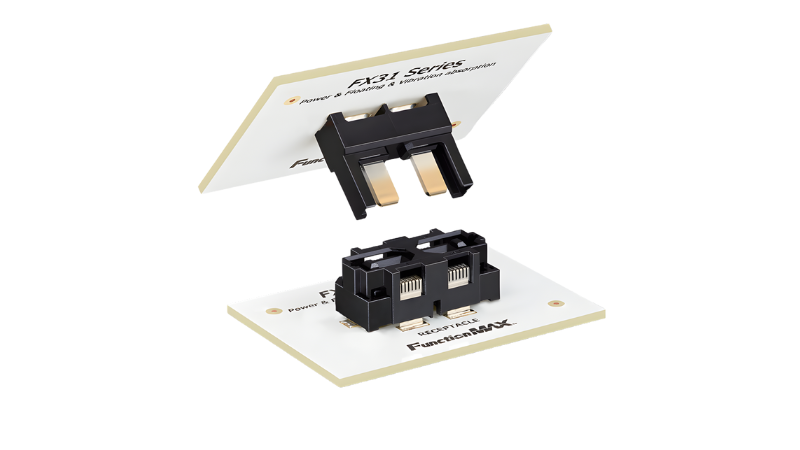
The FX31 series of board-to-board connectors features a floating contact design to help absorb board misalignment. Image used courtesy of Hirose Electric Group
The FX31 series of board-to-board connectors addresses these issues through a proprietary floating structure designed to absorb misalignment and vibration. The connector features a floating range of ±0.5 mm in both the x and y directions. Additionally, the connectors provide an effective mating length of ±1.5 mm in the z direction (the mating direction). This z-axis tolerance is particularly critical for absorbing the board movement and resonance that occur during vehicle operation, ensuring that the electrical connection remains stable even when the PCB undergoes displacement relative to the frame or mating connector.
One of the primary advantages of shifting from screw-fastened busbars to a board-to-board connector solution is the potential for manufacturing improvements. The FX31 eliminates the need for manual screw fastening, allowing for seamless integration into automated pick-and-place assembly lines. This reduction in manual labor can lead to decreased cycle times and lower production costs.
Electrical Specifications and Performance
The electrical characteristics of the FX31 series are tailored for modern high-voltage automotive architectures. The connectors are rated for AC/DC voltages up to 800 V. In terms of current handling, the standard rating is 25 A per pin. However, performance can be extended based on thermal design; depending on the ambient temperature and the width of the PCB traces used, the connector can support up to approximately 40 A per pin in a two-position configuration.
The FX31 series has an operating temperature of -40°C to 125°C for use in harsh environments. Video used courtesy of Hirose Electric Group
This current density enables the FX31 to serve as a viable alternative to bulkier interconnect methods. The contacts are gold-plated to ensure low contact resistance and long-term reliability, a necessity for maintaining efficiency in power transmission systems where resistive heating must be minimized. The series features an operating temperature range from -40°C to 125°C, covering the requirements for under-hood and powertrain applications.
Additionally, the connector uses a 9.5 mm contact pitch, providing sufficient electrical clearance for high-voltage operation, and includes a two-pin configuration with a mating height of 20 mm.
Demanding High-Current Applications
Overall, the FX31 series represents a shift in how power distribution is handled in high-vibration automotive environments. By combining a floating structure capable of absorbing up to ±1.5 mm of Z-axis movement with a high current capacity of up to 40 A, the connector offers a reliable alternative to rigid busbars.
Primary applications for the FX31 include electric and hybrid vehicle powertrains, motor inverters, DC-DC converters, and high-end in-vehicle infotainment systems where stable power delivery is critical despite constant mechanical stress.


