
PEAK Enters Automotive Ethernet with New Media Converter
HMS Networks' PEAK brand debuts its first Automotive Ethernet device, bridging 100/1000BASE-T1 with standard Ethernet for vehicle development and test workflows
HMS Networks has introduced its first Automotive Ethernet product under the PEAK brand: the PAE-Media Converter, a compact device that bridges single-pair Automotive Ethernet (100BASE-T1 or 1000BASE-T1) with conventional Ethernet infrastructure (100BASE-TX or 1000BASE-T). The release marks a deliberate expansion of PEAK’s IVN portfolio beyond its established CAN roots, targeting automotive engineers who need reliable interconnects between vehicle networks and standard lab equipment.
Fault Simulation and Dual-Connector Design
What distinguishes the PAE-Media Converter from a straightforward protocol bridge is its ability to control physical link interruption. Engineers can trigger a deliberate break in the Automotive Ethernet connection either via a button on the device itself or programmatically through an optional USB API without ever unplugging a cable. This enables reproducible fault injection in test scenarios, a particularly useful capability for validating how software-defined vehicle architectures respond to link failures.
The converter also integrates both H-MTD and MATEnet connector types in a single unit, covering the two dominant physical connection standards for Automotive Ethernet. Switching between them is handled in hardware, eliminating the need for separate adapters and reducing the physical overhead on a test bench. Speed selection, 100 Mbit/s or 1,000 Mbit/s, is set via onboard DIP switches, either statically or through the USB API when software-controlled automation is required.
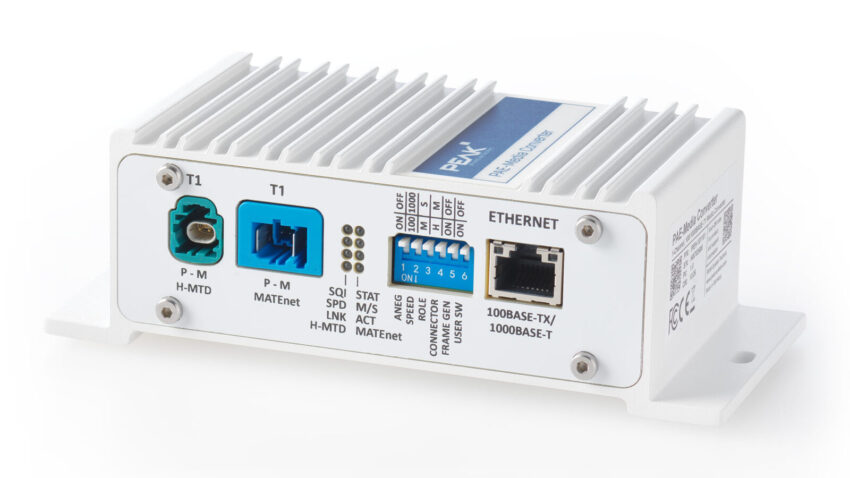
The PAE-Media Converter in its aluminum housing, showing the H-MTD and MATEnet connectors alongside LED status indicators. Image used courtesy of PEAK
Hardware Specifications and Integration
The device ships in an aluminum housing measuring 145 × 61 × 46 mm with IP20 protection and operates over an extended temperature range of −40 °C to +85 °C, making it well-suited to bench testing environments with wide thermal swings. Power arrives via USB-C at 5 V or through a Phoenix-style connector accepting 6 to 36 V DC, the latter making DIN rail integration straightforward with an optional adapter. An integrated frame generator supports link validation and wiring continuity checks, while a set of LED indicators surfaces link status, signal quality, and error conditions without requiring additional diagnostic software.
The device presents itself as transparent at the bit level, supporting both auto-negotiation and manual speed configuration. Because it drops directly into standard Ethernet infrastructure, existing analysis and logging tools connect without modification, which is an important practical consideration when teams are qualifying new vehicle ECU designs against known-good toolchains.
Applications and Outlook
The PAE-Media Converter is a well-timed addition for automotive electronics teams navigating the transition to software-defined vehicle architectures, where Automotive Ethernet is steadily displacing older bus technologies in high-bandwidth domains. Its combination of plug-and-play simplicity, scripted fault injection, and dual-connector flexibility makes it equally at home in ad hoc development setups and formal hardware-in-the-loop test benches. For labs already relying on PEAK hardware for CAN workflows, the converter is a natural complement—a single vendor spanning both sides of an increasingly hybrid IVN landscape. PEAK has indicated that more Automotive Ethernet products are in the pipeline, so this device appears to be the first foothold in what should be a growing product family.


