
Hybrid ReRAM-Spintronic Ising Machine Solves Optimization Problems
French researchers pair memristive memory with magnetic randomness to anneal hard combinatorial problems on a single chip.
Researchers at CEA-Leti, Spintec, and C2N/Université Paris-Saclay have unveiled a nanoelectronic system that pairs two very different device families to tackle combinatorial optimization, a class of computing problems that grows brutally difficult as the number of variables climbs. Detailed in Nature Communications, the work fuses hafnium-oxide resistive random-access memory (ReRAM)—a memristor technology that encodes information as a resistance value rather than a stored charge—with stochastic magnetic tunnel junctions (SMTJs), spintronic elements whose magnetic orientation flips unpredictably under ordinary thermal noise. Together, the two device types form what’s known as an Ising machine: hardware built to hunt through enormous solution spaces for the lowest-energy arrangement of interacting binary variables, a framing that maps cleanly onto problems like vehicle routing, grid balancing, and chip layout.
Coupling Memory and Magnetism
Conventional local-search hardware tends to lean on digital processors that ferry data between memory and logic at every step of a search, an arrangement that taxes both speed and power. The Grenoble and Paris-Saclay teams instead let the ReRAM crossbar encode the problem’s variable graph, while the SMTJs behave as probabilistic yes-or-no bits that jitter on their own. Because the two are wired into a shared loop, the system nudges itself toward better solutions without a separate digital controller micromanaging every update. One of the project’s co-principal investigators, Louis Hutin of CEA-Leti, likened the process to guiding a marble across a tilted, maze-like board: gravity pulls it toward a goal, but a bit of shaking is what frees it from dead ends, and in this hardware, that shake comes from the SMTJs’ natural fluctuations.
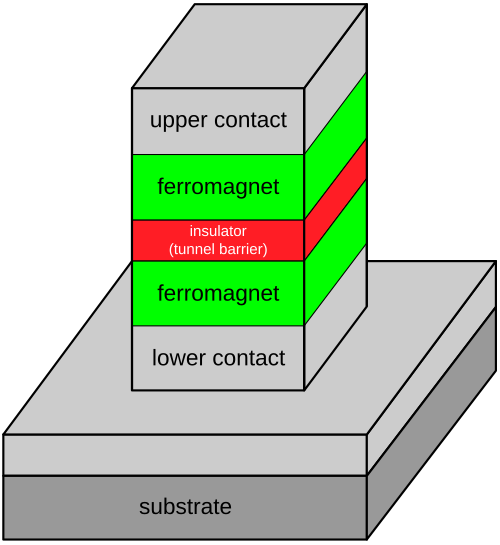
A magnetic tunnel junction pairs two magnetic layers around a thin insulating barrier, letting electron spin state — not just charge — carry information. Diagram: Fred the Oyster, Wikimedia Commons, CC BY-SA 4.0
Annealing Without a Heavy Control Loop
Getting an optimizer to explore broadly early on, then settle down later, usually calls for a mechanism separate from the search itself. Here, the team found that dialing the read voltage across the ReRAM array progressively damps the SMTJs’ randomness as the search matures, delivering that transition intrinsically rather than through added circuitry. Doctoral researchers Mohammed Akib Iftakher and Hugo Levices, the paper’s first authors, noted that reconciling two dissimilar device technologies within one controlled loop was the central engineering hurdle, and that demonstrating real graph-optimization benchmarks marked a meaningful step past isolated device-level results.
Benchmark Results and a Path Toward Speed
Running at room temperature with no applied magnetic field, the prototype reliably located the global optimum for a 24-vertex weighted MAX-CUT instance and a 10-vertex, three-color graph-coloring problem. Its updates currently proceed sequentially, but the authors point to nanosecond-scale device switching and the prospect of wiring the crossbar directly to the SMTJs—skipping analog-to-digital conversion entirely—as routes toward orders-of-magnitude speedups once the architecture is fully integrated. Damien Querlioz, another co-principal investigator, framed the achievement less as stacking two nanotechnologies together and more as letting them interact directly, steering the search without routing every update back through digital electronics.
Both device types are CMOS-compatible and can be built into back-end-of-line layers, which keeps the door open for the kind of 3D stacking that dense, scalable versions would need. Next on the roadmap: moving control electronics closer to the devices, testing larger problem instances, and benchmarking speed and energy use against conventional hardware. If those steps pan out, the approach could offer a genuinely different way to handle logistics routing, power-grid management, industrial scheduling, and the resource-allocation tasks that keep data centers and factory floors running efficiently.


