
Infineon Integrates TLVR Technology Into a Compact Quad-Phase Power Module
The new TDM24745T module features four power stages, a trans‑inductor voltage regulator inductor, and decoupling capacitors, delivering over 2 A/mm² current density in a compact package.
Power delivery in AI data centers is becoming one of the more demanding engineering problems in the industry. As GPU and AI accelerator silicon grows hungrier for current, the components that feed those rails need to deliver more amperes, respond faster to transient loads, and do so in a shrinking amount of board space. Infineon Technologies’ newly announced TDM24745T attempts to address these constraints in a single module.
TDM24745T OptiMOS Quad-Phase Power Module
The TDM24745T integrates four power stages, a trans‑inductor voltage regulator (TLVR) inductor, and decoupling capacitors into a compact 10 mm x 9 mm x 5 mm package. Squeezing all of that into a volume smaller than a postage stamp is notable in itself, but the headline spec is the resulting current density: the module delivers a current density exceeding 2 A/mm², which Infineon describes as industry-leading for this type of module.
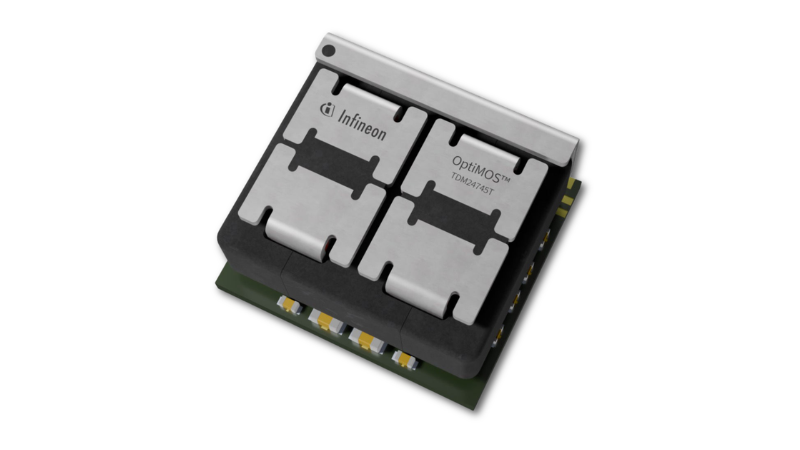
Infineon’s TDM24745T is a quad‑phase power module in a 10 mm x 9 mm x 5 mm package. Image used courtesy of Infineon Technologies
The module is built on OptiMOS-6 MOSFET technology, chip-embedded integration, and proprietary magnetics. The chip-embedded approach is key to achieving the density figures. Placing components directly into the substrate removes parasitic inductance and routing losses associated with discrete placements, which helps keep thermal performance manageable in tight server chassis environments.
What Is a Trans‑Inductor Voltage Regulator (TLVR)?
A TLVR is a topology that has been gaining traction in server power design over the past few years. The core idea is to magnetically couple the inductors across phases so that each phase responds more quickly to load transients than a conventional multiphase design would allow. That faster response matters because modern AI processors can draw large, rapid current steps when workloads change.
According to Infineon, the TLVR architecture enables faster transient response while reducing required output capacitance by up to 50%, simplifying system design. Fewer bulk capacitors on the board translates into recovered PCB area, which can be allocated to additional compute resources or thermal management.
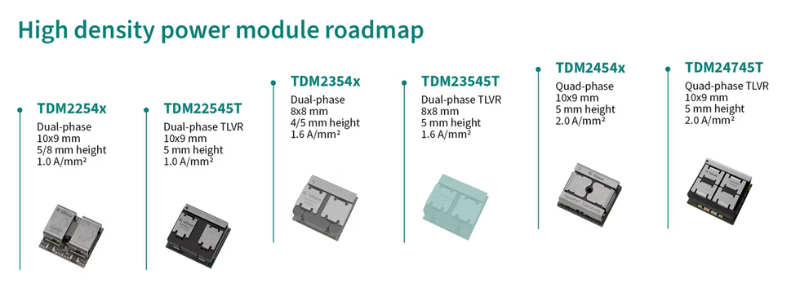
Infineon’s power module portfolio for vertical power delivery. Image used courtesy of Infineon Technologies
Infineon’s TDM24745T module supports high-current core rails required by advanced GPU and AI processors, in both lateral and vertical power-delivery configurations. Vertical power delivery, where the voltage regulator module sits directly beneath the processor package, is an increasingly popular approach in high-density server designs because it shortens the power path and reduces resistive losses.
AI Data Center Power Requirements
Combined with Infineon’s digital multiphase controllers, the module supports flexible, scalable architectures that accelerate system deployment in rapidly evolving AI environments. The TDM24745T offers up to 320 A of peak current, making it especially well-suited for next-generation AI processors and high-current multiprocessor platforms.
Infineon positions the module within a broader data center power chain. The TDM24745T power module integrates seamlessly into Infineon’s end-to-end AI server power-delivery ecosystem, spanning from the grid interface to the core processor rails.


