
Toshiba’s New LDO Regulator Series Improves Load Transient Response
The TCR5FM series of 35 LDO regulators designed for high-density mounting in battery-powered devices offers an 80% improvement in load transient response from standby compared to previous generations.
The stability of a DC power line is frequently challenged in modern portable electronics when a system transitions from a low-power standby state to high-speed processing. Toshiba Electronics’ new TCR5FM series of 35 LDO regulators address this issue by improving load transient response. Compared to the company’s existing TCR3RM series, the TCR5FM achieves an 80% reduction in response time when recovering from standby.
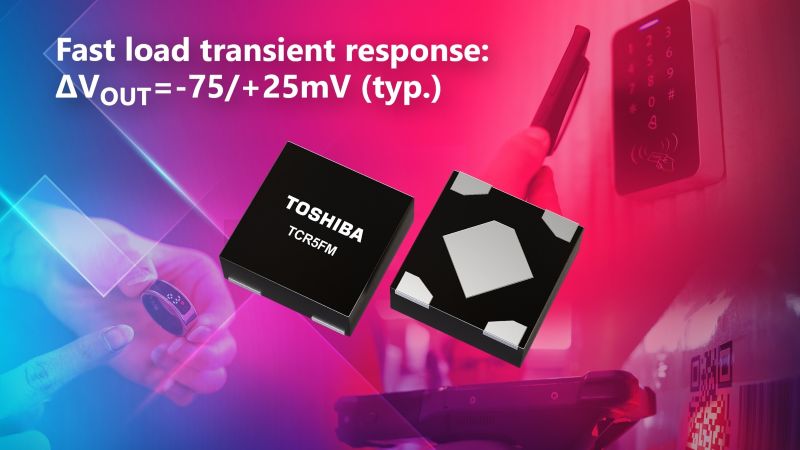
Toshiba’s TCR5FM series includes 35 LDO regulator models for battery-powered devices. Image used courtesy of Toshiba Electronics
TCR5FM Series LDO Regulators
The TCR5FM series LDO regulators’ performance gain is realized through a high-speed feedback mechanism that quickly detects output voltage fluctuations. By minimizing these variations during sudden load changes, the regulator ensures the power line remains stable for downstream components. The series supports up to a 500 mA output current and operates across a temperature range of -40°C to 125°C, making it suitable for both consumer and industrial-grade power management.
Noise Handling and Internal Circuitry
In addition to transient speed, the TCR5FM series is engineered for noise-sensitive rails, such as those powering CMOS sensors or high-frequency communication circuits. The devices feature a ripple rejection ratio of 91 dB (typical at 1 kHz, 2.8 V output). At higher frequencies, the rejection remains robust, with typical values of 89 dB at 10 kHz and 59dB at 1 MHz.
This noise suppression is achieved by integrating a bandgap circuit with a specialized low-pass filter and a high-speed, low-noise operational amplifier. This internal architecture results in a low output noise voltage of 5 μVrms (typical) over the 10 Hz to 100 kHz frequency range. Despite the high-speed internal circuitry, the series maintains a low quiescent current of 10 μA when the output current is zero, helping preserve battery life in portable devices.
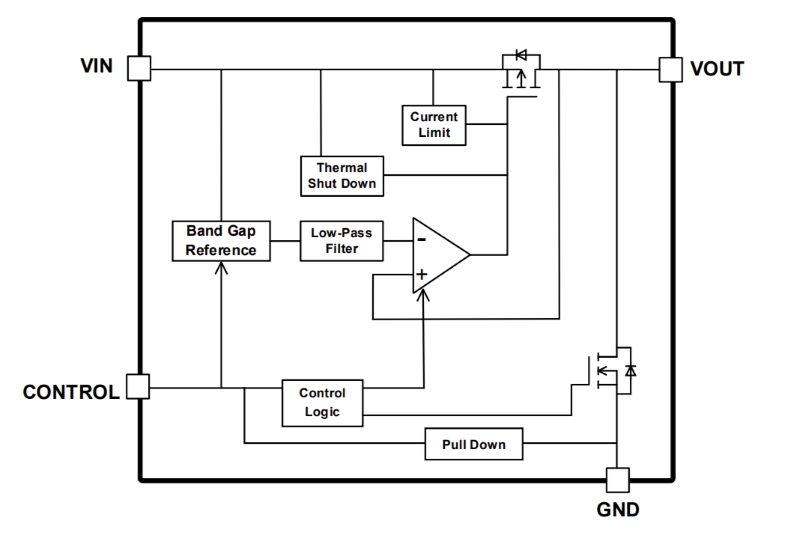
Block diagram of the TCR5FM series LDO regulators. Image used courtesy of Toshiba Electronics
Physical Characteristics and Protection Features
To meet the requirements of high-density PCB assembly, the TCR5FM series is housed in the DFN4D package. This plastic mold package measures 1.0 mm x 1.0 mm with a typical thickness of 0.37 mm. The regulators are stable with small 1.0 μF ceramic capacitors for both input and output, further reducing the total footprint on the board.
The series includes 35 individual products with fixed output voltages ranging from 0.9 V to 5.0 V. Integrated safety features include overcurrent protection, thermal shutdown, and an auto-discharge function that quickly pulls down the output voltage when the device is disabled. A slew rate control function is also included to suppress inrush current during start-up.
High-Performance Battery-Powered Devices
The TCR5FM series provides a solution for engineers balancing the needs of high-speed digital switching and analog precision. By combining fast transient recovery with high ripple rejection and a small physical footprint, these LDOs are designed to stabilize power lines in smartphones, wearables, and other battery-powered devices. Specific applications include power supplies for CMOS image sensors, high-frequency RF circuits, and the digital cores of mobile peripheral devices.


