
STMicroelectronics’ New Ultra-Wideband SoC Family Enhances Range and Power
The ST64UWB family supports the IEEE 802.15.4z and the upcoming IEEE 802.15.4ab standards, enabling next-generation ultra-wideband technology for automotive, consumer, and industrial applications.
STMicroelectronics has introduced the ST64UWB family, a set of three system-on-chip devices designed to extend ultra-wideband (UWB) technology into next-generation automotive access, smart home, and industrial applications. The chips support IEEE 802.15.4ab, the emerging successor to the 802.15.4z standard that underpins today’s hands-free digital car keys.
The family targets localization and tracking at distances up to several hundred meters, integrating an extended range with a high processing power to support secure digital access control, presence and motion sensing, and precise approach detection.
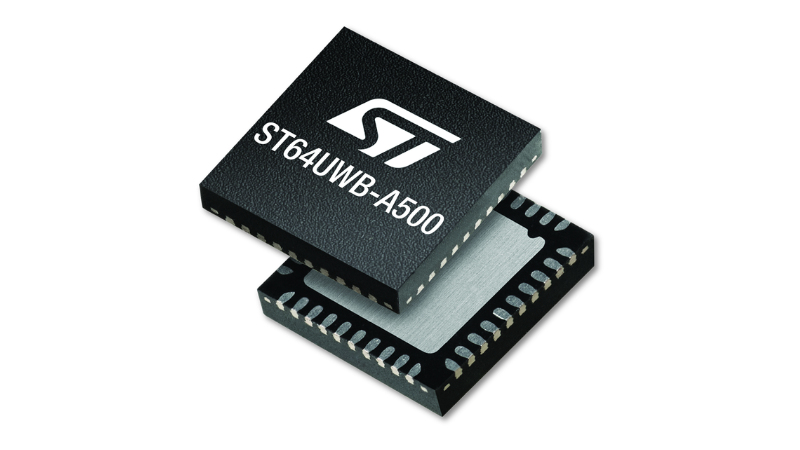
The ST64UWB family includes three SoCs: the ST64UWB-A100, ST64UWB-A500 (pictured above), and ST64UWB-C100. Image used courtesy of STMicroelectronics
What Is IEEE 802.15.4ab?
The original 802.15.4z standard enabled smartphones to act as car keys, unlocking a vehicle as the user approaches. The new 802.15.4ab specification builds on this foundation with two key enhancements: multi-millisecond ranging and narrowband assistance. Together, these features deliver more than eight times the range of 802.15.4z and significantly better non-line-of-sight performance, enabling key fob functionality to reliably work from a back pocket or inside a bag. Direction finding at close range is also improved, helping systems better interpret user intent.
Backward compatibility with 802.15.4z means existing deployments aren’t stranded. Automotive OEMs can either improve reliability using their existing reference points or reduce the number of anchor nodes to cut system cost, whichever approach suits their design.
The ST64UWB Family
All three variants of the new ST64UWB family, including the ST64UWB-A100, ST64UWB-A500, and ST64UWB-C100, are built on an 18 nm FD-SOI process. This process choice offers a direct RF benefit: it boosts the link budget by nearly 3 dB compared with standard bulk technologies, extending range by roughly 50% beyond the gains already delivered by the IEEE 802.15.4ab standard.
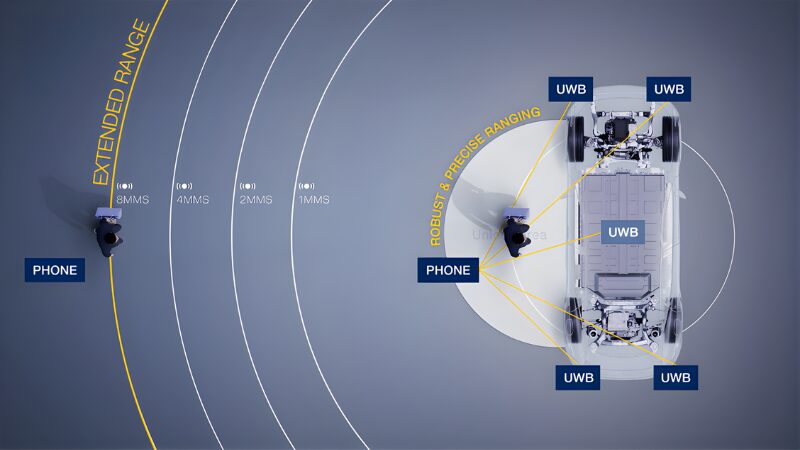
The ST64UWB family supports the upcoming IEEE 802.15.4ab UWB standard for multi-millisecond ranging with ultra-precise sensing. Image used courtesy of STMicroelectronics
The A-series is aimed at automotive applications. The ST64UWB-A100 runs an Arm Cortex-M85 core at 100 MHz and is intended for digital key and vehicle localization use cases, with ASIL A(B) automotive safety support.
The ST64UWB-A500 steps up to 256 MHz and adds a UWB-based radar function that leverages the Kaiser pulse shape and 1.3 GHz bandwidth of UWB channel 11, delivering roughly twice the spatial accuracy compared to traditional 500 MHz UWB channels.
The ST64UWB-C100, operating at 100 MHz, addresses consumer and industrial markets, including smart home and smart building access control.
Technical Specifications and Features
All three chips support UWB channels 5, 6, 8, 9, 10, and 12 (6.49 GHz to 8.99 GHz) with BPRF and HPRF modulation, plus dual transmit and receive antenna ports. Security features are consistent across the family: Arm TrustZone with Armv8.1-M extensions, a secure enclave, tamper detection, and PSA and SESIP Level 3 certification.
On the peripheral side, all devices include up to 20 GPIOs, SPI, I2C, USART, LPUART, and a general-purpose ADC. The C100 adds I3C interfaces, while the automotive variants add FDCAN. All three integrate with the Car Connectivity Consortium Digital Key, Intelligent Car Connectivity Industry Alliance, and Aliro Alliance standards.
A look at the ST64UWB family in action. Video used courtesy of STMicroelectronics
Next-Generation Ultra-Wideband
ABI Research expects the vast majority of UWB-equipped vehicles to migrate to 802.15.4ab by 2030, leveraging a rapidly growing installed base of hundreds of millions of compatible smartphones. Tier-1 automotive suppliers have already weighed in. LG Innotek noted that the eightfold improvement in range helps address obstructed-signal scenarios that have historically been problematic, such as phones left in a rear pocket.
Outside of automotive, smart lock company Nuki Home Solutions is working with ST to demonstrate how 802.15.4ab can bring hands-free UWB unlocking to the residential market via the Aliro standard. The ST64UWB devices are currently sampling with major OEMs and suppliers.


