
MediaTek Genio Edge AI SoCs: 5100, 420, 360 Platform Overview
From a 3nm 50+ TOPS flagship to cost-efficient AIoT chips, MediaTek expands Genio lineup for robotics, industrial IoT, and smart devices.
MediaTek Genio-360
Recently at the Embedded World 2026 in Nuremberg, MediaTek unveiled three new Genio IoT platforms, expanding its range from value-tier embedded devices to a new 3nm flagship aimed at industrial edge AI, autonomous robotics, and commercial drones. Together, the Genio Pro 5100, Genio 420, and Genio 360 push on-device generative AI acceleration all the way down the Genio stack, with the Pro 5100 being MediaTek’s most potent IoT SoC to date. While the Genio 420 and Genio 360 series offer 6 to 7.2 TOPS for cost-effective and value-tier edge AI deployments, the Genio 5100 Pro integrates Arm Cortex-X925, Cortex-X4, and Cortex-A720 cores with an 8th generation NPU delivering over 50 TOPS, supports up to 16 cameras, three 4K displays, and LPDDR5x memory up to 8533 Mbps.
MediaTek Genio Pro 5100 and Genio 420 IoT SoCs
Genio Pro 5100: Robotics and Edge AI’s 3 nm flagship
The Genio Pro 5100 is the first product in MediaTek’s new high-end Genio Pro series, which is based on TSMC’s 3 nm process. With one Cortex-X925, three Cortex-X4, and four Cortex-A720 cores, its octa-core CPU uses an all-big-core Arm v9.2 configuration to provide more than 260K DMIPS of compute. The graphics performance of an Arm Immortalis-G925 GPU is 3.1 TFLOPS. Up to 8533 Mbps of LPDDR5X memory is supported by the Genio Pro 5100. With interfaces like PCIe Gen4, USB 3.2 Gen2, USB 2.0, and dual 2.5GbE MAC, it can manage up to three 4K displays, up to 16 concurrent FHD30 inputs via virtual MIPI channels, and 8K30 video encode/decode across H.265 and H.264.
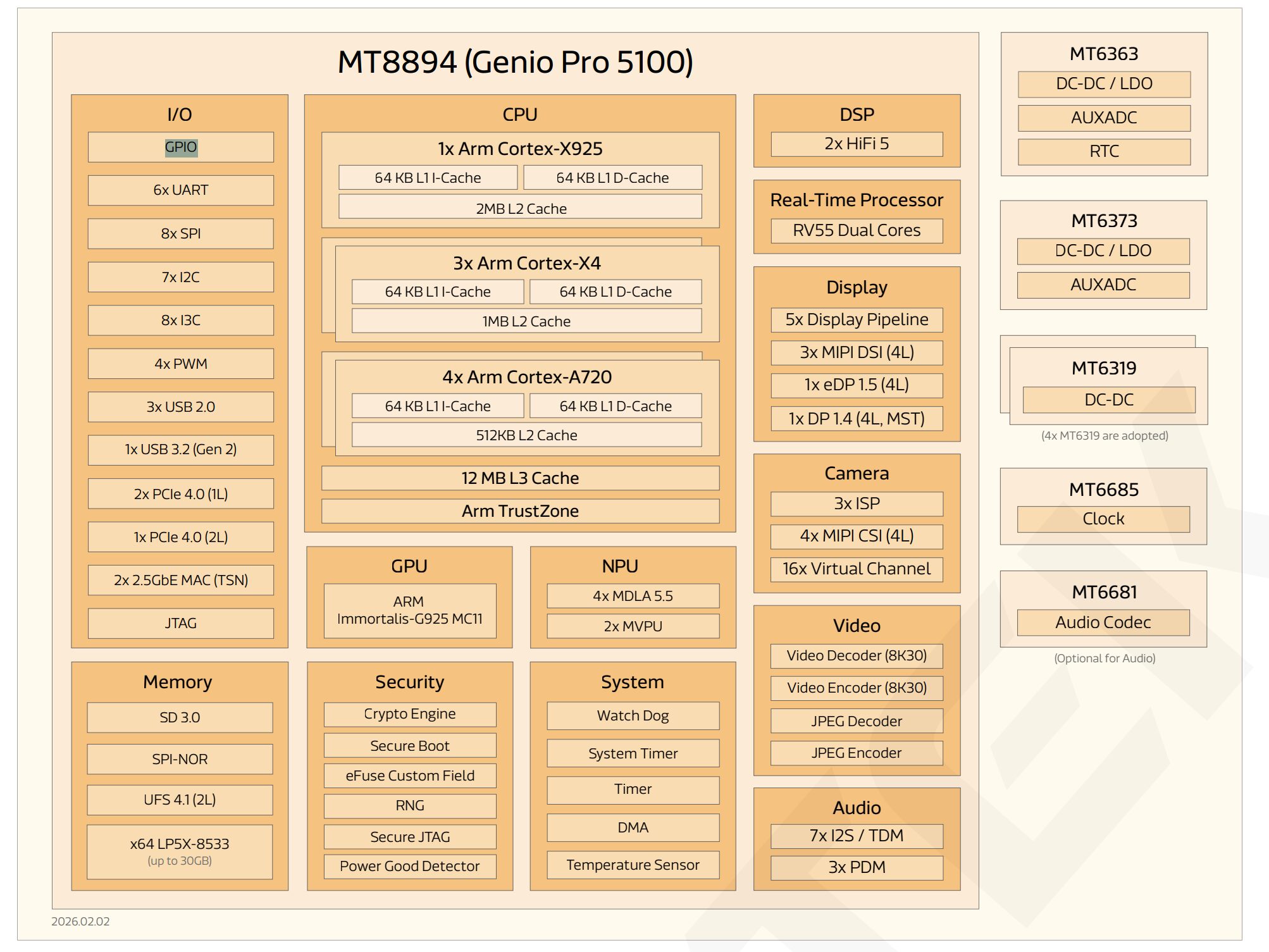
MediaTek Genio Pro 5100 MT8894 Block Diagram
Genio Pro 5100 (MT8894) Specifications:
- Processor:
- Octa-core Arm v9.2 CPU configuration:
- 1× Cortex-X925 core
- 3× Cortex-X4 cores
- 4× Cortex-A720 cores
- Dual-core RV55 real-time processor
- 12MB shared L3 cache with Arm TrustZone security support
- Octa-core Arm v9.2 CPU configuration:
- Graphics:
- Arm Immortalis-G925 MC11 GPU
- Supports OpenGL, Vulkan, and OpenCL APIs
- Video Processing Unit (VPU):
- Video encoding: H.264 and H.265 up to 8K @ 30fps
- Video decoding: H.264, H.265, AV1, and VP9 up to 8K @ 30fps
- JPEG performance:
- Encoding: dual engines at 400 MP/s each
- Decoding: up to 314 MP/s
- Imaging:
- Triple ISP capable of handling:
- 2× 4K @ 30fps streams
- Up to 8× Full HD @ 30fps cameras
- Triple ISP capable of handling:
- AI and Compute:
- MediaTek 8th-gen NPU architecture:
- 4× MDLA 5.5 + 2× MVPU cores
- Delivers up to 53 TOPS AI performance
- Optimized for Generative AI workloads
- MediaTek 8th-gen NPU architecture:
- DSP: 2× Cadence Tensilica HiFi 5 DSPs
- Memory and Storage:
- 64-bit LPDDR5x memory interface up to 8533 MT/s (max 30GB)
- Storage options:
- UFS 4.1 (2-lane)
- SD 3.0
- SPI-NOR flash
- Display:
- Interfaces:
- 4-lane eDP 1.5
- DisplayPort 1.4 with MST
- 3× 4-lane MIPI DSI
- Supports up to three 4K @ 60Hz displays simultaneously
- Interfaces:
- Camera Interfaces:
- 4× MIPI CSI inputs
- Supports up to 16× 1080p @ 30fps streams via virtual channels
- Audio:
- Interfaces:
- 7× I2S / TDM
- 3× PDM
- Audio processing via HiFi-5 DSP
- Interfaces:
- Networking:
- 2× 2.5Gb Ethernet MACs with TSN support
- Wi-Fi 7 and Bluetooth 5.4 via external module
- USB:
- 1× USB 3.2 Gen2 (dual-role, shared with DisplayPort)
- 1× USB 2.0 Host
- 2× USB 2.0 dual-role ports
- PCIe:
- 1× 2-lane PCIe 4.0
- 2× 1-lane PCIe 4.0
- Low-Speed Interfaces:
- 6× UART
- 7× I2C
- 8× I3C
- 8× SPI
- 4× PWM
- GPIO pins
- Security:
- Secure boot with RSA-4096
- Dedicated cryptographic engine
- Hardware random number generator
- Secure JTAG interface
- eFuse for customization
- Power-good detection
- Miscellaneous:
- Watchdog timer
- System and general-purpose timers
- DMA controller
- Integrated temperature sensor
- Physical and Environmental
- Package: ETFC TFBGA (15.9 × 16.6 mm, 0.35 mm pitch)
- Operating junction temperature: -40°C to 105°C (industrial grade)
- Manufacturing Process: Fabricated using TSMC 3nm process technology
The Genio Pro 5100 is compatible with a number of Linux distributions, such as Yocto, Debian, and Ubuntu, as well as the ROS 2 (Robot Operating System) framework for robotics development and Android (NDA required for documents). Additionally, it uses frameworks like PyTorch, ONNX Runtime, and TensorFlow Lite to support MediaTek’s NeuroPilot SDK for AI workloads. In the meantime, over 50 TOPS of system-level AI acceleration is provided by the eighth-generation MediaTek NPU. With Vision Language Model (VLM) support, this translates to up to 23 tokens per second on LLMs with up to 7B parameters for generative AI workloads.
MediaTek Genio 420: GenAI Down the Stack
With two Cortex-A78 and six Cortex-A55 cores, a Mali-G57 MC2 GPU, and up to 7.2 TOPS of AI acceleration, the Genio 420 octa-core Armv8 processor is constructed on a 6nm process. It supports up to 16GB of LPDDR5X memory. While LPDDR4X backward compatibility offers BOM cost flexibility, LPDDR5X support can handle up to 16GB at 6,400 Mbps. With pin-to-pin compatibility with the Genio 720 and Genio 520, display output supports dual 2.5K60 or a single 4K60 or ultrawide 5K60 panel, providing OEMs with a three-chip good-better-best stack on a single board design.
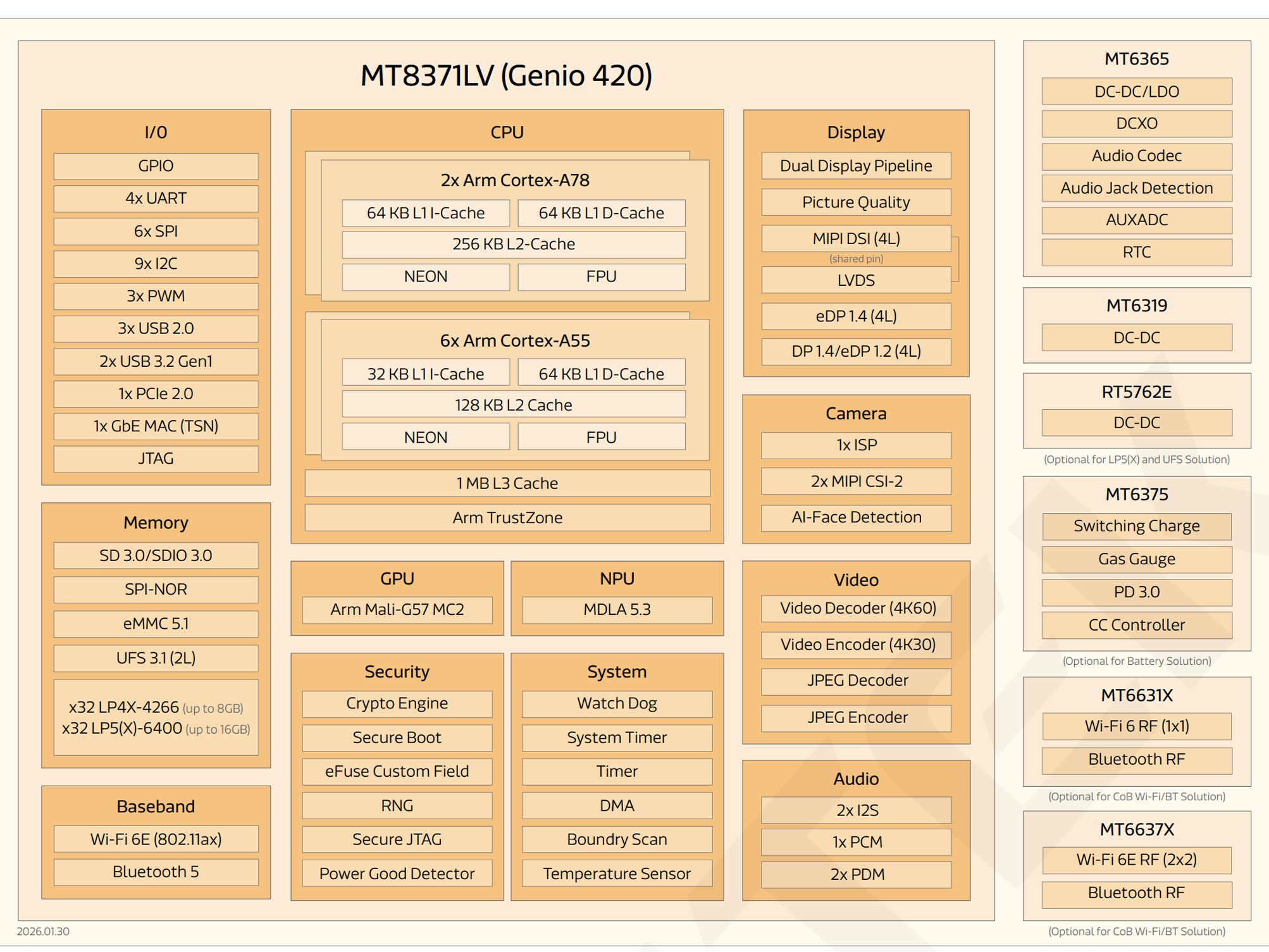
MediaTek Genio 420 MT8371LV Block Diagram
Genio 420 (MT8371LV) Specifications:
- Processor:
- Octa-core Armv8 CPU:
- 2× Cortex-A78 cores running at 1.8 GHz
- 6× Cortex-A55 cores running at 1.6 GHz
- 1MB shared L3 cache
- Integrated Arm TrustZone security
- Octa-core Armv8 CPU:
- Graphics:
- Arm Mali-G57 MC2 GPU
- Compatible with OpenGL, Vulkan, and OpenCL
- Video Engine (VPU):
- Encoding support: H.264 / H.265 up to 4K @ 30fps
- Decoding support:
- H.264 / H.265 / VP9 up to 4K @ 60fps
- MPEG4 / VP8 up to 1080p @ 60fps
- JPEG performance:
- Encoding up to 400 MP/s
- Decoding up to 250 MP/s
- Imaging: Single ISP supporting camera input up to 16MP at 30fps
- AI Processing:
- MediaTek 8th-generation MDLA 5.3 NPU
- Delivers 6.1 TOPS (up to 7.2 TOPS total system AI performance)
- Memory:
- LPDDR4X support up to 4266 MT/s (maximum 8GB)
- LPDDR5 / LPDDR5X support up to 6400 MT/s (maximum 16GB)
- Storage Options
- 2-lane UFS 3.1
- eMMC 5.1
- SD 3.0 / SDIO 3.0
- SPI-NOR flash
- Display:
- Supports:
- Single 4K @ 60Hz display
- Dual 2.5K @ 60Hz displays
- Ultra-wide 5K resolution
- Interfaces: eDP, DisplayPort, LVDS, and MIPI-DSI
- Dual display capability
- Supports:
- Camera Interfaces:
- 2× MIPI-CSI inputs
- Up to 6× 1080p @ 30fps streams using virtual channels
- Audio
- Input: 2× I2S, 1× PCM, 2× digital microphones (DMIC)
- Output: 2× I2S, 1× PCM
- Networking:
- Gigabit Ethernet MAC with TSN support
- Wireless connectivity (optional):
- Wi-Fi 6 (1×1) + Bluetooth 5.3 via MT6631X
- Wi-Fi 6E (2×2) + Bluetooth 5.3 via MT6637X
- USB Interfaces:
- 3× USB 2.0 host ports
- 1× USB 3.2 Gen1 host
- 1× USB 3.2 Gen1 dual-role (shared with DisplayPort)
- Expansion: 1× PCIe 2.0 (single lane, root complex, WoWLAN support)
- Low-Speed Interfaces:
- 4× UART
- 9× I2C
- 6× SPI
- 3× PWM
- GPIO and JTAG
- Security:
- Arm TrustZone
- Secure boot with RSA-4096
- Hardware crypto engine
- Random number generator
- eFuse for customization
- Secure JTAG
- Power-good detection
- Miscellaneous:
- Watchdog timer
- System and general-purpose timers
- DMA controller
- Boundary scan support
- On-chip temperature sensor
- Physical and Environmental:
- Package: VFBGA (13.8 × 11.8 mm, 0.4 mm pitch)
- Operating junction temperature: -20°C to 95°C
- Manufacturing Process: Fabricated using TSMC 6nm process technology
The Genio 420 uses MediaTek’s unified Genio software platform, which offers Android, Yocto Linux, and Ubuntu operating system support via official SDK and BSP. For AI development, NeuroPilot SDK offers support with TensorFlow Lite, PyTorch, and ONNX, and also offers optimized models from MediaTek’s Model Hub and NVIDIA TAO. With NVIDIA TAO and ONNX support, these AI models will run faster and smarter than ever before.
MediaTek Genio 360/360P
Designed for cost-conscious embedded applications, MediaTek Genio 360 and Genio 360P are hexa-core and octa-core Arm Cortex-A76/A55 AIoT processors with a MediaTek NPU that can achieve up to 8 TOPS of AI performance. Up to 8GB of memory and eMMC 5.1, SPI NOR, and SD 3.0 storage interfaces are supported by the chips. For single or dual display configurations, they have two 4-lane MIPI DSI and one 4-lane DP/eDP interface; two 4-lane MIPI CSI camera interfaces; audio inputs/outputs; Gigabit Ethernet with TSN; optional WiFi 5 and Bluetooth 5.3 via MT6631N; USB 3.1 and USB 2.0 interfaces; PCIe Gen2 x1; and low-speed interfaces. CAN-FD bus support is a noteworthy addition for industrial use. Both tiers support commercial and industrial temperature ranges and come with a 10-year supply guarantee.
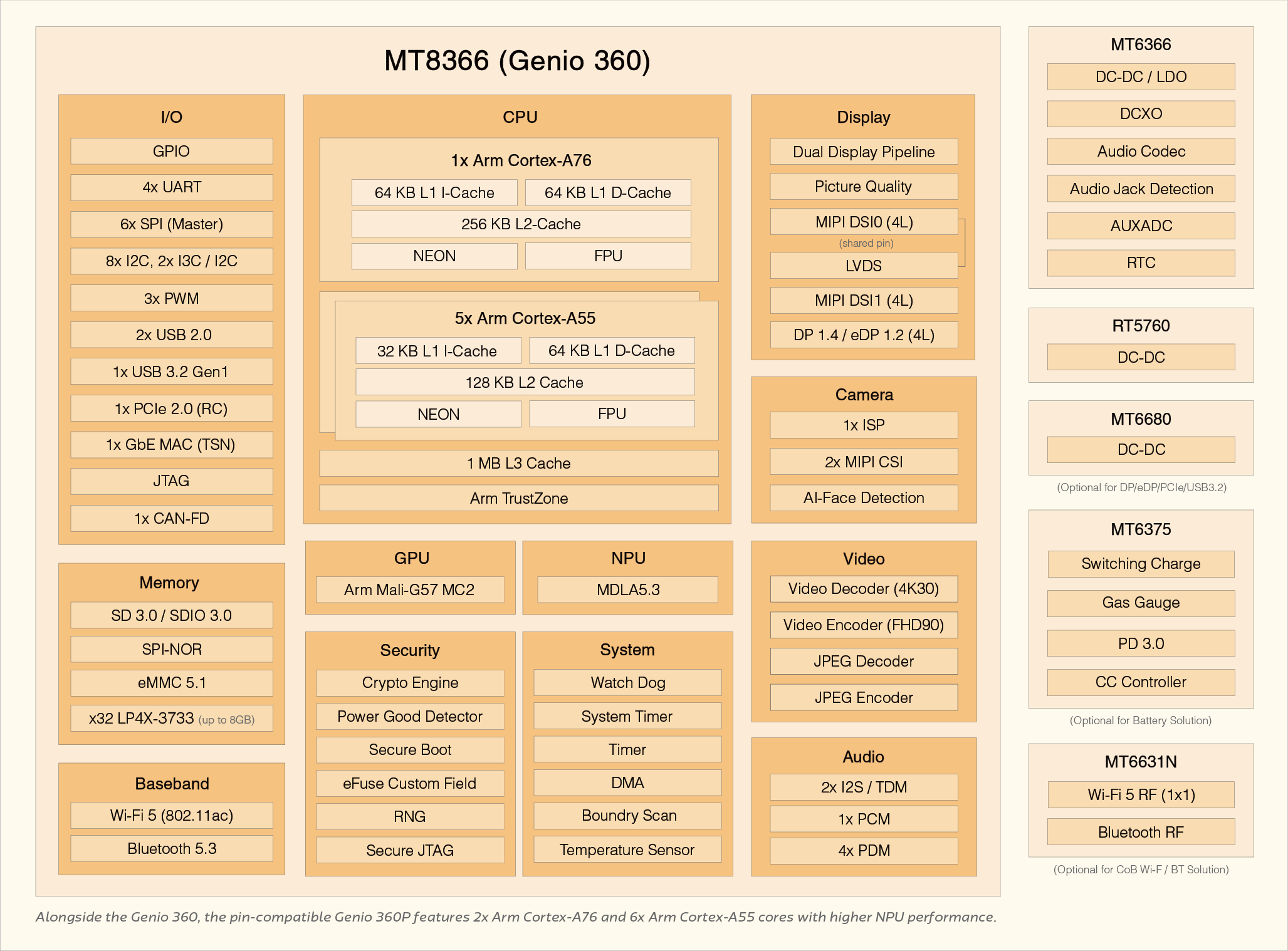
MediaTek Genio 360 MT8366 Block Diagram
MediaTek Genio 360 / Genio 360P Specifications:
- Processor:
- Genio 360 (MT8366):
- Hexa-core CPU configuration:
- 1× Arm Cortex-A76 core (up to 1.9 GHz industrial / 2.0 GHz commercial)
- 5× Arm Cortex-A55 cores (up to 1.7 GHz industrial / 2.0 GHz commercial)
- Hexa-core CPU configuration:
- Genio 360P (MT8367):
- Octa-core CPU configuration:
- 2× Arm Cortex-A76 cores (up to 1.9 GHz industrial / 2.0 GHz commercial)
- 6× Arm Cortex-A55 cores (up to 1.7 GHz industrial / 2.0 GHz commercial)
- Octa-core CPU configuration:
- Genio 360 (MT8366):
- Graphics:
- Arm Mali-G57 MC2 GPU clocked at 700 MHz
- Supports OpenGL ES 3.2, Vulkan 1.1, and OpenCL 2.0
- Video Processing Unit (VPU):
- Video decoding: H.264, H.265, and VP9 up to 4K @ 30fps
- Video encoding: H.264 and H.265 up to 1080p @ 90fps
- JPEG processing:
- Decode: up to 250 MP/s
- Encode: up to 400 MP/s
- Imaging:
- Integrated ISP with features such as 3A, noise reduction (NR), AI-based face detection (AI-FD), and lens shading correction (LSC)
- Supports a single camera up to 16MP @ 30fps
- AI Acceleration:
- MediaTek 8th-generation NPU (1× MDLA 5.3)
- AI performance:
- Up to 5.1 TOPS (Genio 360)
- Up to 7.4 TOPS (Genio 360P)
- Designed to support Generative AI workloads
- Memory: Up to 8GB LPDDR4X memory (32-bit) at up to 3733 MT/s
- Storage:
- Supports eMMC 5.1 flash
- SD 3.0 interface
- SPI NOR flash
- Display Interfaces:
- 1× 4-lane MIPI-DSI (2.5 Gbps/lane) or LVDS
- 1× additional 4-lane MIPI-DSI (2.5 Gbps/lane)
- 4-lane DisplayPort 1.4 / eDP 1.2
- Display configurations:
- Dual display: 1080p60 + 1080p30
- Single display: up to 4K @ 60fps
- Camera Interfaces:
- 2× 4-lane MIPI-CSI inputs
- Supports up to 6× 1080p @ 30fps streams via virtual channels
- Audio:
- 2× I2S/TDM inputs
- 2× I2S/TDM outputs
- 4× PDM inputs
- 1× PCM input/output
- Networking:
- Gigabit Ethernet MAC with TSN capability
- Optional wireless connectivity:
- Wi-Fi 5 (1×1) and Bluetooth 5.3 via MT6631N
- USB:
- 2× USB 2.0 host ports
- 1× USB 3.2 Gen1 host
- Expansion: 1× PCIe 2.0 (single lane, root complex, WoWLAN support)
- Low-Speed Interfaces:
- 4× UART
- 8× I2C + 2× I2C/I3C
- 6× SPI master
- 3× PWM
- 1× CAN-FD
- Security:
- Arm TrustZone technology
- Secure boot with RSA-4096
- Hardware crypto engine
- Random number generator (RNG)
- Physical and Environmental:
- Package: VFBGA (12.2 × 13.4 × 0.9 mm, 0.4 mm pitch)
- Temperature range:
- Consumer: -20°C to 95°C (Tj)
- Industrial: -40°C to 105°C (Tj)
- Manufacturing Process: Built on a 6nm process node by TSMC
For the Genio 360/360P SoCs, MediaTek will support Yocto Linux (Q3 2026), Ubuntu (Q4 2026), and Android (NDA required for documents). Cost-effective solutions for AI-enhanced IoT devices in education, business, healthcare, industrial settings, retail, and transportation are among the target applications.
The Genio Pro 5100 will begin sampling in Q1 2026 and go into mass production in Q3 2026, according to the company. Sampling for the Genio 420 will start in April 2026. Partners are currently sampling the Genio 360 series, which was previously announced. The press release and the Genio website have more information.
Images used courtesy of MediaTek


