
Renesas’ Second-Generation RA8 Series Pushes MCU Performance to 1 GHz
The new Arm Cortex-M85-powered RA8M2 and RA8D2 MCUs offer embedded MRAM for fast, high-endurance storage and dedicated DSP/ML acceleration, targeting high-performance IoT and HMI applications.
The boundary between microcontrollers and microprocessors continues to blur as embedded systems demand higher computational density at the edge. Traditional MCU roles in industrial control, HMI, and connected IoT devices now require capabilities previously reserved for MPUs, specifically in high-speed digital signal processing and machine learning inference.
Renesas Electronics Corporation has responded to this trend by adding two new groups to its RA8 series of MCUs: the RA8M2 and RA8D2. These devices are centered around the Arm Cortex-M85 processor, operating at a 1 Ghz frequency.
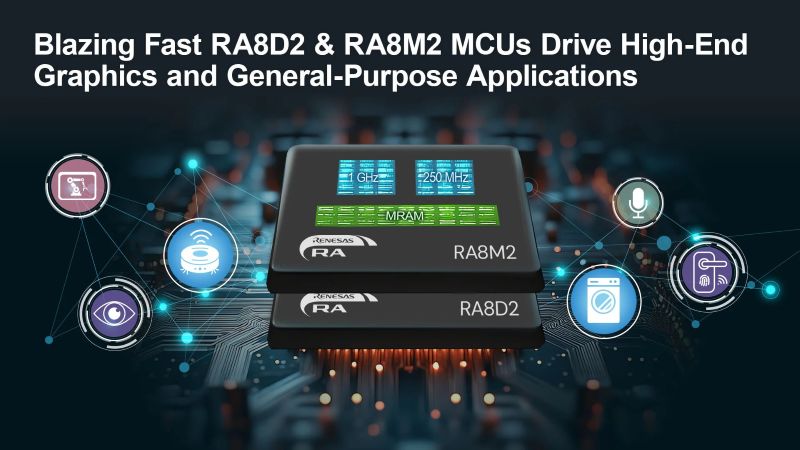
Renesas has ushered in the next-generation of its RA8 series MCUs with the RA8D2 and RA8M2 devices. Image used courtesy of Renesas Electronics Corporation
The RA8D2 and RA8M2 Ultra-High Performance MCUs
The primary draw of the new RA8 MCU groups is the raw performance delivered by the Cortex-M85 core. This core incorporates Arm’s Helium technology, the M-Profile Vector Extension, which accelerates DSP and ML workloads. Renesas states the RA8 MCUs deliver up to 7300 Coremarks, an industry benchmark indicating substantial compute capability for a microcontroller.
To optimize system efficiency and task segregation, the new groups offer dual-core options. In addition to the 1 GHz Cortex-M85, a lower-power 250 MHz Arm Cortex-M33 core is included. This architectural partitioning allows engineers to designate the Cortex-M33 as a “housekeeping” core to execute system tasks and manage low-level I/O. The high-performance Cortex-M85 can then remain in a low-power sleep state, waking only when the system demands high-compute tasks, thereby reducing overall system power consumption while maintaining rapid responsiveness.
The RA8M2 and RA8D2 MCUs are powered by the 1 GHz Arm Cortex-M85 processor. Video used courtesy of RenesasPresents
Embedded MRAM and Memory Architecture
A notable feature shared by both the RA8M2 and RA8D2 groups is the integration of embedded magnetoresistive RAM (MRAM). MRAM offers distinct advantages over traditional embedded flash memory, including faster write speeds, high endurance, byte addressability, and no erase cycle.
For applications with even greater memory requirements, Renesas offers System-in-Package (SiP) options that combine the MCU with either 4 MB or 8 MB of external flash memory in a single package.
The RA8D2 for High-End Graphics and HMIs
While the RA8M2 is built for general applications, the RA8D2 is specifically engineered for high-end graphics and human-machine interface (HMI) applications. Its peripheral set is extensive, including a high-resolution graphics LCD controller that supports displays with resolutions up to 1280×800. The device supports both traditional parallel RGB and the more modern, low pin-count 2-lane MIPI display serial interface.
To offload the CPU, the RA8D2 includes a two-dimensional drawing engine for accelerating graphics primitives. For vision applications, the MCU features both a 16-bit camera interface and a low-pin-count MIPI CSI-2 interface (2 lanes at up to 720 Mbps). A dedicated VIN module handles vertical/horizontal scaling, format, and color space conversions of incoming video data.
For networking in industrial environments, both the RA8M2 and RA8D2 MCUs incorporate Gigabit Ethernet interfaces and a 2-port time-sensitive networking (TSN) switch. The TSN capability is crucial for implementing deterministic, real-time communication required by Industry 4.0 applications, factory automation, and industrial Ethernet protocols.
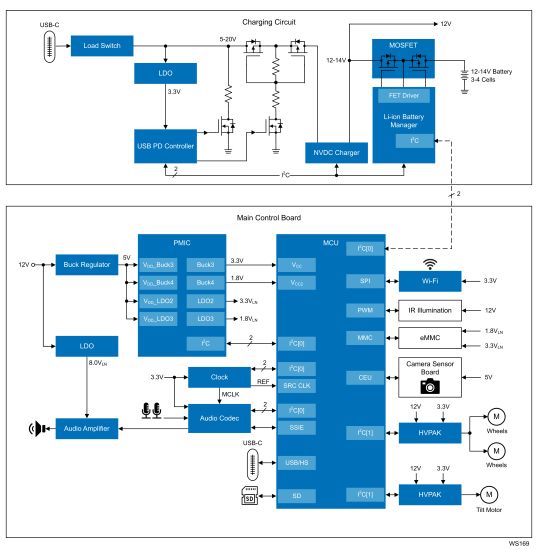
Block diagram of the RA8M2 in a mobile pet camera that offers live video, audio, and remote control. Image used courtesy of Renesas Electronics Corporation
Next-Generation MCUs
Renesas’ new RA8M2 and RA8D2 MCUs introduce a significant leap in performance for the Cortex-M ecosystem, pushing the operating frequency to 1 GHz and achieving 7300 Coremarks via the Arm Cortex-M85 with Helium. The strategic inclusion of an optional low-power Cortex-M33 core for system partitioning, high-endurance embedded MRAM, and a dedicated 2-port TSN switch underscores a design focus on deterministic, low-latency, and power-efficient operation.
The RA8M2 is targeted at general-purpose compute-intensive applications, while the RA8D2, with its rich set of camera interfaces, 2D graphics acceleration, and MIPI DSI/CSI-2 support, is specifically tailored for high-resolution industrial HMI, advanced control panels, and vision AI systems in industrial and IoT environments.


