
Microchip Debuts Disaggregated NVMe RAID Accelerator
The Adaptec SmartRAID 4300 series is a new family of NVMe RAID storage accelerators with disaggregated architecture, separating software and hardware for enhanced performance.
In the evolving landscape of data center and enterprise storage, the demand for higher-performance, lower-latency solutions is driving a shift away from traditional architectures. Microchip Technology’s new Adaptec SmartRAID 4300 series of NVMe RAID accelerators represents a significant departure from conventional RAID controller designs, introducing a disaggregated approach aimed at maximizing performance and scalability in modern computing environments.
Microchip Reimagines NVMe RAID with Disaggregated Architecture
The core innovation of the SmartRAID 4300 series is its separation of the storage software stack from the underlying hardware. Unlike traditional in-line RAID controllers that act as a bottleneck by routing all data traffic through a single PCIe interface, this new architecture leverages the host CPU and existing PCIe infrastructure for direct data paths. The Smart Storage software operates on the host CPU, allowing I/O writes to occur directly from the CPU to the NVMe endpoints at their full generational speeds.
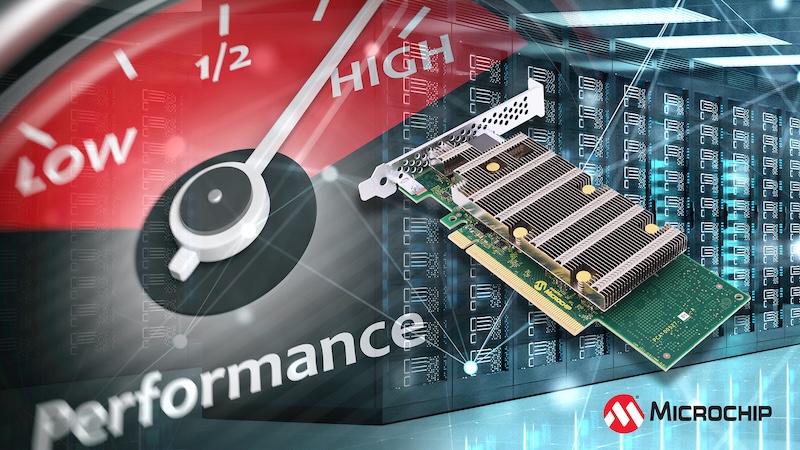
Splitting NVMe RAID into separate hardware and software components has increased I/O performance several times beyond older components. Image used courtesy of Microchip.
The accelerator card serves a specialized function: offloading parity-based redundancy calculations (XOR) from the host CPU. This division of labor addresses a critical performance bottleneck. By dedicating a separate hardware component to the compute-intensive task of RAID parity, the host CPU is freed to manage other operations. At the same time, the data path remains optimized for maximum throughput. Internal testing by Microchip reportedly shows an improvement of up to 7x in I/O performance compared to previous generations, a testament to the efficiency of this new architectural model.
From a hardware perspective, the SmartRAID 4300 series is based on Microchip’s SmartROC 3200 and SmartIOC 2200 families of PCIe storage controllers. The accelerators are designed to be a high-performance complement to Gen 4 and Gen 5 PCIe host CPUs, offering high levels of scalability. The architecture supports up to 32 CPU-attached x4 NVMe devices and 64 logical drives or RAID arrays. This scalable design is particularly well-suited for demanding workloads in modern AI data centers, where accelerating access to NVMe storage is paramount.
A Safe and Energy-saving Innovative Design
Security is also a key feature of the new series. The accelerators are engineered with a hardware root of trust, establishing a secure system foundation. Additional security features include secure boot and update capabilities, platform attestation, and support for Self-Encrypting Drives (SEDs). These features are crucial for maintaining end-to-end data integrity and meeting the stringent data protection requirements of enterprise-class systems.
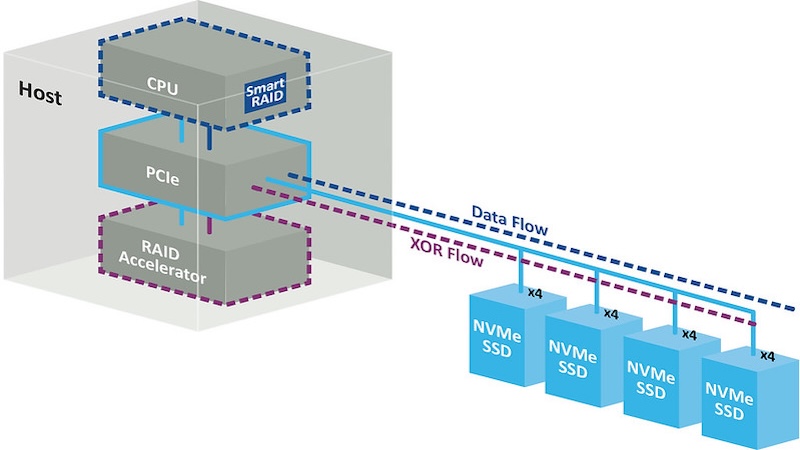
Block diagram highlighting the data flow for the SmartRAID 4300 line of NVMe RAID accelerators. Image used courtesy of Microchip.
Furthermore, the SmartRAID 4300 series integrates several management and power-saving features. Power efficiency is optimized through specific semiconductor design techniques, such as automatic idling of processor cores. For management, the accelerators are supported by a suite of host tools, including the Adaptec maxView web-based graphical user interface, the ARCCONF command-line interface, and plug-ins for popular management platforms. For out-of-band management, the series supports Distributed Management Task Force (DMTF) standards, including Platform-Level Data Model (PLDM) and Redfish Device Enablement (RDE) via the MCTP protocol.
Summary
The introduction of the Adaptec SmartRAID 4300 series signals a new strategic direction in NVMe RAID, one that prioritizes a modular and disaggregated approach to overcome the limitations of monolithic storage architectures. By separating the software and hardware components and offloading specific computational tasks, this new family of accelerators aims to deliver a scalable, flexible, and high-performance solution for the next generation of enterprise and data center storage.


