
Littelfuse’s Solid-State Relay Features Fast Switching in a Space-Saving Package
The CPC1056N relay delivers high input-to-output isolation and fast switching speeds for space-constrained applications, including medical devices, EV infrastructure, and consumer electronics.
Littelfuse’s introduction of the CPC1056N, a 60 V, 75 mA 1-Form-A solid-state relay (SSR), offers engineers an alternative solution for signal switching in power- and space-constrained environments. The device utilizes optically coupled MOSFET technology, employing Littelfuse’s proprietary OptoMOS architecture to integrate the control and switching elements.
The solid-state nature of the CPC1056N eliminates mechanical wear and audible noise, which are inherent characteristics of electromechanical relays. Furthermore, the SSR’s design avoids the generation of electromagnetic interference and radio frequency interference, making it suitable for sensitive analog or digital circuits. The relay provides 1500 VRMS input-to-output isolation, meeting basic galvanic isolation requirements necessary for sensitive systems. The SSR’s compact 4-pin SOP package also addresses board space limitations common in dense electronic designs.
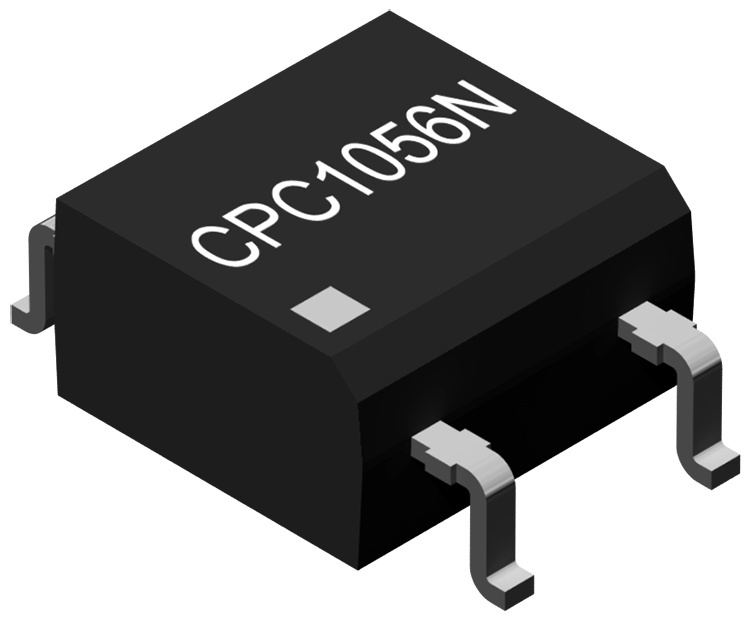
Littelfuse’s CPC1056N SSR comes in a small SOP-4 package for space-constrained designs. Image used courtesy of Littelfuse
The CPC1056N Normally Open Relay
A core technical specification of the CPC1056N 1-Form A SSR is its highly efficient input stage. The relay requires an ultra-low LED trigger current of only 0.5 mA to activate the switch. This low input current is a critical feature for designers utilizing microcontrollers or other low-power logic devices, as it allows for the direct connection and driving of the SSR using standard TTL or CMOS logic outputs without the need for supplementary buffer or driver circuitry. This simplification reduces component count, system complexity, and overall power consumption on the control side of the application circuit.
The control current drives an infrared LED, which optically couples to an integrated photovoltaic generator/driver. This driver controls the output stage, which consists of efficient MOSFET switches configured for bidirectional operation, allowing the relay to handle either AC or DC loads.
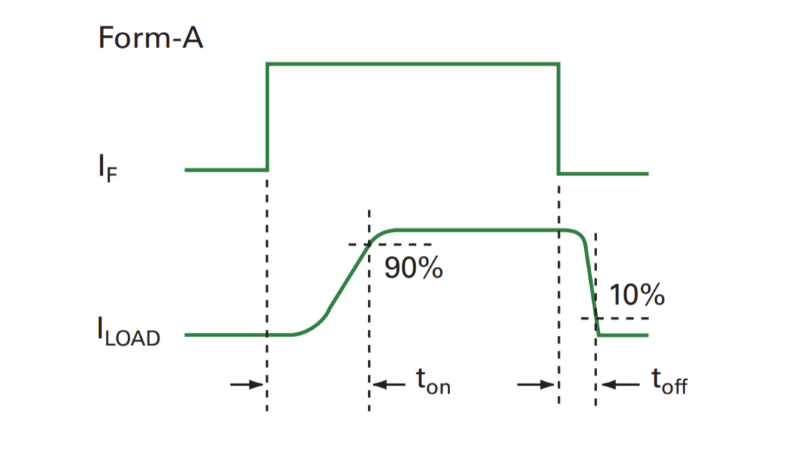
Switching characteristics of the CPC1056N 1-Form A SSR. Image used courtesy of Littelfuse
Output Stage Parameters and Switching Characteristics
The output stage parameters define the suitability of the CPC1056N for intermediate signal and low-voltage control circuits. The relay features a continuous load current rating of 75 mA and a blocking voltage of 60 V.
When in the closed state, the relay exhibits a maximum on-resistance of 10 Ω. This resistance specification, combined with the 75 mA load current, determines the power dissipation across the switch, a factor critical for thermal management in the application.
When in the open state, the relay maintains a low off-state leakage current of 1 μA, ensuring minimal current flow through the circuit when the switch is nominally open. Furthermore, the output capacitance is specified at 5 pF, which is a factor when considering signal integrity at higher data rates.
The CPC1056N is characterized by fast switching speeds, with turn-on time and turn-off time both rated at 3 ms. This rapid response time supports applications requiring swift signal routing with minimal latency.
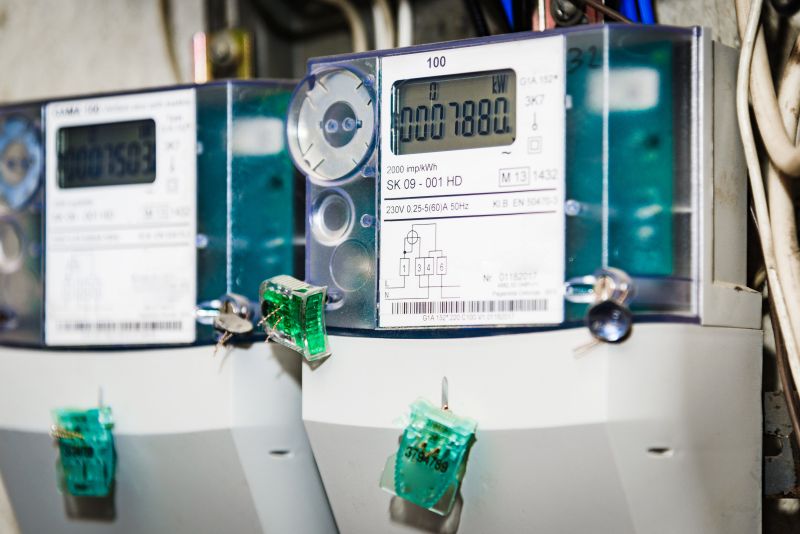
The CPC1056N is suitable for medical, industrial, and consumer electronics, including smart utility meters. Image used courtesy of Adobe Stock
Fast, Space-Saving Switching
The technical characteristics of the CPC1056N, specifically its low-power control requirements, high isolation voltage, and compact SOP-4 footprint, position it for use in several industrial and consumer market segments. Applications include data signaling and sensor control in security systems, such as PIR motion detectors, where low quiescent current is prioritized. In medical equipment, the isolation and low-noise operation support patient and equipment safety, while in industrial settings, the device can function as a multiplexer or be integrated into automated test equipment. The relay’s specifications are also relevant for signal switching and logic control within modern smart utility meters and EV charging infrastructure.


