
Artery AT32F406 & AT32F408 Cortex-M4F MCUs Features USB OTG PHY
These new 32-bit microcontrollers run up to 216 MHz and feature integrated DSP instructions, ample memory, and advanced I/O capabilities for IoT and industrial applications
Artery Technology has introduced the AT32F406 and AT32F408, two new mainstream MCU series based on an Arm Cortex-M4F core running at up to 216 MHz. The new MCUs are designed for embedded control, industrial automation, IoT devices, USB accessories, gaming peripherals, and other applications requiring real-time processing and multiple interfaces.
Both devices combine DSP instructions and a single-precision floating-point unit (FPU) with up to 512 KB of Flash and 192 KB of SRAM. They also provide QSPI for external Flash or RAM expansion, multiple SPI, I2C, USART, UART, and ADC interfaces, along with fast GPIOs and a wide range of timers.
The main difference between the two devices is USB connectivity. The AT32F408 adds a USB 2.0 OTG High-Speed controller with an integrated PHY and dedicated 4 KB FIFO, allowing high-speed USB operation without requiring an external PHY. The AT32F406 instead focuses on general-purpose embedded control and analog processing.
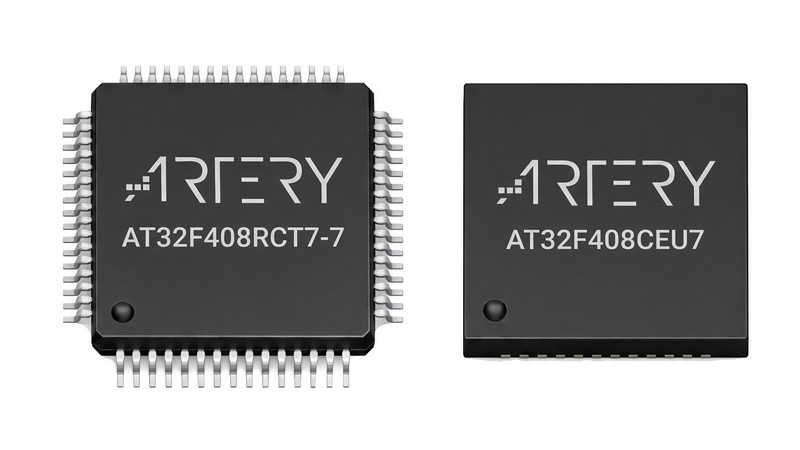
Artery AT32F408RCT7-7 (LQFP) and AT32F408CEU7 (QFN) microcontrollers
Artery AT32F406/AT32F408 Specifications:
- CPU Core:
- CPU: 32-bit Arm Cortex-M4F running at up to 216 MHz
- FPU: Hardware floating-point unit for faster mathematical operations
- MPU: Integrated Memory Protection Unit
- DSP: Supports DSP instructions for signal processing applications
- Memory & Storage:
- Flash: 256 KB to 512 KB
- SRAM: 128 KB to 192 KB
- Boot Memory: 26 KB, configurable as bootloader or general instruction/data memory
- OTP Memory: 4 KB one-time programmable memory
- External memory: QSPI interface for external SPI Flash or SPI RAM
- Peripherals and I/O:
- GPIO: Up to 57 fast GPIOs on the AT32F406 and 54 on the AT32F408
- GPIO Voltage Tolerance: Almost all GPIOs are 5V-tolerant
- USB: USB 2.0 OTG High-Speed controller with integrated PHY and dedicated 4 KB buffer on the AT32F408
- I2C: Up to 3 interfaces with SMBus and PMBus support
- SPI: Up to 8 interfaces with speeds up to 36 Mbit/s
- I2S: Multiplexed half-duplex I2S support
- USART: Up to 6 interfaces with LIN, IrDA, RS485 drive-enable, and ISO7816 support.
- UART: Up to 2 additional UART interfaces
- Analog:
- ADC: 3x 12-bit ADCs with sampling rates up to 5.33 MSPS
- ADC channels: Up to 16 external input channels
- ADC resolution: Configurable at 12-, 10-, 8-, or 6-bit
- Oversampling: Hardware oversampling up to 16-bit equivalent
- Temperature sensor: Integrated internal temperature sensor
- Reference: Internal reference voltage, with a dedicated VREF+ pin on the -7R LQFP64 variant
- EMUXC: External Multiplexer Controller for fast ADC scanning without CPU intervention
- Timers and Clock:
- Advanced Timer: 16-bit, 8-channel timer with complementary PWM outputs and dead-time generation
- General-purpose timers: Up to 7x 16-bit timers and 1x 32-bit timer
- Basic Timers: 2x 16-bit timers
- Watchdogs: 2x watchdog timers, including general-purpose and windowed types
- SysTick: 24-bit SysTick timer
- RTC: Enhanced RTC with auto-wakeup, subsecond accuracy, and hardware calendar
- Clock: 48 MHz High-speed Internal Clock (HICK)
- Other Features:
- DMA: 2x 7-channel DMA controllers
- Infrared: Integrated infrared transmitter
- CRC: Hardware CRC calculation unit
- Unique ID: 96-bit unique identification number
- Debugging: SWD and SWO interfaces
- Protection: Power-on reset, low-voltage reset, and power voltage monitoring
- Operating Voltage: 2.4 V to 3.6 V
- Operating Temperature: -40°C to +105°C
- Packages: LQFP64 (7 × 7 mm) and QFN48 (6 × 6 mm)
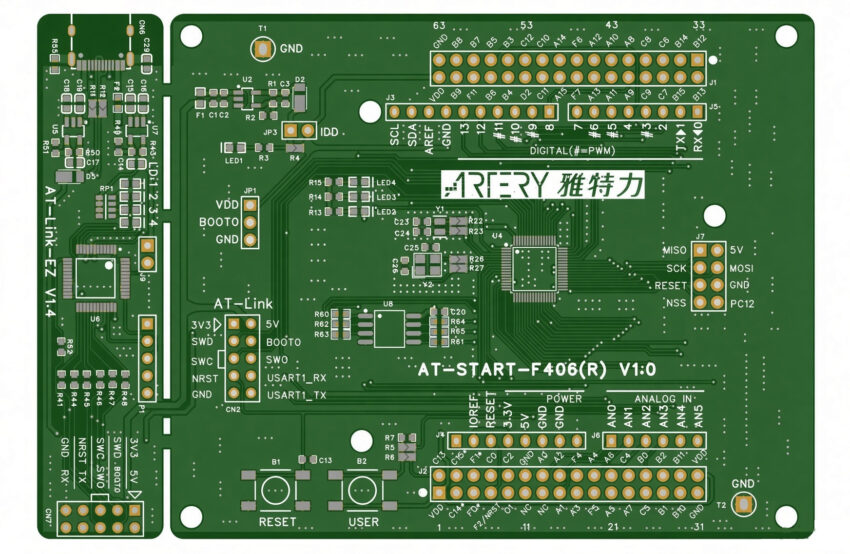
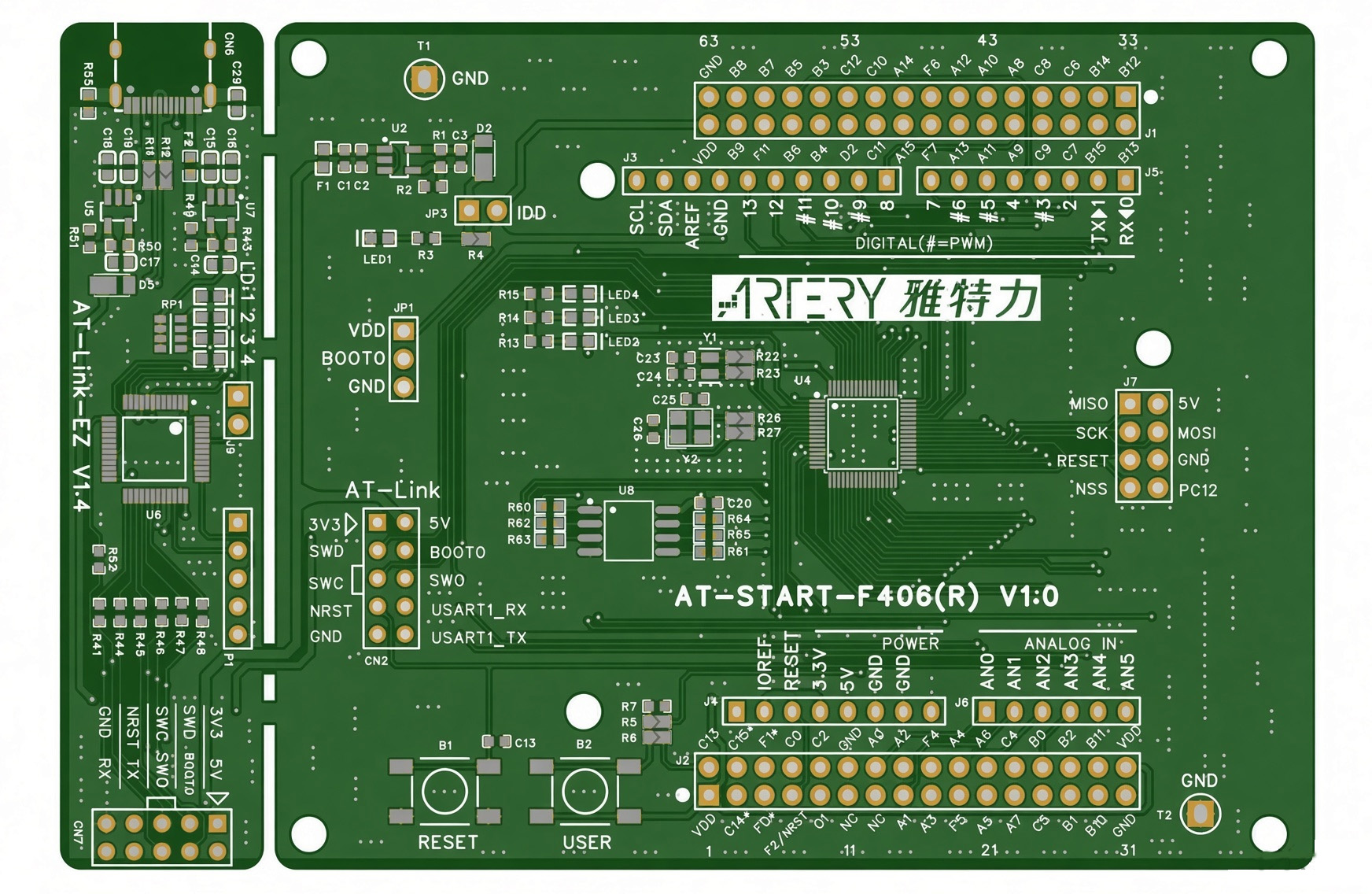
Artery AT-START-F406(R) evaluation board with AT-Link-EZ debugger.
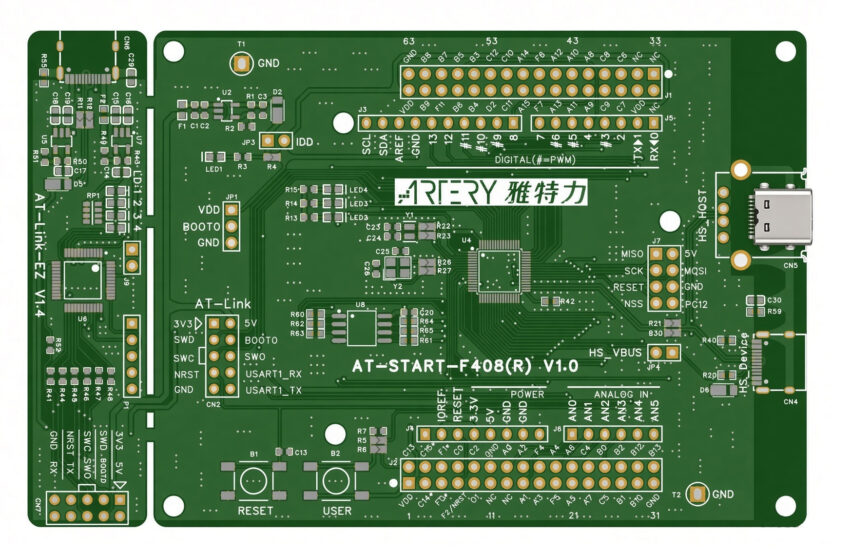
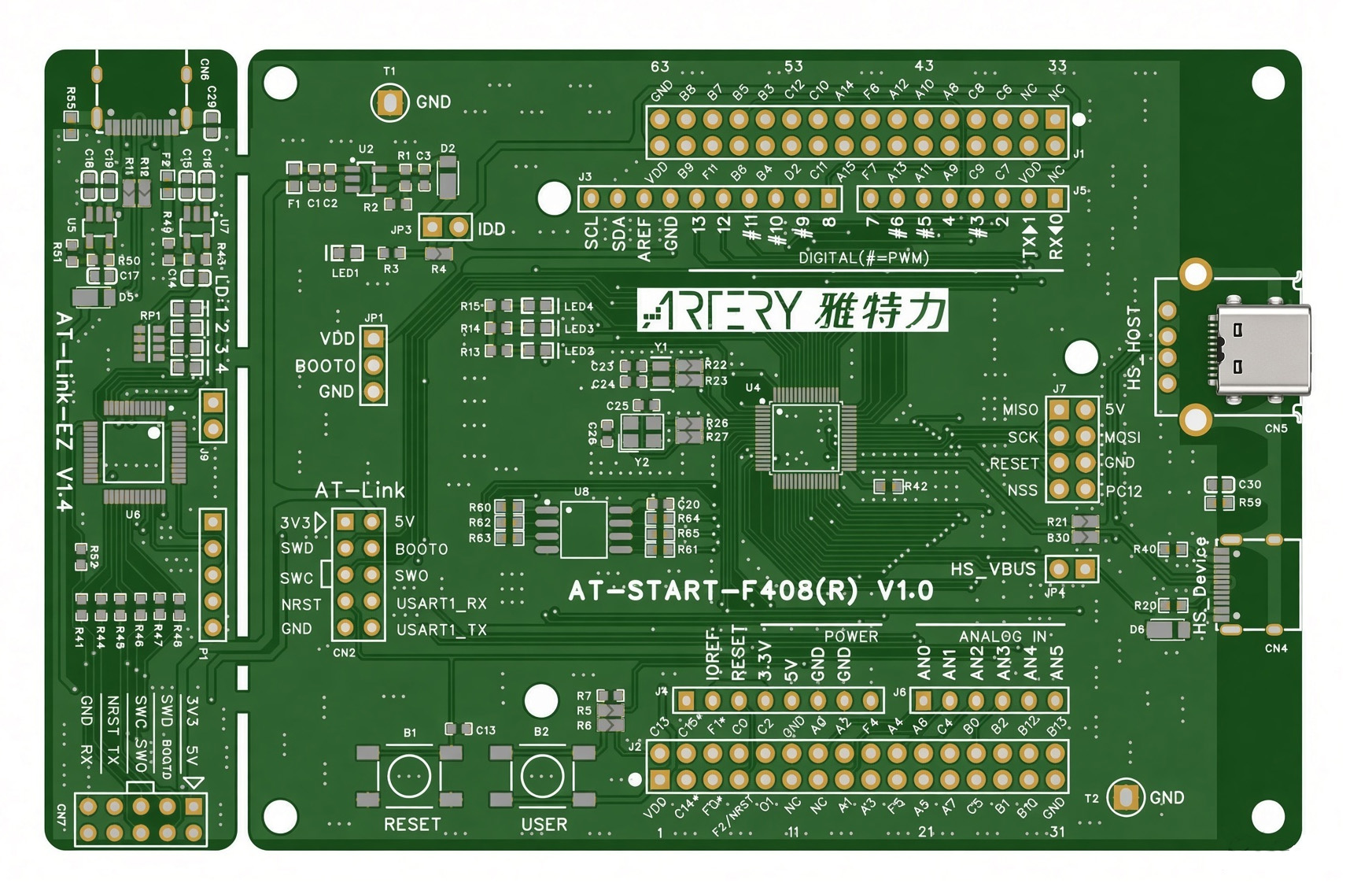
Artery AT-START-F408(R) evaluation board with USB host/device and AT-Link-EZ debugger.
Artery provides software support for the new MCUs through the AT32 IDE, VS Code extension, Workbench, AI Studio, and AT-Link tools. The devices also support sLib, which prevents selected Flash memory areas from being read while allowing code execution. Artery provides BSP libraries, documentation, and a migration guide for moving from the AT32F405 to the AT32F408.
Artery has also released the AT-START-F406 and AT-START-F408 evaluation boards. Both boards feature Arduino-compatible headers for connecting compatible shields and peripherals.
The AT32F406 and AT32F408 MCUs are currently in the sampling phase, with mass production underway. More details and documentation are available in the respective Artery press release.
Images used courtesy of Artery


