
Microchip’s 65V Monitors Add Energy Accumulation to 48V Designs
Two digital power monitor families combine accumulated-energy tracking with 75V spike protection for 48V rails in vehicles, servers, and telecom gear.
Moving a power rail to 48V improves efficiency and allows heavier loads, but it also changes what a power monitor must endure and understand. Microchip has announced the PAC1761 and PAC1861 families of digital power monitors, aimed at designs where instantaneous voltage and current readings no longer tell the whole story. Both families offer a 65V measurement range and can accumulate energy data over time.
Headroom for 48V Rails
A nominal 48V bus leaves little slack once a transient rides on top of it. Microchip pairs the 65V measurement range with 75V of spike protection, a margin meant to keep the monitor alive through disturbances rather than merely watching them pass. According to the product pages, each device is a single-channel monitor with bi-directional, high-side current sensing, an I2C interface, and an alert output. The PAC1761 digitizes at 12 bits; the PAC1861 at 16.
Energy Accounting and Alerts
The accumulator is what sets these parts apart from a plain voltage-and-current monitor. By tallying power measurements over time, the devices let a system reason about how much energy has been consumed, not just how much is flowing at this instant. Microchip also describes the devices as scalable, low-power parts intended to trim monitoring overhead.
Alerting follows the same two-sided view. Thresholds are programmable for voltage, current, and power excursions, while step-limit detection flags abrupt load changes. Configurable accumulated-energy thresholds round out the set, so a controller can respond to slow, long-term drift as readily as to a sudden jolt.
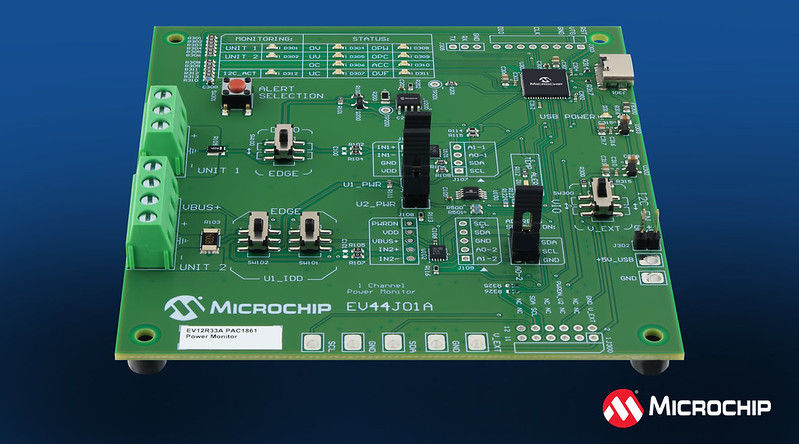
A top-down look at the EV12R33A evaluation board, with I2C headers, jumpers, and slide switches for configuring the PAC1861. Image used courtesy of Microchip
Packages, Pricing, and Where They Fit
Both families ship in VDFN-8 (comparable to SOT23-8), VDFN-10, and MSOP-10 packages, including automotive-orderable variants. Pin-compatible options are a notable part of the pitch: Microchip says they can lower redesign risk, shorten qualification cycles, and let designers swap between devices as requirements, availability, cost, or performance change.
Development support includes the EV12R33A evaluation board, priced at $49.00, along with a Python Command Line Interface (CLI) and library, a Linux driver, and a generic C library with several MCU code examples. The parts are available now, with the PAC1761T-3E/E3 and PAC1861T-1E/3P in MSOP-10 starting at $0.56 each in 10,000-unit quantities.
All told, the PAC1761 and PAC1861 let 48V designs blend snapshot measurements with a running tally of energy use, all in a part that tolerates 75V spikes. Expect them in automotive systems, AI and data center hardware, networking gear, industrial equipment, servers, telecom and Power over Ethernet (PoE) installations, and 48V power distribution in general. Anyone wrestling with a stubborn load-step problem or hunting for a pin-compatible second source may find the pair worth a closer look.


