
OrangePi O1 SBC Features Sophgo BM1688 with 16 TOPS TPU
Targeting edge AI, this compact 90x70mm board combines an octa-core Cortex-A53 CPU, up to 16GB LPDDR4X RAM, NVMe and SATA storage, Wi-Fi 6E, and multi-channel video processing.
Orange Pi has introduced the OrangePi O1, an SBC powered by the Sophgo BM1688 processor, with an octa-core Arm Cortex-A53 CPU, a RISC-V C906 coprocessor, and an integrated TPU delivering up to 16 TOPS of INT8 AI performance. The board is designed for edge AI, machine vision, intelligent surveillance, industrial automation, and other applications requiring local AI processing.
The SBC supports 8GB or 16GB LPDDR4/LPDDR4X memory, along with multiple storage options, including eMMC, SPI flash, microSD, M.2 NVMe SSD, and SATA 3.0. It also features dual Gigabit Ethernet, Wi-Fi 6E, Bluetooth 5.3, optional 4G/5G connectivity, and multiple camera and display interfaces. The board measures just 90 × 70 mm, making it suitable for compact edge computing systems.
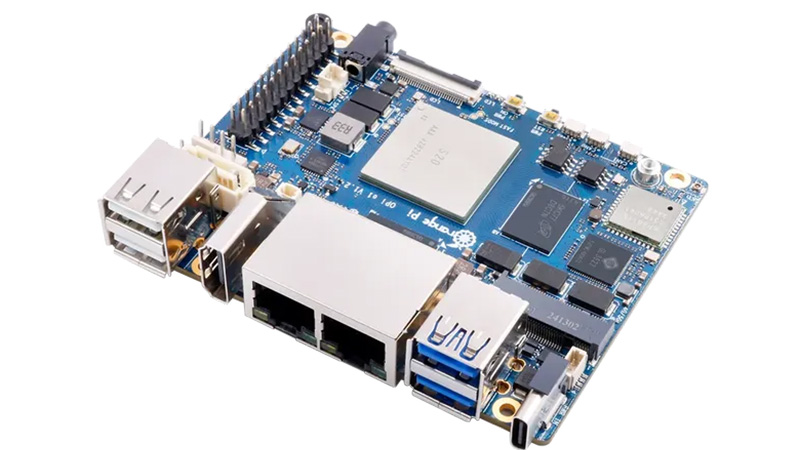
OrangePi O1 SBC powered by the Sophgo BM1688 AI SoC
Orange Pi O1 specifications:
- SoC: Sophgo BM1688
- CPU: 8-core Arm Cortex-A53 @ up to 1.65 GHz
- Co-processor: RISC-V C906 @ up to 1.2 GHz
- AI accelerator: Built-in SOPHGO Neural Network Acceleration Engine (TPU) delivering up to 16 TOPS@INT8 (also reported as up to 32 TOPS@INT4, 4 TFLOPS FP16/BF16, and 0.5 TFLOPS FP32)
- VPU:
- Video decoding: H.264 & H.265: 16 channels of 1080p @ 30 fps
- Video encoding: H.264 & H.265: 10 channels of 1080p @ 30 fps
- JPEG: Decoding and encoding: 480 frames/sec @ 1080p
- System Memory: 8 GB or 16 GB LPDDR4/LPDDR4X (optional)
- Storage:
- Optional eMMC module: 16 GB, 32 GB, 64 GB, or 128 GB
- Optional SPI Flash: 128 Mb or 256 Mb (mutually exclusive with eMMC)
- M.2 M-Key slot supporting PCIe 3.0 NVMe SSD
- SATA slot supporting SATA 3.0 SSD
- microSD card slot supporting up to 128 GB
- Networking:
- 2× 10/100/1000 Mbps Gigabit Ethernet (onboard YT8531C PHY)
- Wi-Fi 6E + Bluetooth 5.3 (BLE) via onboard combo module
- M.2 B-Key socket for optional 4G/5G module
- Display:
- 1× HDMI TX 2.0 port up to 4K @ 60 Hz
- 1× 4-lane MIPI DSI interface (via FPC connector)
- Camera: 2× 4-lane MIPI CSI camera interfaces
- USB: 2× USB 3.0 host + 2× USB 2.0 host
- Audio:
- 3.5 mm headphone jack (input/output)
- 2-pin speaker output connector
- Electret microphone input
- Expansion:
- 26-pin header supporting GPIO, UART, I2C, SPI, PWM
- Additional interfaces noted in board labeling/photos include CAN and RS485
- Misc:
- Power and Reset buttons
- 4-pin DC 12 V fan interface
- 2-pin RTC backup battery interface
- Power Supply: USB Type-C 20 V / 3.25 A
- Dimensions: 90 × 70 mm
- Weight: 76 g
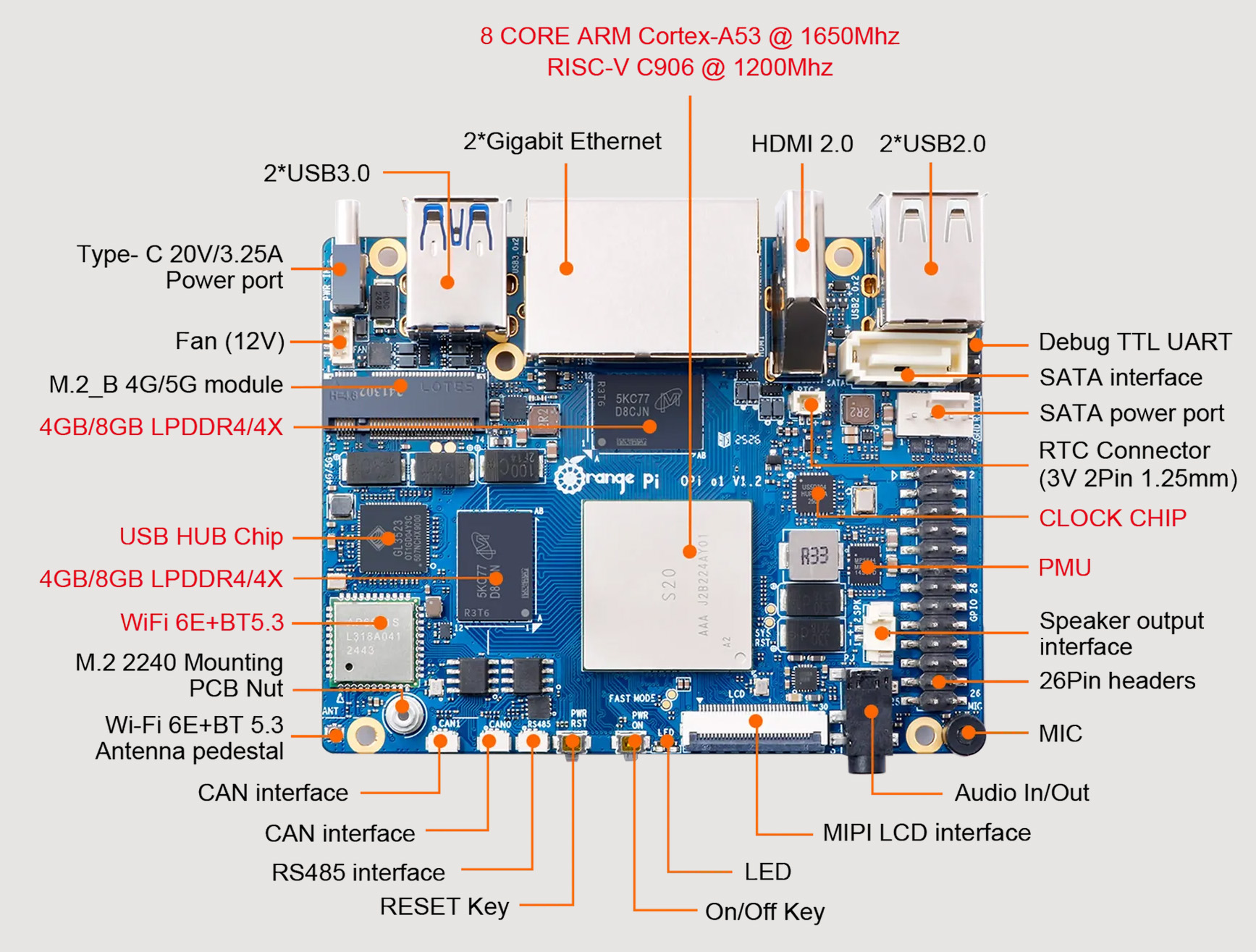
OrangePi O1 top view with labeled components, connectors, and expansion interfaces
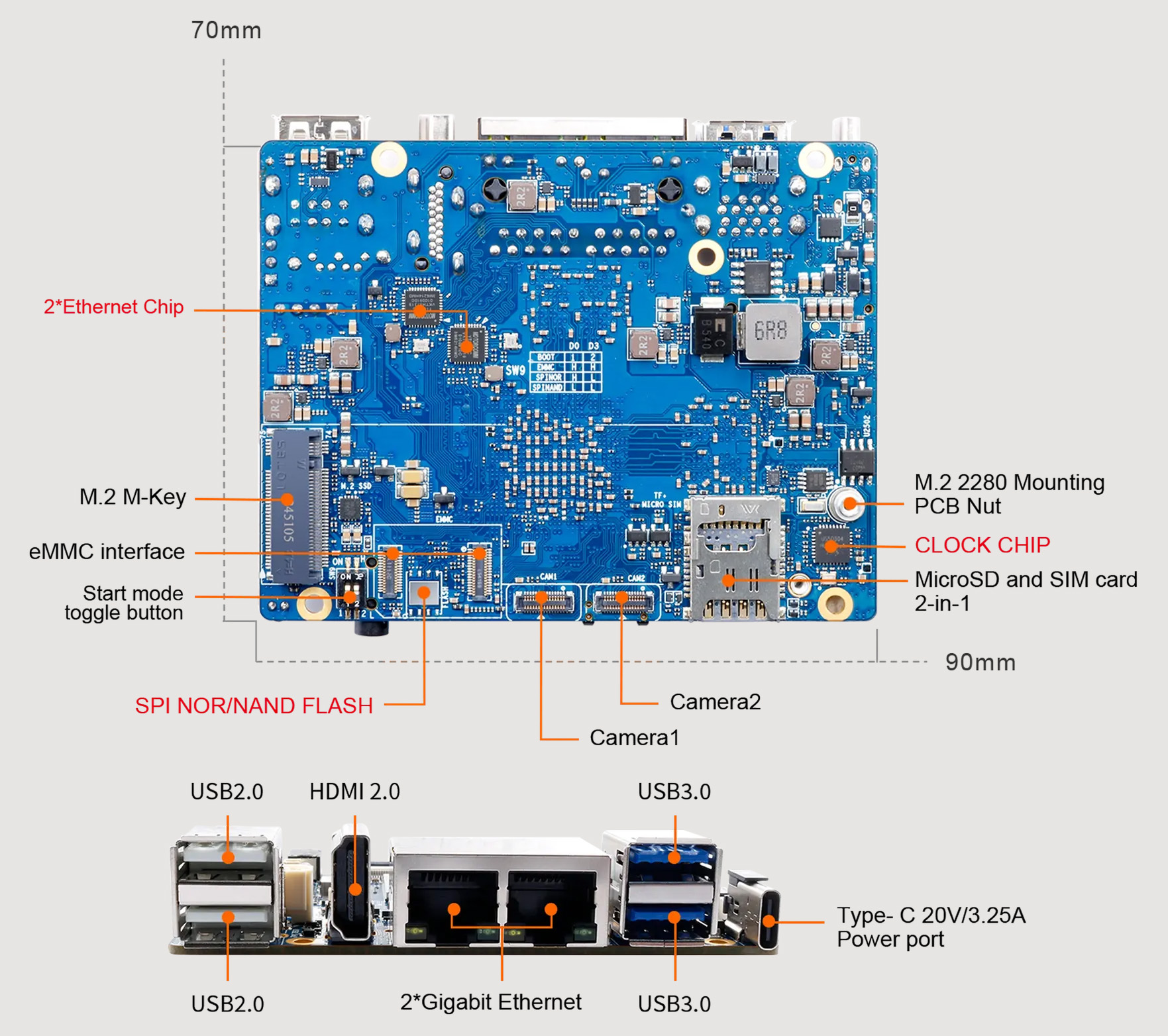
OrangePi O1 bottom view and side view showing storage interfaces, camera connectors, USB ports, and dual Gigabit Ethernet
On the software side, the Orange Pi O1 uses the Sophgo SOPHON SDK and supports popular AI frameworks such as PyTorch, TensorFlow, and ONNX. The board can also run local AI models, including Gemma-2B, Qwen1.5-1.8B, Llama2-7B, and ChatGLM3-6B. Other supported applications include image classification, object detection, instance segmentation, behavior analysis, OCR, speech recognition, and speech synthesis.
The provided documentation does not include pricing for the Orange Pi O1, but the boards are expected to launch soon on Orange Pi’s official AliExpress and Amazon storefronts. Orange Pi will make further documentation and OS images available through the Orange Pi O1 product page.
Images used courtesy of Orangepi.org


