
Rohde & Schwarz Debuts FNH Handheld Combi Analyzer Reaching 32 GHz
A keycode-upgradable platform pairs spectrum analysis with real-time capture, two-port network measurements, and power metering for towers, labs, and classrooms.
Hauling a spectrum analyzer, a network analyzer, and a power meter to a remote site is a chore, and one that Rohde & Schwarz hopes to shrink with the R&S FNH, a handheld combi analyzer introduced at electronica in Munich. Spectrum analysis is the baseline feature. Keycodes then switch on real-time spectrum analysis (RTSA), a cable and antenna tester (CAT), and a two-port vector network analyzer (VNA). Power measurements become possible when the instrument is paired with a Rohde & Schwarz USB power sensor, and pulse analysis is available as an option.
The FNH succeeds the R&S FSH and R&S ZVH handhelds. Three hardware versions cover frequencies up to 6 GHz, 13 GHz, and 26.5 GHz, and keycode upgrades stretch spectrum analysis to 8 GHz, 20 GHz, and 32 GHz, respectively. The vector network analyzer side tops out at 26.5 GHz. Rohde & Schwarz sells the analyzer directly and through selected distribution partners, with a standard three-year warranty.
Capturing the Fleeting and the Faint
Real-time capture is the headline specification. With the RTSA option, analysis bandwidth reaches 125 MHz, and it captures signals as brief as 3.6 µs with full-amplitude accuracy. A rate of 310,000 FFT/s leaves no gaps in time coverage, which matters for radar pulses, hopping signals, and transient bursts, as well as entire LTE-Advanced, 5G NR, and Wi-Fi 6/6E channel blocks.
Sensitivity holds its own, too. With the preamplifier switched on, the displayed average noise level (DANL) sits at −164 dBm (1 Hz) at 1 GHz and slips only to −152 dBm at 32 GHz. Phase noise stays below −110 dBc (1 Hz) at a 1 GHz carrier with a 10 kHz offset, and Rohde & Schwarz also cites a low voltage standing wave ratio (VSWR) across the frequency ranges. In CAT and VNA modes, full S-parameter measurements (S11, S21, S12, and S22) proceed in under 200 µs per point.
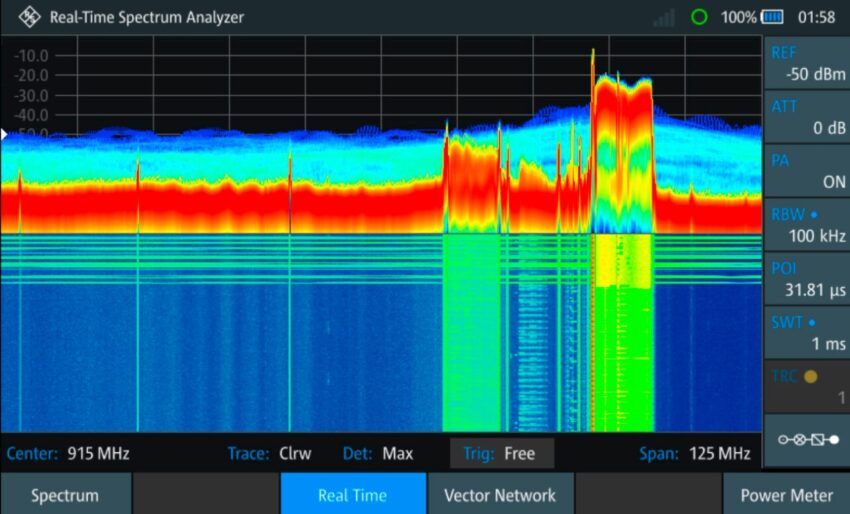
The R&S FNH’s real-time view stacks a density-colored spectrum atop a scrolling spectrogram, with a −50 dBm reference level and 100 kHz resolution bandwidth. Image used courtesy of Rhode & Schwarz
Rugged Hardware, Flexible Workflows
Rohde & Schwarz designed the FNH with aerospace and defense work in mind. The analyzer meets IP51 protection requirements and operates from −10 °C to +55 °C, while an optional rain holster lifts protection to IP54. The brochure adds that the design meets MIL-PRF-28800F class 2 and MIL-STD-810H. Control happens on a 7-inch multi-touch display; a measurement wizard guides technicians through test sequences and automatically generates reports, and Wi-Fi mirroring lets a smartphone stand in for the screen. Battery life runs to about 4 hours in spectrum analyzer and CAT/VNA modes, or 3.5 hours in RTSA mode.
Software options broaden the field toolkit. Interference analysis adds spectrograms and triangulation with a directional antenna, while signal strength mapping overlays measurements on indoor or geographic maps.
Back at the bench, full SCPI compatibility lets the analyzer slot into existing automation setups, and R&S VSE software handles signal demodulation analysis. A channel scanner automates measurements across predefined lists, and the integrated power meter reports peak and average power. For education, R&S InstrumentView offers remote access, so students can work with a live instrument without standing next to it. Accessories from the FSH, ZVH, ZPH, and FPH families remain compatible.
Where It Fits
Taken together, the FNH works as a portable RF bench: spectrum analysis, real-time capture, network measurements, and power readings, all without swapping instruments. Crews installing, maintaining, and calibrating radar systems, satellite ground stations, and communication links stand to benefit most, as do teams chasing interference or monitoring the spectrum. Labs and classrooms get a seat at the table too, and anyone with a drawer full of older FSH or ZVH accessories can keep putting them to work. That is a lot of test equipment folded into one carry-along.


