
Siglent’s SSG3000X Plus Generators Cover 9 kHz to 3.2 GHz
Four benchtop models pair low phase noise with pulse and analog modulation, an optional precision reference, and external IQ inputs for receiver and component testing.
Siglent has rolled out the SSG3000X Plus series, a quartet of benchtop RF signal generators spanning 9 kHz to 3.2 GHz. Two frequency ceilings define the family: the SSG3021X Plus reaches 2.1 GHz, while the SSG3032X Plus extends to 3.2 GHz. Each has an IQE counterpart that adds external IQ modulation, and the 2.1 GHz units can be upgraded to the full 3.2 GHz range through an option. Output level ranges from −110 dBm to +20 dBm, though the specified performance range tops out at +13 dBm above 1 MHz.
Phase Noise and Frequency Stability
Signal purity gets top billing. Typical single-sideband phase noise is better than −117 dBc/Hz at a 1 GHz carrier with a 20 kHz offset, and the guaranteed figure sits at −115 dBc/Hz. For carriers above 250 MHz, wideband noise at a 40 MHz offset is typically better than −153 dBc/Hz. At output levels up to +13 dBm, the data sheet lists harmonics below −30 dBc and non-harmonic spurs below −63 dBc under its stated CW conditions.
Frequency accuracy over long runs hinges on the reference. The standard 10 MHz timebase holds temperature stability under 1 ppm across 0 °C to 50 °C, with first-year aging below 0.5 ppm. The optional 10M_OCXO_L reference tightens those numbers considerably: ±1 ppb over the same temperature span, and 50 ppb per year in aging.
Modulation, Pulses, and IQ Inputs
AM, FM, and PM come standard, each drawing from an internal source, an external source, or both. Pulse modulation offers an on/off ratio of up to 68 dBc and typical rise and fall times under 15 ns, which Siglent credits with reducing stress on power amplifiers and T/R modules during testing. It supports single and double pulses; the optional PT upgrade extends this to trains of up to 2047 pulses, with width and period adjustable in 10 ns steps.
On the IQE models, I and Q inputs accept an external baseband source. Paired with an SDG6000X, the generator can produce vector signals such as 16QAM and QPSK across a 200 MHz RF modulation bandwidth, and the data sheet quotes a nominal EVM of 0.7% or better for both schemes below 1.5 GHz.
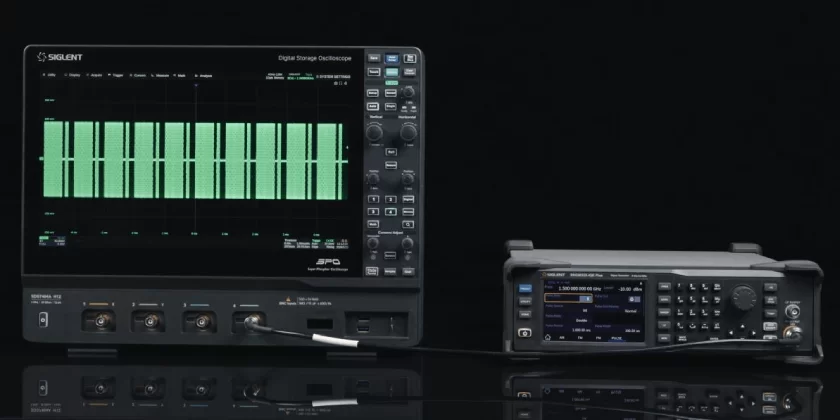
Verifying pulse output: the generator’s RF output, routed to an oscilloscope channel, reveals the shape and timing of each burst. Image used courtesy of Siglent
Operation and Automation
A 5-inch capacitive touchscreen, with mouse and keyboard support, handles local control. Step sweeps run to 65,535 points, and list sweeps to 500, with several trigger modes. Plug in a USB power meter, and the generator can automatically compensate for cable loss and temperature drift, closing the loop on the level delivered to a device under test. For automated benches, USB, LAN, and web-browser remote control are standard, while GPIB is available as an option through a USB-GPIB adapter.
Taken together, the SSG3000X Plus series reads like a handy bench companion for anyone who prizes clean carriers and a steady timebase. It handles receiver sensitivity checks, pulsed testing of power amplifiers and T/R modules, component characterization, production-line verification, teaching labs, and routine maintenance. At 338 × 113 × 369 mm and just under 5 kg, it should slot onto most benches without much fuss.


