
ST Pairs Vibration-Immune Gyroscopes With Dual Accelerometers
A consumer-grade part and an industrial-grade sibling use mirrored sensing structures to cancel external disturbances while tracking everything from slight tilts to hard impacts.
STMicroelectronics has released a pair of six-axis inertial measurement units (IMUs) designed to stay stable when a device is shaken, struck, or generally mistreated. The LSM6DSK320X targets consumer designs; its sibling, the ISM6HGK256X, targets industrial applications. Both belong to ST’s Sustainable Technology initiative, and both are free of PFAS, lead, and BPA.
Mirrored Structures, Quieter Signals
At the heart of the upgrade sits a super-symmetric gyroscope architecture. Two mirrored electromechanical structures operate out of phase, so the effects of external vibration and shock cancel each other out. A fully differential signal chain then maximizes the strength and resilience of the detected signal. That gain in precision matters for event reconstruction, the ability of an application to distinguish one kind of incident from another, which underpins functions such as accident alerting, tool-usage monitoring, robot teaching, sports-performance analysis, and concussion detection. Selectable gyroscope full-scale ranges run from ±250 dps to ±4000 dps.
Two Accelerometers, Four Channels
Compact by design, each IMU fits one gyroscope and two separate accelerometers into a 2.5 mm x 3 mm x 0.83 mm package. The low-g accelerometer spans ±2 g to ±16 g, while the high-g accelerometer reaches ±320 g in the LSM6DSK320X and ±256 g in the ISM6HGK256X. Because the two operate side by side, they capture gentle disturbances and violent impacts at the same time; single-accelerometer IMUs, by contrast, cannot measure while switching between low and high ranges. Data moves through four independent processing channels, with one reserved for high-g events.
Intelligence also resides on the die. A machine-learning core performs AI processing inside the sensor, reducing the energy and system resources an application would otherwise use, while a programmable finite state machine tracks motion at 960 Hz. Adaptive self-configuration lets the device reconfigure itself when it detects a particular motion pattern or machine-learning output, with no host intervention required. In the six-axis configuration, supply current is 0.67 mA in combo high-performance mode, and host connections include SPI, I²C, and I3C interfaces.
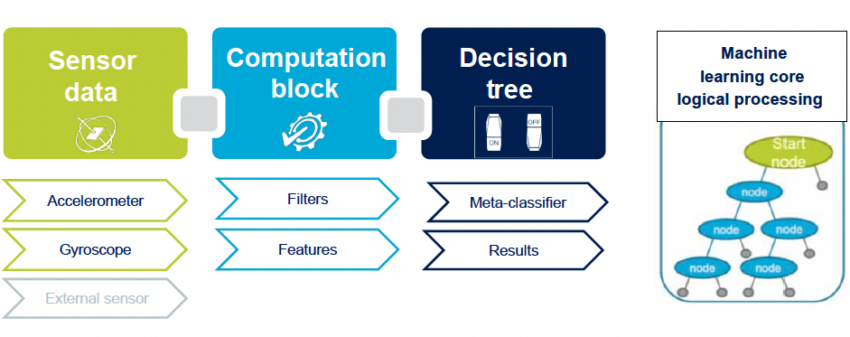
Each IMU’s machine-learning core handles context awareness on the sensor itself, branching from a start node through successive decision nodes. Image used courtesy of STMicroelectronics
Grades, Tools, and Pricing
Operating temperature separates the two parts. The LSM6DSK320X works from -40 °C to +85 °C, while the ISM6HGK256X extends to +105 °C and is part of ST’s 10-year longevity program for long-term availability. Developers can work in the ST MEMS Studio environment, supplemented by Motion XLF, sensor-fusion, and context-awareness libraries. Adapter boards, the STEVAL-MKI257A for the consumer part and the STEVAL-MKI258KA for the industrial one, are slated to reach the eStore and distributors by November 2026. For orders of 1000 pieces, pricing starts at $4.6 for the LSM6DSK320X and $5.1 for the ISM6HGK256X.
In short, ST has assembled a compact route to motion data that holds up under abuse. Consumer products such as fitness trackers, smart tags, and game controllers can borrow the added shock awareness, and drones doing photography or agricultural surveying gain a steadier flight-stabilization signal. Industrial teams, meanwhile, have asset monitors, robots, structural-condition monitoring, and worker personal protective equipment on the menu. Anyone building hardware destined to be rattled, dropped, or flung around may want to keep these two parts on the short list.


