
Qualcomm Acquires Arduino, Unveils Hardware and Software Tools
The acquisition combines Qualcomm’s edge computing and AI hardware with Arduino's accessible development ecosystem; new releases include the Arduino UNO Q dual-processor board and the Arduino App Lab IDE.
In a move set to reshape the landscape of embedded systems development, Qualcomm Technologies has announced an agreement to acquire the open-source hardware and software company Arduino. This acquisition, subject to regulatory approval, signifies a strategic push by Qualcomm to democratize access to its high-performance edge computing and AI technologies for a broader community of developers.
The acquisition is accompanied by the introduction of new hardware and software tools: the Arduino UNO Q and the Arduino App Lab. These products are positioned to bridge the gap between traditional microcontroller-based prototyping and the demands of modern, high-performance edge AI applications.
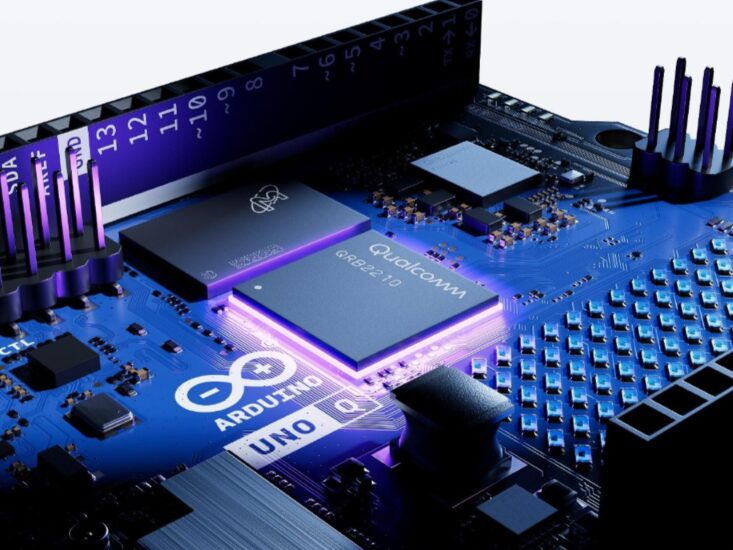
Qualcomm has acquired Arduino in a move to open up developer access to its edge AI and computing solutions. Image used courtesy of Arduino
The Arduino UNO Q Single-Board Computer
A significant technical development stemming from the Qualcomm-Arduino acquisition is the launch of the Arduino UNO Q, a next-generation single-board computer. The board utilizes a “dual-brain” architecture that integrates two distinct processing units: a Linux Debian-capable microprocessor and a real-time microcontroller.
The microprocessor is powered by the Qualcomm Dragonwing QRB2210, a processor capable of running an entire Linux environment. This provides the computing power necessary for complex tasks such as AI-powered vision and sound solutions. The inclusion of a Linux environment enables developers to leverage a vast ecosystem of software libraries, frameworks, and tools, offering a level of computational flexibility not previously available on an official Arduino board.
The real-time microcontroller works in tandem with the microprocessor, handling the low-latency, real-time control functions critical for sensor interfacing, motor control, and other deterministic tasks. This dual-processor design directly addresses a common challenge in embedded systems: the trade-off between high-level computation and precise, real-time control. By offloading time-sensitive tasks to the microcontroller while utilizing the microprocessor for computationally intensive operations, the UNO Q is designed to offer a balanced platform for a wide range of applications, including smart home and industrial automation systems.
The new Arduino UNO Q is a “dual-brain” board powered by the Qualcomm Dragonwing platform. Video used courtesy of Arduino
The Arduino App Lab Integrated Development Environment (IDE)
To support this new class of hardware, the companies are also launching the Arduino App Lab IDE, built to streamline the development process for modern projects. Unlike the traditional Arduino IDE, which is primarily focused on C++ programming for MCUs, the App Lab is designed to unify development across multiple flows, including Real-time OS, Linux, Python, and AI.
The App Lab offers an open-source platform intended to facilitate the rapid ideation, prototyping, and scaling of AI-powered solutions. A key feature is its integration with the Edge Impulse platform, which Qualcomm previously acquired. This integration is designed to simplify the process of building, fine-tuning, and optimizing machine learning models using real-world data. For developers, this means a more direct path from data collection on a prototype to deploying a trained model for tasks such as object detection, anomaly detection, or keyword spotting.
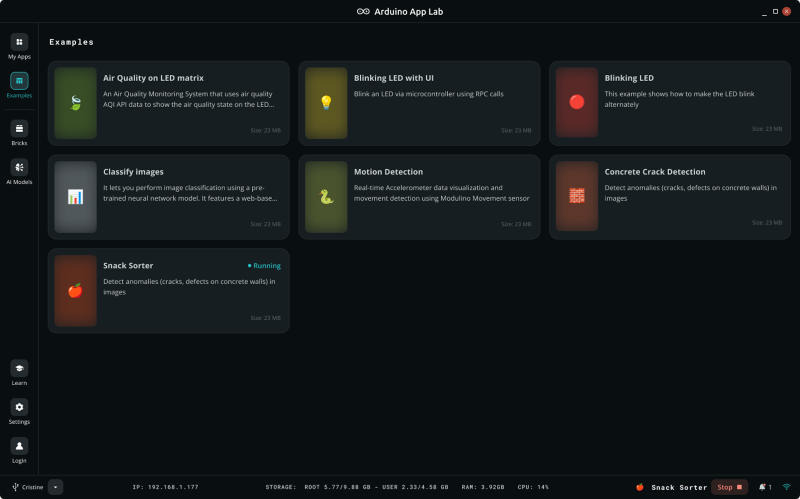
The Arduino App Lab open-source IDE comes preloaded on the Arduino UNO Q. Image used courtesy of Arduino
The Qualcomm-Arduino Acquisition
Qualcomm’s acquisition of Arduino is part of a broader strategy to create a “full-stack edge platform.” This vision, which has been reinforced by previous acquisitions of Edge Impulse and Foundries.io, aims to provide a comprehensive solution that spans hardware, software, and AI model development. The integration of Arduino’s community and accessible tools is intended to act as a funnel, bringing a new wave of developers into this full-stack ecosystem.
For the existing Arduino community and electrical engineers, the news presents both opportunities and considerations. According to the companies, Arduino will retain its independent brand and continue to support a wide range of microcontrollers from multiple semiconductor providers. The introduction of the UNO Q and App Lab, however, marks a clear inflection point, pushing the Arduino brand into a higher-performance category that is directly competitive with single-board computers like the Raspberry Pi while retaining the ease-of-use ethos of the Arduino platform.
The move provides a clearer path to commercialization for engineers and businesses. By developing on a platform powered by Qualcomm’s advanced technologies, prototypes can transition to production with the support of a global semiconductor provider’s ecosystem. The introduction of a Linux-capable board also facilitates a higher degree of software complexity, enabling more sophisticated applications that leverage networking, file systems, and more complex data processing.
The acquisition and subsequent product announcements represent a significant technical shift. The dual-processor UNO Q and the multi-flow Arduino App Lab signal a new chapter for the Arduino ecosystem, one focused on integrating high-performance computing and AI capabilities into its accessible and community-driven platform.


