
SIGLENT’s New AWG Combines RF Synthesis, IQ Modulation, and Sequencing
The SDG8000A pairs 16-bit resolution and 12 GSa/s sampling with direct 5 GHz output and vector signal creation for wireless, semiconductor, and high-speed digital test.
SIGLENT Technologies has introduced the SDG8000A series, a family of arbitrary waveform generators that combines baseband waveform playback, direct RF synthesis, and IQ vector signal generation into a single bench instrument. The lineup pairs the two-channel SDG8002A with the four-channel SDG8004A, and both target engineers working on RF front ends, wireless communication systems, semiconductor devices, and high-speed digital designs.
A 12 GSa/s Core With 16-Bit Resolution
Both models sample at 10 GSa/s through interpolation, with an optional 12 GSa/s rate available in IQ mode. At the standard rate, output frequency reaches 4 GHz; the 12 GSa/s option extends that ceiling to 5 GHz. Vertical resolution is 16 bits, falling to 15 or 14 bits when one or two marker outputs are enabled on a channel, a tradeoff worth noting in setups that rely on markers to trigger downstream instruments.
SIGLENT’s TrueArb architecture plays arbitrary waveforms point-by-point at sampling rates from 100 Sa/s to 5 GSa/s, preserving waveform detail while maintaining low jitter. The platform’s EasyPulse technology produces low-jitter square waves and pulses with fine control over width and edge times, down to 250 ps. A multi-pulse mode generates configurable pulse trains to measure the switching parameters of power devices and evaluate their dynamic characteristics. Waveform memory runs 2 Gpts per channel as standard, expandable to 4 Gpts, which sustains roughly 800 ms of playback at the maximum sampling rate without sacrificing bandwidth.
Direct RF Output Without an External Modulator
The headline capability is the internal digital modulator, which produces RF output directly up to 5 GHz and removes the need for outboard IQ hardware. The baseband data rate tops out at 5 GS/s, supporting a modulation bandwidth of 2 GHz through the internal modulator; routing the baseband signal to an external modulator extends the usable signal bandwidth to 4 GHz. Phase noise measures -120 dBc/Hz at a 1 GHz carrier with a 10 kHz offset.
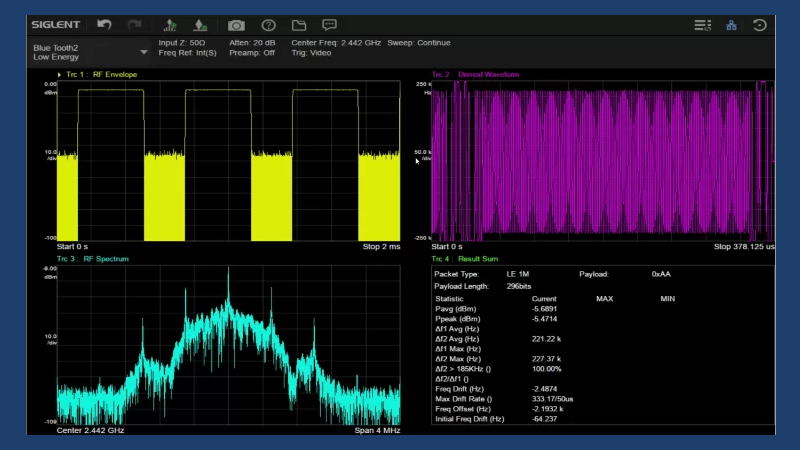
Bluetooth Low Energy signal analysis showing the RF envelope, demodulated waveform, and spectrum of a 2.442 GHz LE 1M packet. Image used courtesy of SIGLENT
Paired with the optional SigIQPro software, the generator builds signals for 5G NR, LTE FDD and TDD, IEEE 802.11ax and 802.11be, Bluetooth, and IoT protocols, along with modulation formats spanning ASK, FSK, PSK, and QAM constellations up to 256QAM, plus OFDM and user-defined schemes. That toolset positions the instrument for receiver testing, amplifier characterization, and RF front-end validation.
Sequencing and Multi-Channel Synchronization
A multi-level sequence engine organizes waveforms into segments, sequences, and scenarios—up to 16,384 segments, 4,096 sequences, and 512 scenarios—so users can compose dynamic signal environments for burst communication, interference simulation, and system-level testing. Built-in multi-tone, chirp, and PRBS functions round out the signal-creation toolbox, and the platform clocks high-speed serial data at up to 1.25 Gbps for serial-link work.
For phase-coherent setups, inter-channel skew stays below 15 ps, and the instrument offers differential output modes, two marker outputs per channel, external clock synchronization, and advanced triggering, features aimed squarely at MIMO and other synchronized RF test environments. Connectivity covers USB, LAN with VXI-11, and optional GPIB, while a built-in WebServer enables browser-based remote control. A 250 GB internal SSD and a 7-inch capacitive touchscreen handle storage and local operation.
The SDG8000A covers an unusual amount of bench territory for a single chassis: 5G and Wi-Fi receiver testing, power amplifier characterization, switching evaluation of power semiconductors, chirped and multi-tone stimulus generation, and high-speed serial stress testing all fall within reach. Labs that have juggled a separate arbitrary waveform generator, vector signal source, and pulse generator may find the consolidation genuinely useful, especially since the feature set is licensed à la carte, letting a test bench pay only for the capabilities it actually needs.


