
Texas Instruments Releases Hall-Effect Switch for In-Plane Sensing
The TMAG5134 in-plane Hall-effect switch features a high sensitivity and a compact size to help reduce system costs and simplify mechanical design for magnetic position sensing.
Texas Instruments has introduced the TMAG5134, a new in-plane Hall-effect switch. The device is designed to sense magnetic fields that are parallel to a printed circuit board (PCB), offering a different approach to magnetic sensing compared to traditional Hall-effect sensors that typically detect fields perpendicular to the package. Texas Instruments has combined this in-plane sensing capability with a high sensitivity to provide engineers with greater flexibility in mechanical and system design.
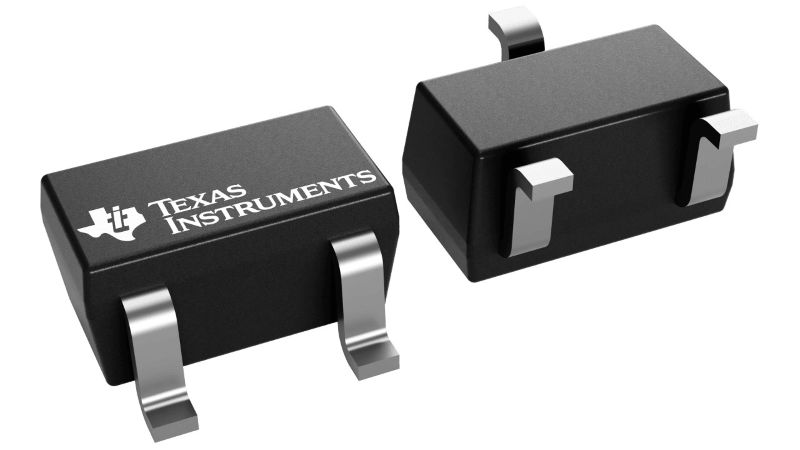
The TMAG5134 is designed to replace AMR, TMR, and GMR sensors and reed switches for reduced design cost and time. Image used courtesy of Texas Instruments
TMAG5134 In-Plane Hall-Effect Switch
The core technology behind the TMAG5134 Hall-effect switch is its integrated magnetic concentrator. This component focuses a weak magnetic field onto the Hall sensing element, significantly increasing the sensor’s effective sensitivity. The device is designed to detect fields as low as 1 mT. For a design engineer, this high sensitivity translates directly into tangible benefits. It allows for the use of smaller, less powerful magnets, which can reduce component costs. It also relaxes the mechanical tolerances of the system, meaning the magnet can be placed further from the sensor or with less precise alignment, making the assembly process more straightforward and potentially more reliable.
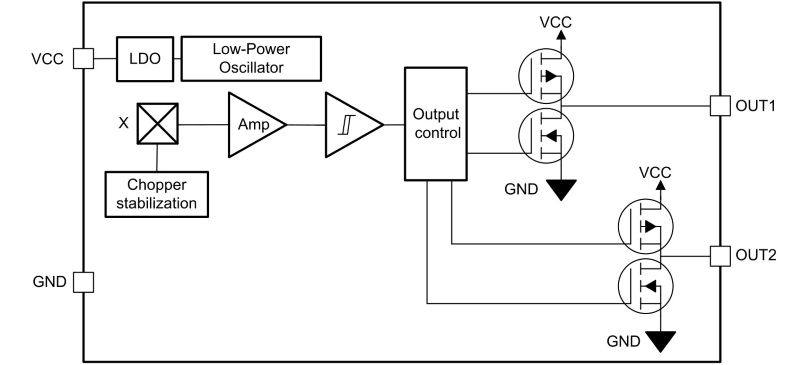
The TMAG5134 ZFC, 4-pin X1LGA package features dual-unipolar outputs. Image used courtesy of Texas Instruments
Cost-Effective and Compact Position Sensing
Traditionally, engineers have relied on technologies like reed switches or more complex magnetoresistive sensors (TMRs, AMRs, or GMRs) for magnetic sensing. Reed switches, while simple, can have issues with reliability due to their mechanical nature and are not well-suited for high-vibration environments. Magnetoresistive sensors, while highly sensitive, often come with a higher component cost and may require more complex calibration or signal conditioning. The TMAG5134, as a highly sensitive Hall-effect-based solution, is more durable than a reed switch and less complex than magnetoresistive sensors.
The new switch also boasts a low average power consumption of 0.6 µA. This makes it a viable option for a range of battery-powered applications where power efficiency is a critical design parameter. The device’s small footprint further aids in high-density PCB layouts, aligning with the trend toward miniaturized electronics. Texas Instruments has also provided an evaluation module and a free simulation tool, the Texas Instruments Magnetic Sense Simulator (TIMSS), to help engineers prototype and test their designs more efficiently.
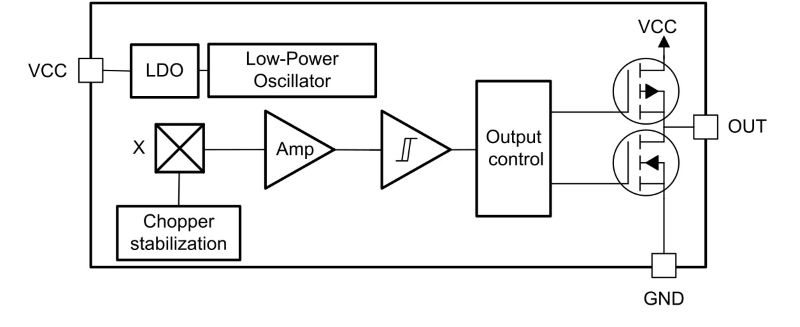
The TMAG5134 DBV, 3-pin SOT-23 package features one omnipolar output. Image used courtesy of Texas Instruments
Magnetic Sensing Simplified
The TMAG5134 is a compact and power-efficient Hall-effect switch that provides a new option for magnetic sensing, particularly in space-constrained or battery-powered systems. Its high sensitivity and ability to work with in-plane magnetic fields allow for smaller, more cost-effective designs. It is suited for use in various applications, including factory automation, robotics, home appliances, and personal electronics.


