
xMEMS’ Solid-State Micro Fan Tackles Smart Glasses Thermal Limits
The chip-scale device promises to keep AR displays sharp and processors humming without adding bulk or weight to wearable eyewear.
xMEMS Labs has introduced the XMC-1200, a solid-state micro fan the company describes as the smallest active cooling device built for AR, XR, and smart glasses. Rather than relying on a spinning rotor, the chip uses xMEMS’ piezoMEMS platform to move air directly at the point where heat is generated, a departure from the passive heatsinks and thermal spreaders that most wearable designs have relied on to date.
At 46 mm², the XMC-1200 is small enough to fit inside a temple arm, a location where conventional rotary fans encounter mechanical, acoustic, and thermodynamic limits simultaneously. Paired with the Astra2 drive ASIC, the system draws roughly 70 mW during typical operation and reduces temperature by up to 10°C at a 1 W thermal load, according to xMEMS.
Addressing Heat at the Component Level
Smart glasses increasingly pack light engines, image sensors, and application processors into a form factor with little room for airflow or heat dissipation. As microdisplay LEDs and laser sources warm up, their emission wavelengths can shift, resulting in color bleed or a drifting white point on the display. By actively moving heat away from these components, the XMC-1200 is intended to help keep light sources within a narrower temperature band, supporting steadier color and brightness over a session.
Processors face a related constraint. On-device AI, translation, and computer vision workloads pull glasses toward sustained compute demand rather than the short bursts typical of earlier designs, and thermal throttling becomes a limiting factor well before battery capacity does. Targeted cooling at the processor package is one way to extend the window before a device reduces performance to manage temperature.
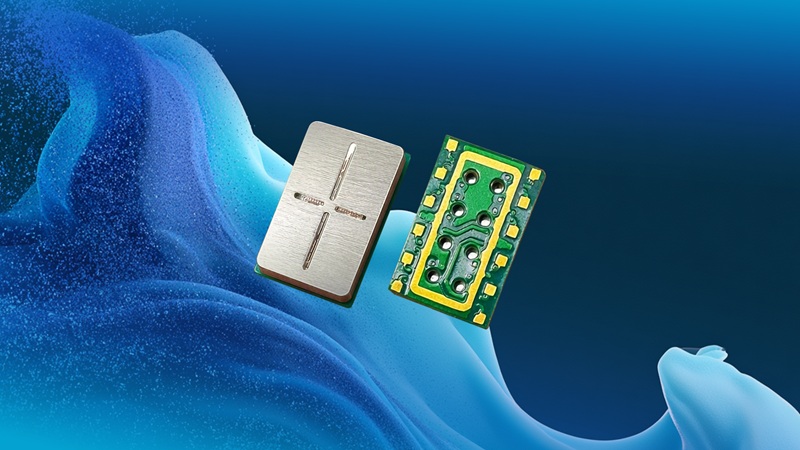
The XMC-1200 package (left) and its underlying substrate (right); at 46 mm², the chip fits inside space-constrained smart glasses designs. Image used courtesy of xMEMS
Extending Recording Time and Wearer Comfort
Camera-equipped glasses illustrate the same tradeoff in a different form. High-bandwidth image sensors and video encoders generate heat inside an enclosure with minimal space for a heatsink, which is part of why many camera glasses cap recording sessions well short of what battery life alone would allow. Moving heat away from these components at the source is one path toward longer recording windows without a larger enclosure.
Wearer comfort adds another constraint that is easy to overlook: a device does not need to reach an unsafe temperature to be rejected by users; only a temperature that feels warm against the skin during extended wear. By directing heat away from the temple arm before it reaches the wearer, active cooling addresses a factor that has more to do with everyday usability than with headline specifications.
xMEMS says XMC-1200 engineering samples are now available under NDA to qualified AR, XR, and wearable customers, with production readiness targeted for the fourth quarter of 2027. A related device, the XMC-2400, is already in mass production and supporting the company’s initial glasses design wins, suggesting the underlying µCooling platform is further along in commercialization than the newest chip alone might indicate. As AI features push further into eyewear, this kind of component-level thermal management looks like a key piece to watch, since it addresses a constraint that display resolution and processor speed alone can’t solve and could influence how bright, how capable, and how comfortable the next generation of AI glasses turns out to be.


