
AI-Assisted Modeling Advances Taoglas’ Antenna Integrator Design Tool
The newest updates to the Taoglas Antenna Integrator tool include complex PCB geometry support and modeling of adjacent metallic components to accelerate optimal RF system placement for IoT devices.
As the density and radio count in connected devices continue to increase, the challenge of achieving optimal antenna performance early in the design cycle has become a bottleneck for engineers. Non-ideal placement, ground plane effects, and coupling between radios are persistent obstacles that traditionally require extensive prototyping and anechoic chamber testing.
Addressing this complexity, Taoglas has updated its Antenna Integrator tool, utilizing AI to enhance predictive capabilities in antenna placement and performance modeling.
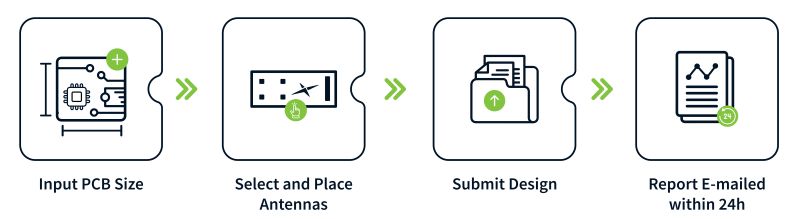
Taoglas has added AI to its Antenna Integrator tool to simplify and speed up product design. Image used courtesy of Taoglas
Antenna Integrator Tool Updates
The core technical enhancement behind the Antenna Integrator tool updates revolves around the system’s ability to refine its internal models based on continuous, real-life use case data. This adaptive modeling is designed to provide engineers with a reliable early-stage simulation environment, allowing better visualization and optimization of antenna performance prior to PCB fabrication. This capability is critical for achieving signal integrity in multi-radio environments, a necessity for the forecasted 13 billion IoT antenna shipments expected by 2030, according to ABI Research. The goal is to reduce the dependency on empirical iteration, providing performance reports, including recommended antenna selection and placement, typically within 24 hours of submission.
A significant update to Antenna Integrator is the expansion of supported PCB geometries. Recognizing that modern devices rarely utilize simple rectangular boards, the tool now includes templates for complex board outlines, such as L-shape, U-shape, stepped, arc, and custom user-defined geometries. This allows for a more accurate representation of the electrical characteristics inherent in non-standard ground plane shapes, which directly influence antenna resonant frequency and radiation efficiency.
Engineers can select up to twelve antennas from Antenna Integrator’s library, which includes GNSS, Cellular, and Wi-Fi. Video used courtesy of Taoglas
Furthermore, the new Antenna Integrator tool update incorporates component modeling via the addition of rectangular and cylindrical metallic blocks. In compact designs, large components, such as batteries, displays, or shielded RF modules, behave as parasitic elements, significantly altering the antenna’s near-field environment and overall system impedance matching. By allowing engineers to incorporate these metallic block models, the tool can predict the resulting shift in return loss and radiation pattern more accurately.
Multi-Radio Support and Design Constraint Enforcement
Taoglas’ Antenna Integrator supports placement optimization across various technologies, including Cellular, GNSS, Wi-Fi/Bluetooth, ISM, UWB, DECT, and SATCOM/NTN, with the ability to handle up to 12 antennas simultaneously. The system includes built-in design constraints, such as enforcing adequate spacing and applying default metallic keep-out areas around specific antennas to maintain datasheet performance. This guidance helps mitigate inter-antenna coupling and desensitization issues common in dense RF designs.
To ensure seamless transition between electrical and mechanical teams, the updated tool provides export options including 3D STEP and DXF files, alongside PDF and JPG formats. This facilitates the mechanical integration and enclosure design process, ensuring the physical realization of the device maintains the optimized RF conditions established in the simulation. The platform continues to expand its supported antenna library, having recently incorporated new models such as the NLA.01, DLA.01, and PCS.62.
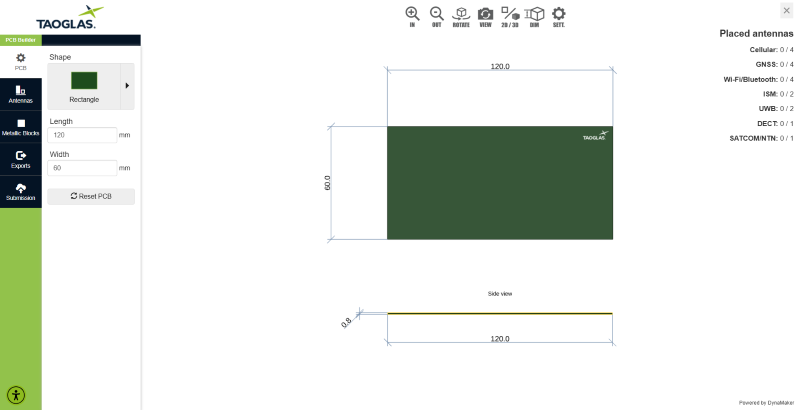
Antenna Integrator’s user-friendly interface enables engineers to select parameters and optimize antenna performance during the initial design phase. Image used courtesy of Taoglas
Advancing Antenna Design
Taoglas’ technical expansion of its Antenna Integrator tool centers on leveraging AI for high-fidelity predictive modeling, enabling engineers to account for the complex interactions between multi-radio systems, non-standard PCB shapes, and large metallic components at the design’s initial phase. By visualizing optimal placement and component influence early on, the workflow minimizes costly redesigns and accelerates time-to-market. This methodology is particularly relevant for applications in connected transportation, smart industrial monitoring, robotics, smart cities, and advanced connected health devices.


This is a meaningful update for RF engineers. Using AI to model real-world placement effects early can significantly reduce trial-and-error and costly re-spins. Support for complex PCB shapes, metallic components, and multi-radio designs makes the Antenna Integrator far more aligned with modern IoT and compact device realities. Cutting chamber time while improving first-pass performance is a clear win for faster, more reliable product development.