
Danisense’s DP12IP Squeezes ppm-Class Precision Into a 32mm Package
New PCB-mount fluxgate transducer targets isolated DC/AC measurement up to 18 A for compact, high-stability power electronics designs.
Precision current sensing has typically demanded a tradeoff between accuracy and board space, but Danisense’s new DP12IP current transducer aims to close that gap. Built around the company’s closed-loop compensated fluxgate architecture, the device delivers a maximum linearity error of just 10 ppm while fitting into a PCB-mounted footprint measuring only 32 mm and tipping the scales at 250 g.
Fluxgate Precision in a Fraction of the Footprint
The DP12IP relies on a fixed excitation frequency paired with second harmonic zero-flux detection, a combination that lets the transducer maintain its stability over both time and temperature. According to the datasheet, offset drifts by no more than 0.1 ppm over 24 hours, 1 ppm per month, and 2 ppm annually, figures that put the device solidly in the realm of laboratory-grade metrology rather than typical industrial sensing.
The transducer measures isolated DC and AC up to 18 A, with a nominal primary current rating of 12 A and a 1:250 primary-to-secondary ratio. It accommodates measurement resistors up to 100 Ω at full scale, and bandwidth extends to 300 kHz at the -1 dB point, with a -3 dB corner near 1 MHz. Sixteen pins carry the signal and power connections directly onto the host board, and reinforced isolation rated at 300 V supports designs where primary and secondary circuits need robust separation, backed by a 2.4 kV rms AC isolation test and a 4.4 kV impulse withstand rating.
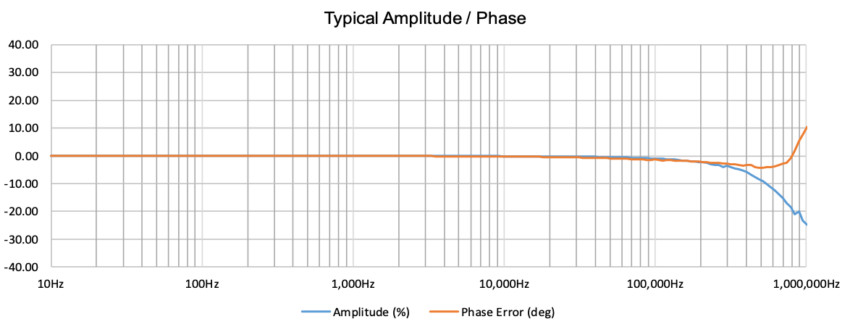
Typical amplitude and phase error of the DP12IP versus frequency. Image used courtesy of Danisense
Where Sub-ppm Stability Pays Off
That level of stability tends to matter most in applications where a current measurement drifting even slightly can cascade into a bigger control or calibration problem. Danisense points to magnet power supplies for particle accelerators, precision servo drives, battery test benches and emulators, and power analysis systems as target uses—all environments where long-term repeatability outweighs raw measurement range.
The compact height also opens the door to integration inside 1U power supply chassis, a form factor that has historically forced designers to choose between accuracy and available vertical clearance. By shrinking the fluxgate sensor into a PCB-mountable package, Danisense is betting that engineers building space-constrained, high-performance power electronics won’t have to make that compromise.
For engineers designing precision power conversion, motion control, or test and measurement equipment, the DP12IP represents a fairly compelling proof that shrinking a sensor doesn’t have to mean shrinking its performance. Its blend of ppm-level linearity, low long-term drift, and a PCB-friendly form factor makes it a natural fit for accelerator magnet supplies, servo drives, battery testers, and power analyzers alike, applications where a current measurement’s stability over months and years matters just as much as its accuracy on day one.


